
Introduction
If you have ever bought a wireless charger overseas, you have most likely seen labels such as Qi, Qi2, or MagSafe compatible on the packaging. You may also have run into these pitfalls: advertised as 20W fast charging but only delivers 5W in reality, repeated disconnection when placed on the charger, gets so hot during charging in summer that it is hard to hold, or even fails to charge when you switch to a device of a different brand.
Many of these problems are related to “whether the product has formal Qi/Qi2 certification”. Many people think that as long as a device can charge wirelessly, it has Qi certification, or equate magnetic attraction with Qi2. In fact, there are numerous marketing tactics and cognitive misunderstandings here. This article is intended for ordinary overseas users, starting from the most basic concepts, to help you distinguish the differences between Qi and Qi2, understand what certification is for, learn how to verify authenticity, choose reliable products according to your usage scenarios, and avoid being fooled by merchants.
1. First, Understand What Qi/Qi2 Certification Is
1.1 Qi Certification: The “Universal Compatibility Certificate” for Wireless Charging
You can think of Qi certification as a “universal language certificate” in the field of wireless charging — as long as devices of different brands have passed Qi certification, they are like people who all speak a common language, and can basically communicate and charge normally.
This standard is formulated, maintained, and authorized for certification by the Wireless Power Consortium (WPC). Its core function is to unify the communication rules, power negotiation methods, compatibility requirements, and some safety standards for short-range wireless charging, so that chargers and devices of different brands can charge each other safely, without having to buy accessories of the same brand.
Qi certification covers a wide range of objects, including transmitters that output energy, such as wireless charging pads and car wireless chargers, receivers that receive energy, such as mobile phones and earphone charging cases, as well as some wireless charging modules embedded in furniture and cars. But its boundaries are also clear: it only targets short-range inductive wireless charging for consumer electronics. Wireless charging for electric vehicles, industrial wireless power supply, and long-range wireless power transmission are not within the scope of Qi.
There is also a very important premise: Qi/Qi2 is a voluntary industry certification, not a mandatory market access requirement of any country or region. Whether there is certification or not is a separate matter from whether the product can be sold legally.
1.2 Qi2 Certification: The New Generation Standard with Magnetic Alignment
Qi2 is a new generation of wireless charging standard launched by the WPC around 2023. Its core upgrade is the addition of MPP (Magnetic Power Profile) — simply put, it relies on the attraction of magnets to automatically align the coils in the charger and the mobile phone, so you don’t have to manually find the position.
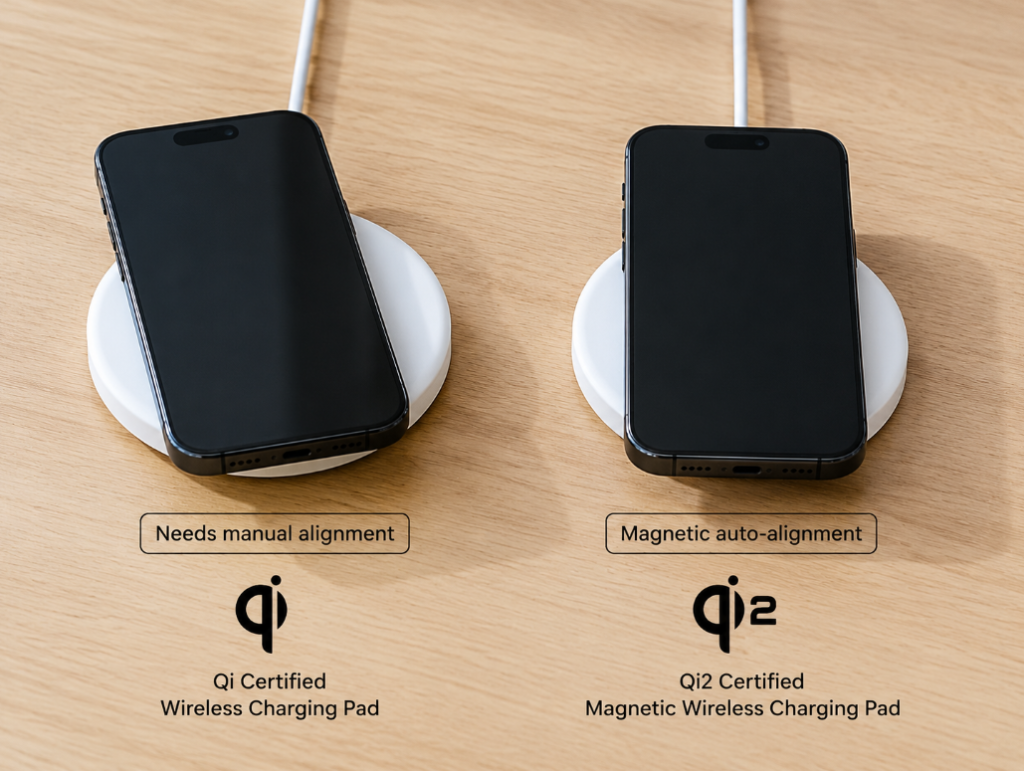
Many people think Qi2 is the “official version of MagSafe”. In fact, to be precise, Qi2’s magnetic alignment solution is indeed based on the MagSafe-related technical ideas contributed by Apple to the WPC, but Qi2 is an industry-wide open standard managed by the WPC. Any brand can apply for certification, and it is not an exclusive technology or certification of Apple.
At present, the mainstream upper limit of certification for consumer-grade Qi2 MPP products is 15W, but the actual charging power is not determined unilaterally by the charger. It also depends on the phone’s protocol support, system strategy, battery temperature, and the power of the adapter and cable. It is a result of “negotiation” between both sides.
In terms of compatibility, most Qi2 chargers are compatible with ordinary Qi devices, but whether they can be used and how good the experience is depends on whether the product has Qi BPP/EPP compatibility mode, and whether the device can be placed stably and the coils can be aligned — using a Qi2 charger with a non-magnetic device does not give you the advantage of magnetic alignment, and the experience is essentially that of ordinary Qi.
1.3 5 Most Easily Confused Concepts, Clarified at Once
There are many marketing tactics in the wireless charging field, and these groups of concepts are the most easily confused. Clarifying them in advance can help you avoid many pitfalls:
- “Has wireless charging function” ≠ “Passed Qi/Qi2 certification”: Being able to charge is just the basics, it does not mean it meets the unified testing requirements of the WPC. It may only pair with devices of the same brand, and may not recognize or disconnect when you switch to another brand.
- “Qi2 certification” ≠ “Apple MagSafe certification”: Qi2 is an open industry standard managed by the WPC, while MagSafe is Apple’s own ecosystem technology and certification system. The two have similar experiences but completely different rules, and the certification processes and requirements are also different.
- “Has magnetic attraction” ≠ “Qi2 certification”: Magnets have no technical threshold. Magnetic cases, magnetic rings, and uncertified wireless chargers can all be equipped with magnets. Only specific models that have passed WPC official testing and can be queried in the database are considered truly Qi2 certified.
- “Brand has certification” ≠ “All series are certified”: Certification is based on specific product models, SKUs, or modules. Different models and configurations of the same brand may have completely different certification statuses.
- “Compatible with Qi2 / for MagSafe / Qi2 Ready” ≠ “Qi2 Certified”: All of the above are marketing terms that at most indicate the product may work. Only “Qi2 Certified” is the official certification statement and can be verified in the WPC database.
1.4 Key Terms Beginners Must Know
To help you understand the following content, let’s first explain a few frequently appearing words in plain language. You don’t have to memorize them deliberately, just come back and check when you encounter them:
- Transmitter: The side that outputs energy, such as a wireless charging pad on the desk, a car wireless charging mount. Just know it is “the charger side”.
- Receiver: The device that receives energy, such as a mobile phone, an earphone charging case.
- BPP (Baseline Power Profile): The most basic power level of Qi, commonly up to 5W. Most older devices support this level.
- EPP (Extended Power Profile): The high power level of Qi, up to 15W, depending on the certified level of the product.
- MPP (Magnetic Power Profile): The exclusive power configuration of Qi2, whose core is to realize automatic coil alignment through magnetic attraction. Currently the mainstream maximum is 15W.
- FOD (Foreign Object Detection): A safety function of wireless chargers, which can identify metal foreign objects such as coins, keys, and metal cards, then reduce power or stop charging to avoid overheating.
- Interoperability: The ability of devices of different brands to normally recognize each other, negotiate power, and charge stably according to the same standard. Simply put, it is “whether it can be used normally across brands”.
- Power negotiation: Before charging, the charger and the device first “communicate” the power range supported by both parties, then decide the actual output level, instead of forcing power.
2. Why Should Overseas Users Care About Qi/Qi2 Certification? 4 Core Values
Many people think that as long as it can charge, it doesn’t matter whether it has certification or not. But for overseas users, formal certification can help you avoid many invisible pitfalls, especially when using across brands, shopping overseas, or buying third-party accessories.
2.1 Better Safety Guarantee, Reducing Risks of Overheating and Misuse
Products with formal Qi/Qi2 certification will undergo relevant tests such as power control, temperature control, abnormal state handling, and foreign object detection. For example, the FOD function can reduce the risk of coins or keys accidentally falling on the charging surface and being continuously heated and scalding; in case of over-temperature, position deviation, or abnormal power negotiation, certified products are more likely to actively reduce power or stop charging, instead of continuously forcing output.
Of course, two boundaries must be clarified: first, certification does not mean no heat at all. Wireless charging itself has energy conversion loss, and slight warmth is normal; second, Qi/Qi2 certification cannot replace regional electromagnetic compatibility, electrical safety, or market access certifications such as FCC, CE, UL, ETL, etc. The two are different requirements.
2.2 More Stable Compatibility, Less Likely to Have Problems with Cross-Brand Accessories
Certified products need to complete communication, identification, and interoperability tests according to WPC rules, which is equivalent to everyone “speaking” according to the same set of rules, so it is less likely to have “language barriers”.
This is particularly practical for overseas users: your phone may be Samsung, your earphones may be Apple, your car charger may be a third-party brand, and the public charging devices in hotels, airports, and offices may be another brand. If all of them have passed Qi certification, they can basically be used normally, greatly reducing the probability of “a certain brand can charge, but another one won’t recognize or repeatedly disconnects”.
However, it should also be noted that compatibility does not mean that all devices can run at the highest power. The actual charging power is still negotiated by the transmitter and receiver together.
2.3 Power Labeling is More Credible, But Pay Attention to the Level
For uncertified products, power labeling is often falsely marked, while Qi-certified products have clear standards for power levels: they may be 5W, 7.5W, 10W, 15W, etc. You cannot assume that all Qi products are 15W. The current mainstream certification upper limit of Qi2 MPP is also 15W. Whether the phone can reach this power depends on the model, system version, battery temperature, and protocol support.
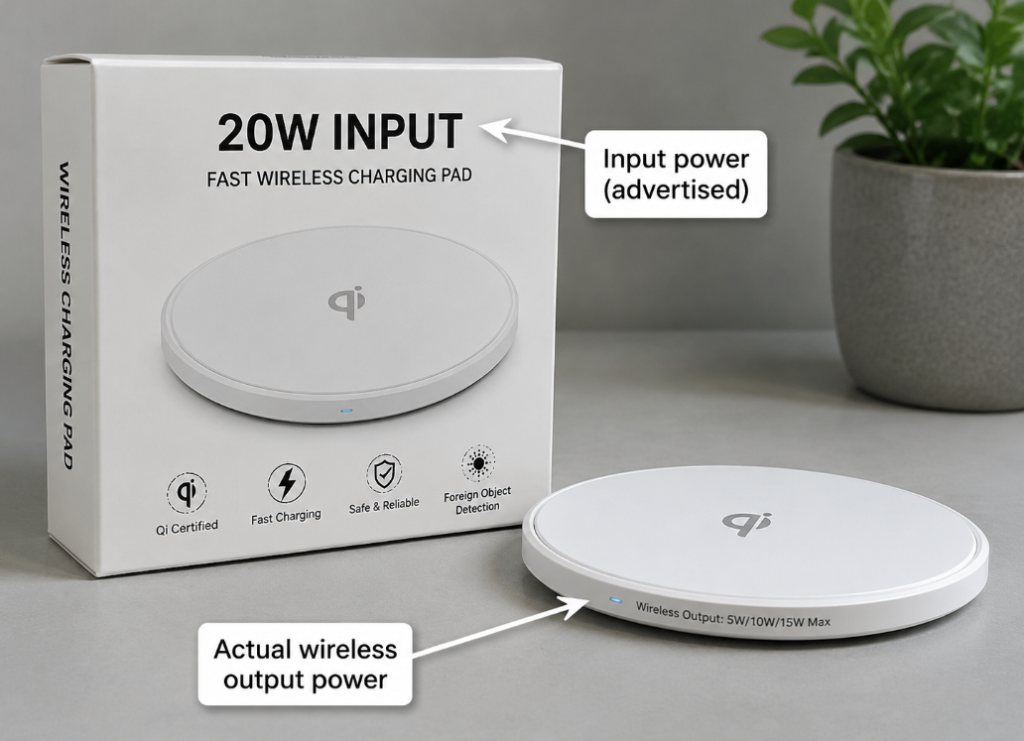
Here we also need to avoid a common digital trap: input power ≠ wireless output power. Many merchants label “20W input” or “equipped with 30W adapter”, which actually refers to the input of the charger or the power of the adapter, not the actual output power of wireless charging. Don’t be fooled by large-character advertisements. In addition, the maximum power is not equal to the power throughout the charging process. When the battery is nearly full, in high temperature, charging while using, or the protective case is too thick, the speed will automatically reduce.
2.4 More Basis for After-Sales Rights Protection
Queryable WPC certification records can help you confirm that the product is actually tested according to standards, not just “compatible” as the merchant verbally claims. It is also a strong evidence when problems really occur. Generally speaking, brands that are willing to spend money on formal certification usually also pay more attention to firmware optimization, specification standardization, after-sales policies, and regional compliance documents, and the probability of after-sales disappearance is lower.
However, it should also be reminded that certification is only a basic credible signal, not a universal guarantee of quality. When buying, you should also make a comprehensive judgment based on brand reputation, return and exchange policies, real user reviews, and whether there are recall records, not just look at whether there is certification.
3. Plain-Language Principle: How Wireless Charging Works and What Certification Does
You don’t need to memorize complex electromagnetic formulas, you can understand it with life-like analogies.
3.1 Life-Like Understanding of Wireless Charging
You can think of a wireless charger as an “energy-emitting pad”, and there is an “energy-receiving coil” on the back of the phone. The two mainly transmit energy through short-range electromagnetic induction — usually they need to be close to a distance of a few millimeters, not the kind of long-range wireless power supply that can charge from a few meters away.
The more accurately the coils are aligned, the more stable the energy transmission, the faster the charging speed, and the less heat is generated; the more deviation, the lower the efficiency, the more likely it is to charge slowly, heat up, disconnect, or even not be recognized at all. Because there is loss in the energy conversion process, under the same conditions, wireless charging is usually easier to heat up and less efficient than wired charging. This is a normal technical feature, not a product quality problem.
3.2 The “Handshake” Process Before Charging: Invisible But Perceptible
Many people think that the charger outputs full power as soon as it is plugged in, but that’s not the case. For formal wireless charging products, there is a complete “handshake” process before charging:
- The charger first detects whether there is a chargeable device on the surface at low power, and does not run at full power as soon as it is powered on;
- After detecting the device, the transmitter and receiver will communicate with each other to confirm the protocols supported by both parties, power range, temperature status, and charging demand;
- The system will enter a stable charging state only after confirming that there are no obvious metal foreign objects, abnormal temperature, or abnormal power.
Users cannot see this process, but they can perceive it: a normal product should light up stably when you place the phone on it, and the phone shows charging, without frequent flickering, error reporting, or sudden extreme heat. If it flashes as soon as you put it on or repeatedly disconnects, it is likely that there is a problem with the handshake process, which may be poor compatibility or the product itself is unqualified.
3.3 What Exactly Does Certification Check? Corresponding Benefits You Can Feel
Qi/Qi2 certification has many test items, but when it comes to actual user experience, it mainly checks these four things:
- Checking handshake rules: All certified products are required to identify devices according to the same set of communication rules, to avoid “language barriers” between different brands, and reduce the situation of not recognizing devices;
- Checking power negotiation: Products are required to truthfully report their power capabilities, not falsely report power, to reduce the probability of overheating and disconnection caused by incorrect power increase;
- Checking safety protection: Products are required to have functions such as foreign object detection, over-temperature protection, and deviation protection, and can actively reduce power, issue alarms or stop charging when abnormalities occur;
- Checking alignment experience (Qi2 exclusive): The magnetic structure is required to actually help align the coils, instead of just installing a few magnets as a marketing gimmick, to ensure the actual experience of magnetic attraction.
4. Core Comparison of Qi vs Qi2: What’s the Difference and How to Choose
Many people struggle to choose between Qi and Qi2. In fact, the core depends on your device and usage scenario. First, unify the comparison caliber: the following comparisons all refer to genuine WPC-certified products. Products with false labeling, no certification, or using proprietary fast charging protocols are not within the comparison range, otherwise it would be unfair. In addition, the actual experience is also affected by factors such as phone support, protective case thickness, ambient temperature, and car vibration, so it cannot be generalized.
To help you quickly see the differences, a comparison table is compiled first:
| Comparison Dimension | Genuine Qi-Certified Products | Genuine Qi2-Certified Products |
|---|---|---|
| Alignment Method | Requires manual alignment to the coil center | Magnetic automatic coil alignment |
| Mainstream Maximum Power | 5W for BPP level / up to 15W for EPP level | Up to 15W for MPP level |
| Core Advantages | Mature ecosystem, wide selection, cost-effective | Convenient placement, stable alignment, reduced speed drop due to deviation |
| Compatibility Range | All Qi-certified devices | Qi2 devices + most Qi devices (requires Qi compatibility mode support) |
| Price Level | Lower | 20%-50% higher than Qi models under the same brand and specifications |
| Safety Focus | Basic wireless charging safety, FOD foreign object detection, temperature control | Same basic requirements as Qi + magnetic positioning accuracy, magnet specification |
4.2 Explain the Perceptible Differences Item by Item
4.2.1 Alignment and Placement Experience
Ordinary Qi products require you to manually align the center of the coil. Novices may have to place it several times to find the correct position. A slight deviation may cause slow charging, overheating, disconnection, or even no recognition. Qi2 products rely on the magnetic structure, which will automatically attract to the correct coil position when placed on it. You can align it with just a casual placement, which is much more convenient.
But this advantage has prerequisites: if the protective case is too thick (generally more than 3mm), with a metal case, card holder, ring holder, or the third-party magnetic ring is pasted crookedly, the magnetic advantage of Qi2 will be greatly reduced, and even trigger charging stop.
4.2.2 Charging Speed and Stability
Many people think Qi2 is faster than Qi. In fact, the mainstream maximum power of both is 15W. The core advantage of Qi2 is not “faster”, but “more stable” — because the coils remain aligned all the time, it is less likely to slow down due to deviation, especially in scenarios with frequent movement (such as in the car, frequent picking up and putting down), the stability improvement is obvious.
The actual charging speed is affected by many factors: when the phone battery is above 80%, trickle charging will start to slow down; if the ambient temperature is too high, temperature control will trigger to slow down; charging while navigating, playing games, or running many background apps will also slow down due to high phone load. These are all normal phenomena.
Here is a special reminder for Apple users: although older Apple phones with MagSafe can be attracted by Qi2 chargers, whether they can run at Qi2’s 15W power depends on the specific model and system version. It is recommended to refer to Apple’s official instructions, and do not assume that magnetic attraction means Qi2 15W.
4.2.3 Compatibility Range and Product Ecosystem
The Qi standard has been developed for more than ten years, and there are many certified products, from old mobile phones, earphone cases to desktop chargers, car chargers, basically all support it, with a wide range of choices and more transparent prices. Qi2 is a new standard that only began commercial use in 2023. The number of supported devices and accessories is growing rapidly, but the overall number is still less than Qi.
In terms of compatibility rules, when a Qi2 device is placed on an ordinary Qi charger, it can only charge in the ordinary Qi way, without the advantage of magnetic alignment; conversely, when an ordinary Qi device is placed on a Qi2 charger, whether it can charge normally depends on whether the charger has Qi compatibility mode, and whether the device can be placed stably and the coils can be aligned — after all, Qi devices have no magnetic attraction, and may slide when placed on it, which is easy to deviate.
4.2.4 Price and Safety Details
For products of the same brand, same type, and same power level, Qi2 models are usually 20%-50% more expensive than basic Qi models. The specific premium depends on the brand, promotion, and region, and the premium of first-tier brands may be higher.
In terms of safety, both must pass the wireless charging safety test specified by the WPC. Qi2 additionally adds requirements such as magnetic positioning accuracy, magnet layout, and abnormal handling in magnetic scenarios, but this does not mean that Qi2 is “absolutely safer” — as long as it is a formally certified Qi product, safety is guaranteed when used with normal alignment. Qi2 only indirectly reduces the probability of deviation heating because of more stable alignment.
4.3 Choose According to Needs: When to Choose Qi and When to Choose Qi2
4.3.1 Scenarios Where Basic Qi is Sufficient
If the following conditions are met, choosing a basic Qi-certified model is sufficient and more cost-effective:
- Your device is relatively old, does not support Qi2 and has no MagSafe magnetic function;
- You mainly charge in fixed positions such as the bedside or desk, and do not frequently pick up and put down after placing it;
- You mainly charge low-power devices such as earphone cases and old mobile phones, and do not need high power;
- You have a limited budget, value cost-effectiveness more, and do not need the convenience of magnetic attraction.
4.3.2 Scenarios Where Qi2 is More Cost-Effective
If the following conditions are met, spending a little more money on Qi2 will be more practical:
- Your mobile phone clearly supports Qi2, or your Apple device clearly supports the corresponding magnetic wireless charging experience;
- You frequently place and pick up in scenarios such as office desks, kitchens, and car mounts, and don’t want to find the coil position every time;
- You have high requirements for charging stability and want to reduce disconnection, slow charging, and overheating caused by deviation;
- You are willing to pay for the convenience of magnetic attraction, the stability of car mounting, and the compatibility with future device changes.
4.3.3 Several Key Reminders
- If your device itself does not have a magnetic structure, the Qi2 charger may not be able to attract it, and it will not be faster than ordinary Qi, so there is no need to spend extra money;
- If the device only says “MagSafe compatible”, it does not mean that it can definitely charge with the Qi2 protocol. It may just be able to be attracted, and the power is still at the ordinary Qi level;
- Don’t buy a much more expensive Qi2 charger just for “upgrading devices in the future”, unless you do have plans to change to a Qi2-supported device in the near future. Otherwise, when you change your device, there may already be newer standards and more cost-effective products.
5. What Exactly Does Qi/Qi2 Certification Test? Only Content You Can Perceive
Many people’s impression of certification is “a bunch of incomprehensible test items”. In fact, you don’t need to memorize professional parameters, just figure out what certification can prove, what it cannot prove, and what experience the core test items correspond to.
5.1 First Clarify: What Certification Can Prove and What It Cannot
Many people either “deify” certification or think certification is useless. In fact, figuring out the boundaries first is the most important.
5.1.1 What Certification Can Prove
- This specific model of product has completed conformity and interoperability tests in accordance with WPC’s wireless charging specifications;
- Within the power range declared by the product, it has basic communication, power negotiation, compatibility, and safety protection capabilities related to wireless charging;
- The corresponding brand, model, and certification record can be found in the WPC official certified product database.
5.1.2 What Certification Cannot Prove
- It does not mean that your certain mobile phone can definitely reach the maximum power — because the actual power also depends on the protocol supported by the phone itself and the system strategy;
- It does not mean that it has passed the mandatory safety, electromagnetic compatibility, environmental protection or energy efficiency requirements of your country/region — these are separate regional certifications, which Qi does not cover;
- It does not mean that the product’s adapter, cable, battery pack, and plug are all compliant — for example, for a wireless charger with a power bank, the battery safety certification is done separately;
- It does not mean that the product’s workmanship, heat dissipation, magnet life, cable durability, and after-sales service are all excellent — these belong to the scope of quality control and brand service, which are not covered by certification.
5.2 General Basic Test Items: Tests Both Qi and Qi2 Must Pass
5.2.1 Interoperability and Communication Test
Simply put, it tests “whether it can communicate normally with devices of different brands”. During certification, standard reference devices are used for testing to see if the product can identify devices, establish communication, and negotiate power according to WPC rules, and whether there will be situations where it only recognizes devices of a certain brand and becomes abnormal when switching to another brand.
5.2.2 Power and Efficiency Test
Test whether the actual wireless output power is consistent with the level declared by the product, whether the energy conversion efficiency can meet the standard requirements under normal alignment, and whether there will be abnormal heating or repeated disconnection due to wrong power negotiation.
5.2.3 Foreign Object Detection and Abnormal Handling Test
Test whether the product can recognize metal foreign objects, then reduce power, stop charging or issue an alarm; whether it can enter the protection state in time when the temperature is too high, the position is deviated, or the communication is abnormal.
Here is a special reminder: Do not actively place coins, keys, or metal pieces to test the foreign object detection function, which may cause local overheating, damage to the device, or even danger. Verification shall be based on official certification records and product manuals.
5.2.4 Electromagnetic Compatibility Related Requirements
Qi/Qi2 certification will pay attention to the working stability and electromagnetic performance of the wireless charging system itself, but if the product is to be sold legally in markets such as the United States, the European Union, the United Kingdom, Australia and New Zealand, it also needs to meet local electromagnetic compatibility and radio related requirements such as FCC, CE, UKCA, RCM, etc. This part is not covered by Qi certification.
5.3 Exclusive New Tests for Qi2: Special Requirements for Magnetic Scenarios
Because Qi2 has an additional magnetic structure, the certification also adds corresponding test items, all of which focus on “whether the magnetic attraction can really help align, rather than a marketing gimmick”:
- Magnetic positioning: The layout of the magnets must be able to guide the coil alignment, not just install a few magnets to attract;
- Alignment accuracy: After adsorption, the coil error between the transmitter and receiver must be within the allowable range of the standard, otherwise the dislocation will still lead to low efficiency and heating;
- Magnet experience: The suction force must balance stability and ease of removal. It should not be too loose to fall off as soon as you pick it up, nor too tight to pull off. For car scenarios, it must be judged comprehensively in combination with the mount structure, road conditions, and phone weight;
- Magnetic foreign object risk: Because magnets are easy to attract items such as metal sheets, magnetic rings, and card holders, the product must be able to handle such abnormal states. Users should also pay attention not to place metal objects between the charging surface and the phone during daily use.
6. How to Judge Whether a Product Has Really Passed Certification? 3-Step Operable Verification Method
Many merchants use terms such as “Qi compatible”, “Qi2 level”, “same style as MagSafe” to ride on the coattails of certification, which is easy for ordinary users to be fooled. Follow these three steps, and you can basically avoid 90% of fake certifications.
Step 1: Check the Official Statement on the Packaging and Product Page (Quick Preliminary Screening)
First, check whether there are clear “Qi Certified”, “Qi2 Certified”, “WPC Certified” words and the official Qi/Qi2 logo authorized by the WPC on the product packaging, detail page, and body nameplate — note that it is the officially designed logo, not just a random “QI” letter or “wireless fast charging”.
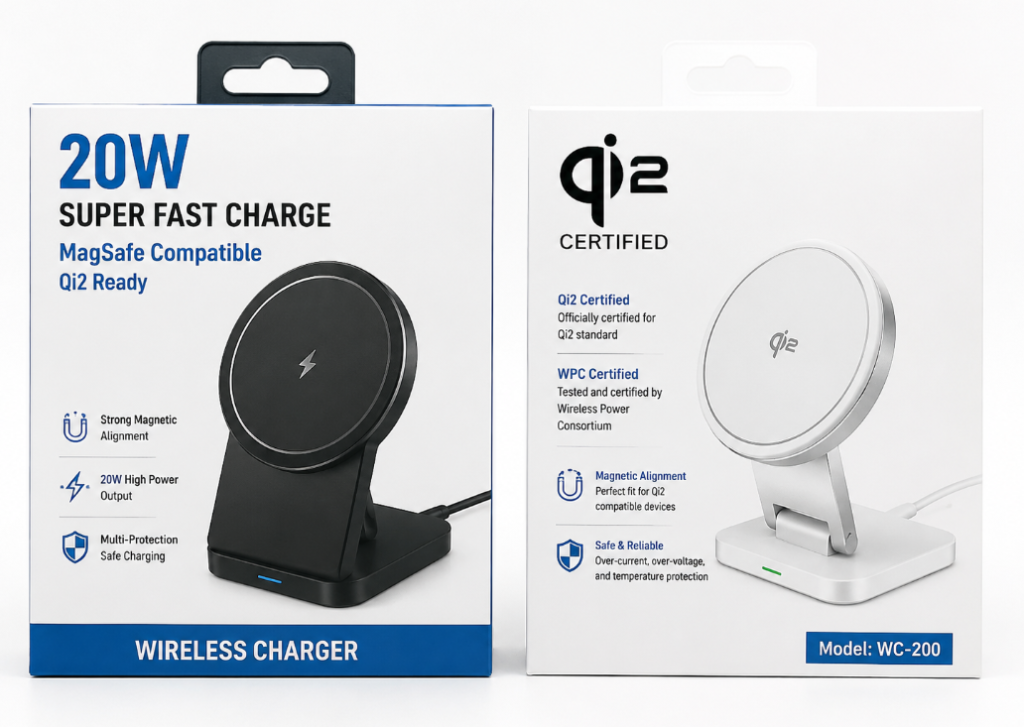
Be especially wary of these marketing terms, which are not equal to formal certification: “Supports Qi”, “Compatible with Qi2”, “Qi2 Ready”, “Qi2 level”, “for MagSafe”, “MagSafe compatible”, “Magnetic wireless fast charging”. These words at most indicate that the product may work, but do not mean it has passed the WPC official test.
There is also a key action: be sure to find the specific model of the product, don’t just look at the series name, store title, or advertising picture. For example, a wireless charger is called “XX Magnetic Fast Charging Series”, but the specific model is XX-WC001. Certification is based on the specific model, and the series name does not count.
Step 2: Check the WPC Official Database (The Most Accurate Method)
If you think it’s good after the first step of screening, be sure to check the Certified Product Database on the WPC official website. This database is free and open to everyone, and is the gold standard for judging genuine certification.
You can search by brand name, product name, specific model, or certification ID, and you can find information such as the corresponding certification type (Qi or Qi2), power level, and certification time. When checking, pay attention to matching: the model in the database must completely correspond to the SKU marked on the product packaging, the body nameplate, and the Amazon/independent station product page. A difference of one letter or suffix may not be the same product.
What if you can’t find it? You can ask the seller to provide the WPC certification link or certification ID. If the seller cannot provide it, or the provided information does not match the product, then you have to question it. Prioritize products with clearly verifiable certification.
It should also be reminded that for the same series of the same brand, different colors, different sets (such as with adapter and without adapter), and different regional versions may have different certification statuses. Be sure to check the model of the specific SKU you want to buy.
Step 3: Non-Destructive Experience Check After Receipt (Only Preliminary Screening, Cannot Replace Certification)
After receiving the product, you can do some simple experience checks to further judge, but note that these checks can only initially screen out obviously problematic products, and cannot prove that the product has passed certification. The final decision should still be based on the records in the WPC database.
Preliminary Check for Qi Products
- Test with a mobile phone or earphone case that you are sure supports Qi, to see if it can be stably recognized and continue to charge when placed on it, instead of having no response for a long time;
- If possible, test with Qi devices of different brands to see if there is a situation where only one device is recognized;
- If there is frequent flashing, repeated disconnection, obvious scalding, peculiar smell, or shell deformation, stop using it immediately and do not continue to use it.
Again: Do not actively place coins, keys, or metal pieces to test the foreign object detection function, it is very dangerous.
Preliminary Check for Qi2 Products
- Test with a device that you are sure supports Qi2, to see if the magnetic attraction can align naturally and the charging is stable;
- You can place it slightly off-center to see if the device can automatically adsorb to the correct position. This can help you judge the experience of the magnetic structure, but cannot prove it is Qi2 certified;
- Note: Testing only with Apple phones with MagSafe cannot prove that the product is Qi2 certified — because many uncertified magnetic chargers can also attract MagSafe phones, and may only charge with ordinary Qi protocol, or even proprietary protocol.
7. Must-Read for Overseas Users: Relationship Between Qi/Qi2 and Other Common Compliance Certifications
Many overseas users confuse Qi certification with labels such as FCC, CE, and UL. In fact, they are completely different things. You should look at them separately when buying, and they cannot replace each other.
7.1 First Clarify: Qi/Qi2 is “Compatibility Certification”, Not Mandatory Access Certification
Qi/Qi2 certification solves the problem of “whether wireless chargers of different brands can charge each other stably according to a unified standard”, which is a voluntary industry compatibility certification, not a legally mandatory requirement.
The access certification of each country/region solves the problem of “whether the product can be sold legally locally and whether it meets local safety, electromagnetic, and environmental protection requirements”, which is mandatory (if required locally).
When buying wireless chargers overseas, you need to look at both types of certification, neither is dispensable.
7.2 Differences from Regional Mandatory Access Certifications
Common regional access labels include:
- FCC (United States): Certification of the Federal Communications Commission of the United States, focusing on electromagnetic compatibility and radio spectrum related requirements. Electronic devices basically need FCC certification to be sold in the United States.
- CE (European Union): Compliance label for products entering the EU market, covering multiple applicable directives and regulations such as safety, health, electromagnetic compatibility, and environmental protection.
- UKCA (United Kingdom): Market compliance label launched after Brexit, replacing the original CE certification for use in the UK market.
- RCM (Australia/New Zealand): Statutory compliance label in Australia and New Zealand, covering electromagnetic compatibility, radio and other requirements.
Simple summary: Qi manages “whether wireless chargers can be used normally across brands”, and these labels manage “whether products can be sold legally locally”.
7.3 Differences from Electrical Safety Certifications
What we often call UL, ETL, TÜV, etc., belong to electrical safety certifications, focusing on electrical safety issues such as electric shock, fire, insulation, temperature rise, and material flame retardancy.
Although Qi/Qi2 certification also includes safety requirements related to wireless charging, it cannot cover all electrical safety scenarios. Especially for wireless chargers with power adapters, magnetic wireless charging power banks with built-in batteries, and wireless chargers powered by car cigarette lighters, the safety of the power supply part and battery part of these products requires additional corresponding electrical safety and battery safety certifications, which Qi does not cover.
7.4 Differences from Environmental Protection, Chemical, and Energy Efficiency Requirements
There is another type of common compliance requirement, which is also completely unrelated to Qi/Qi2:
- RoHS: Restricts the use of harmful substances such as lead, mercury, and cadmium in electrical and electronic products. Many countries and regions such as the EU, the United States, and China have relevant requirements.
- REACH: EU’s chemical management regulation, which has strict registration, evaluation, and authorization requirements for chemical substances in products (especially substances of very high concern, SVHC).
- WEEE: EU’s Waste Electrical and Electronic Equipment Directive, requiring manufacturers to bear the responsibility for the recycling and disposal of electronic waste.
- Energy efficiency requirements: Many regions have energy efficiency requirements for the standby power consumption of external power adapters and electronic products, such as the EU’s ERP directive, the United States’ Energy Star, etc.
These all belong to environmental protection, chemical, and energy efficiency compliance requirements, which are different from the compatibility certification of wireless charging and need to be confirmed separately.
7.5 Compliance Priority for Overseas Purchases
If you don’t know what to look at first, follow this order and you won’t go wrong:
- First look at regional access: Confirm that the product has the mandatory access label required by your country/region, such as FCC for the United States, CE for the EU, UKCA for the United Kingdom, and RCM for Australia and New Zealand.
- Then look at Qi/Qi2 certification: Confirm that the specific model can be found in the WPC database, and the certification type and power level meet your needs.
- Then look at accessory compliance: Confirm that the adapter, cable, and built-in battery (if any) meet local electrical safety and battery safety requirements, the plug specification adapts to the local socket, and the voltage supports 100-240V wide voltage (if you need it for travel).
- Finally look at brand service: Make a comprehensive judgment based on brand reputation, after-sales policy, return and exchange convenience, and real user reviews.
8. Choose by Scenario: Selection Logic of Certified Products for Different Usage Scenarios
There is no absolute “best” wireless charger, only the most suitable one for your scenario. The selection logic is sorted out according to common usage scenarios, just follow it.
8.1 Home Fixed Scenarios (Bedside/Desk): Basic Qi-Certified Models are Sufficient
If it is placed on the bedside or desk, with a fixed position and no frequent picking up and putting down after placing, choosing a basic Qi-certified model is sufficient and more cost-effective.
When choosing, prioritize products clearly marked with FOD foreign object detection, temperature control protection, and over-power protection. For night charging, you don’t have to blindly pursue high power. On the contrary, products with low heat, no noise, and indicator lights that can be turned off or are very dim are more comfortable to use and won’t dazzle your eyes in the middle of the night.
8.2 Office Desk Scenarios: Prioritize Qi2 for Frequent Casual Placement and Pickup
If it is placed on the office desk, and you often pick it up to reply to messages or attend meetings during work, with a high frequency of casual placement and pickup, prioritize Qi2-certified magnetic models. You don’t have to find the coil position every time, just put it on and charge, which can save a lot of trouble.
But if your device does not support Qi2 and has no magnetic function, there is no need to spend extra money, just ordinary Qi models. In terms of form, vertical magnetic mounts are suitable for reading messages and holding video meetings while charging; flat models are suitable for charging mobile phones and earphone cases at the same time, with more uses.
8.3 Car Wireless Chargers: Prioritize Qi2 or Reliable Magnetic Solutions
In car scenarios, because the vehicle will vibrate, turn, and brake suddenly, alignment and fixation are very important. Prioritize Qi2-certified magnetic models, which can not only automatically align, but also hold the phone stably, reducing the situation of disconnection when bumped.
But note: Qi2 certification is only for the wireless charging part, and does not mean that the mechanical strength of the car mount is sufficient. When choosing, also check whether the fixing method of the mount (air vent clip, suction cup, adhesive, etc.) is firm, and whether the clamping arm or magnetic suction can stabilize your phone, especially for large-size and heavy phones, which should also be judged in combination with local road conditions.
In addition, the temperature inside the car is very high in summer, and the phone will trigger temperature control protection. It is normal for the wireless charger to slow down or even pause charging. It is not that the product is broken, and it will resume when the temperature drops.
8.4 Simultaneous Charging of Multiple Devices: Confirm the Certification and Compatibility of Each Charging Position One by One
If you buy a multi-device charging base such as 2-in-1 or 3-in-1, don’t just look at “total power XXW”, confirm the certification status and compatible models of each charging position one by one.
The charging coils and protocols of mobile phones, earphones, and smart watches may be completely different. For example, smart watches such as Apple Watch and Galaxy Watch mostly use brand-specific or dedicated charging solutions, and you cannot assume they support Qi/Qi2. Many users buy a 3-in-1 base only to find that it cannot charge the watch, which is the pitfall.
When choosing, be sure to read the description on the product detail page: whether the phone position is Qi/Qi2 certified, whether the earphone position supports Qi, and which models the watch position is specifically compatible with. Don’t just look at vague words like “compatible with all wireless charging devices”.
8.5 Travel and Business Trip Scenarios: Prioritize Portable, Multi-Region Compliant Certified Models
For frequent travel and business trips, prioritize certified models with small size, light weight, and detachable cables, which are more portable and easy to replace if the cable is broken.
When traveling across countries/regions, confirm that the adapter supports 100-240V wide voltage and the plug adapts to the socket type of the destination country, otherwise you have to bring an adapter which is very troublesome.
If it is a magnetic wireless charging power bank with a built-in battery, confirm that the battery capacity meets the aviation carry requirements — usually power banks within 100Wh can be carried on the plane, but the specific regulations depend on the airline and the requirements of the departure place. It is best to confirm clearly before buying to avoid being confiscated during security check.
9. Pitfall Avoidance and Troubleshooting: Common Misconceptions + Daily Fault Judgment
9.1 7 Most Common Cognitive Misconceptions, Don’t Be Fooled by Merchants
Misconception 1: The higher the power, the better. A 20W label must be faster than 15W.
Truth: The mainstream maximum power of Qi/Qi2 general certification is 15W. Publicity exceeding 15W is most likely to label the input power of the adapter as wireless output power, or it is the brand’s own proprietary protocol power, or even false labeling.
How to avoid: Don’t just look at the large-character power in the advertisement. Look at the WPC certified power level, see what protocol your phone supports, and then refer to real user reviews to know the actual charging speed.
Misconception 2: Having magnetic attraction means Qi2 certification.
Truth: The magnetic structure has no technical threshold at all. Magnetic rings worth a few yuan and uncertified wireless chargers worth more than ten yuan can be equipped with magnets. It does not mean that they have passed WPC’s Qi2 certification, and may also have poor alignment, serious heating, or even safety hazards.
How to avoid: You must check the official “Qi2 Certified” logo and the corresponding model can be found in the WPC database to be considered truly Qi2 certified.
Misconception 3: Qi2 must be faster and better than MagSafe.
Truth: Qi2 is an open industry standard managed by the WPC, while MagSafe is Apple’s own ecosystem technology and certification system. The two have similar experiences but completely different rules. The power performance on Apple devices depends on the specific model, system version, and product certification type, and cannot be generalized.
How to avoid: Apple users should read Apple’s official support instructions before buying, distinguish whether the device supports MagSafe, Qi2, or ordinary Qi, and do not assume that Qi2 is a substitute for MagSafe.
Misconception 4: Qi certification is a legally mandatory requirement.
Truth: Qi/Qi2 is a voluntary industry certification, not a mandatory market access requirement of any country or region. Whether there is Qi certification or not is a separate matter from whether it can be sold legally.
How to avoid: When buying overseas, you should not only confirm Qi/Qi2 certification (to ensure compatibility), but also confirm local mandatory access certifications such as FCC, CE, UKCA, RCM, etc. (to ensure legal compliance and basic safety). Both are indispensable.
Misconception 5: With Qi certification, there will be 100% no problems.
Truth: Certification only proves that the submitted sample of this product meets the WPC standard requirements. It cannot replace the quality control during mass production, nor can it guarantee that the product’s heat dissipation design, material quality, and workmanship are perfect, let alone represent good after-sales service.
How to avoid: Certification is a basic credible signal, but not a universal guarantee. It should also be comprehensively judged in combination with brand reputation, user reviews, warranty policies, and whether there are recall records.
Misconception 6: Qi2 chargers can only be used for Qi2 devices.
Truth: Most Qi2 chargers have Qi compatibility mode and can charge ordinary Qi devices, but the actual experience depends on whether the device can be placed stably and whether the coils can be aligned — after all, ordinary Qi devices have no magnetic attraction, and may slide when placed on it, which is easy to deviate.
How to avoid: If you mainly use it for old Qi devices, check the product description before buying to see if it clearly says “compatible with Qi BPP/EPP devices”, to avoid buying it back and not being able to use it.
Misconception 7: “Qi2 Ready”, “for MagSafe”, “magnetic fast charging” mean certification.
Truth: These are all merchants’ marketing terms that at most indicate that the product may be compatible with related devices, but do not mean that it has passed the WPC official certification. There may also be false labeling, poor compatibility, and unsafe problems.
How to avoid: Only regard products with “Qi2 Certified” and corresponding models that can be found in the WPC official database as genuine certified products.
9.2 User-Level Troubleshooting for Common Faults: Don’t Look for Repair, Check It Yourself First
When you encounter a bad wireless charger, don’t rush to return it or repair it. Many problems are caused by small reasons and can be troubleshooted by yourself.
No Charging When Placed On
Check these points in order first:
- Confirm that your device supports wireless charging and is placed at the center of the coil; if it is a Qi2 device, confirm whether it is stably attracted.
- Check whether the protective case is too thick (generally more than 3mm may affect), and whether there are metal card holders, ring holders, magnetic sheets, bank cards and other things, which will affect wireless charging.
- Check whether the power of the adapter and cable is sufficient, whether the interface is loose, and try another adapter and cable.
- Confirm that your device is in the product’s compatibility list, don’t just look at vague descriptions like “compatible with all wireless charging devices”.
Significantly Slow Charging Speed
First judge whether it is normal: when the phone battery reaches more than 80%, trickle charging will start, and it is normal for the speed to slow down; if the ambient temperature is too high (such as in the car in summer, placed on a quilt), temperature control will trigger to slow down; charging while navigating, playing games, or running many background apps will also slow down due to high phone load.
If these situations are excluded and it is still very slow, you can try: replace with an original or reliable adapter and cable with sufficient power, remove the thick protective case, put the phone in a ventilated and cool place, and re-align the coil position.
You should know that the core advantage of wireless charging is convenience, not extreme fast charging. If you pursue the fastest charging speed, wired fast charging is still more suitable.
Frequent Disconnection
Common reasons are: the coil is not aligned, the protective case is too thick resulting in insufficient distance, vibration displacement in car scenarios, unstable power supply (such as insufficient adapter power, poor cable contact), and the phone triggers temperature control protection.
Troubleshooting method: re-place the device to ensure alignment, try removing the protective case, replace the adapter and cable, and cross-test with another Qi-supported device to see if it is the device’s problem or the charger’s problem. If it is a Qi2 product, check whether the magnetic case or magnetic ring is pasted crookedly, and incorrect position will also cause disconnection.
Abnormal Heating
Wireless charging has energy conversion loss, so slight warmth is normal and there is no need to worry too much. But if there is scalding, burning smell, shell deformation, local overheating of the charging surface, or frequent charging stop, it is abnormal.
At this time, stop using it immediately, separate the phone from the charger, remove the protective case and nearby metal objects, and place it in a ventilated place to cool down. If the same problem occurs again after cooling down, do not use it again. Contact the seller for after-sales treatment to avoid danger.
Summary
After reading this, you should have a relatively comprehensive understanding of Qi and Qi2 certification. You can distinguish the differences between Qi, Qi2, MagSafe, magnetic compatibility, and Qi2 Certified, and will no longer be fooled by merchants’ marketing tactics; you know that the core value of Qi2 is magnetic alignment and stability, not unconditional faster speed; you can judge the certification credibility of a product through packaging labels, WPC official database, and post-receipt experience check; you can distinguish the relationship between Qi/Qi2 certification and other common overseas compliance certifications such as FCC, CE, UKCA, RCM, UL/ETL, RoHS, REACH, and know that you need to look at them together when buying; you can choose the wireless charger product suitable for you according to different usage scenarios such as home, office, car, multi-device, and travel; when encountering common problems such as no charging, slow charging, disconnection, and abnormal heating, you can also troubleshoot by yourself first, and know when to stop using to avoid danger.
Wireless charging is essentially an accessory that “trades a little speed and efficiency for convenience”. Choosing the right certified product can help you avoid most pitfalls, and make it more worry-free and safer to use.