
Introduction
If you often shop for electronic products from overseas online stores, run a cross-border business targeting the US market, or just want to buy a reliable pair of wireless earbuds, you’ve most likely heard the term “FCC certification”. Some say it’s a pass to the US market, some say a product with the FCC mark is a good product, and others say you can just find any lab to get it done.
What exactly is FCC certification? Which products need it? What’s the difference between FCC ID and SDoC? How to check authenticity? What pitfalls should you avoid when applying? In this article, we’ll explain everything in plain language, from basic judgment to tips for avoiding common pitfalls. Whether you’re an ordinary consumer, a small cross-border seller, or a procurement professional, you’ll be able to understand and use the information.
1. What is FCC Certification: A Plain-Language Introduction for Beginners
Many people who encounter FCC for the first time easily confuse it with “quality certification” or “safety certification”. In fact, if you first understand its essence, the subsequent classification, processes, and authenticity judgment will be much smoother.
1.1 Basic Definition: Electromagnetic/Wireless Access Requirements for US Electronic Products
The full name of FCC is the Federal Communications Commission, an official agency responsible for managing the US radio spectrum, electromagnetic interference, and compliance of communication equipment. The “FCC certification” we often refer to is essentially a set of market access rules for electronic, electrical, and wireless products in the US — as long as a product is sold, imported, or placed on the market in the US and falls within the scope of FCC rules, it usually needs to meet corresponding compliance requirements; devices carried by individuals or for personal use also require attention to frequency band, power, and customs/regulatory risks, but specific obligations need to be judged based on the device type and actual scenario.
To put it in plain language: FCC is not proof of “good quality”, nor is it a safety certification that “prevents electric shock or explosion”. It is a set of access rules ensuring products “do not emit signals randomly, do not occupy wrong frequency bands, and do not seriously interfere with the normal operation of other devices”.
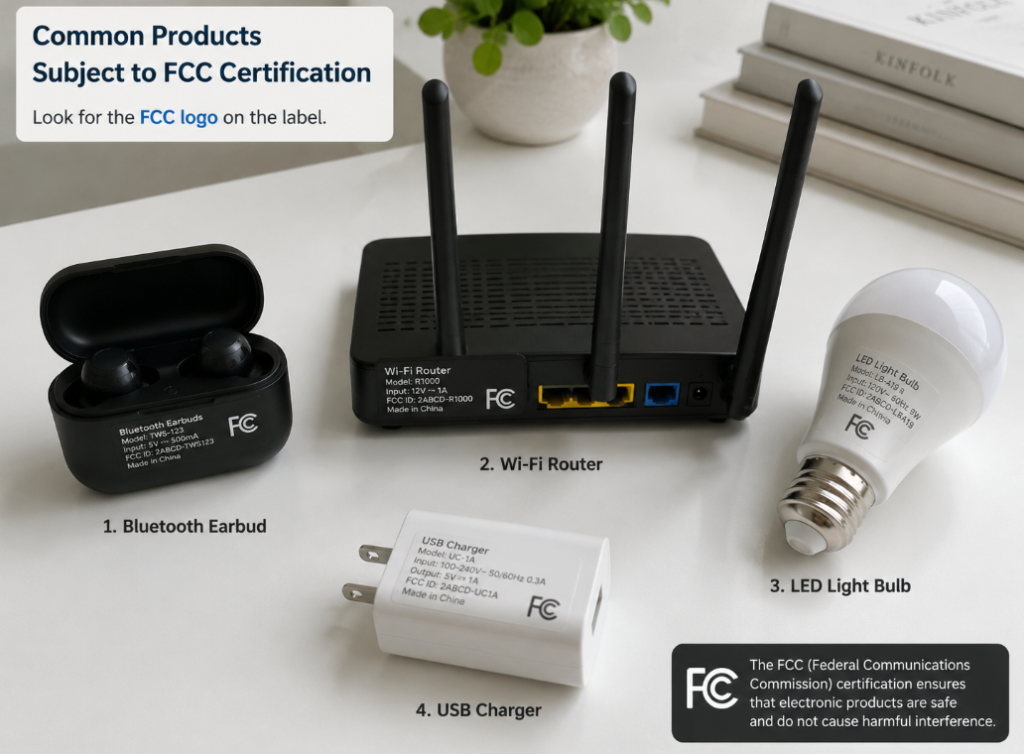
1.2 What FCC Regulates and What It Doesn’t: Don’t Confuse It with Other Certifications
Beginners are most likely to mix up the scope of FCC regulation. Let’s draw a clear boundary here, so you won’t be confused when encountering certifications like UL, CE, and RoHS later.
FCC mainly regulates five categories of content:
- Electromagnetic Interference (EMI): The electromagnetic noise generated by electronic products during operation must not exceed the limit
- Radio Frequency (RF) Emission: Devices that actively emit wireless signals must operate within the permitted frequency bands and power ranges
- Wireless Frequency Band and Power Management: Prevent unauthorized occupation of public frequency bands, and ensure the normal operation of broadcasting, communications, Wi-Fi, Bluetooth, cellular networks, etc.
- Radio Frequency (RF) Exposure: For wireless devices that are close to the human body or have high power, the exposure level of RF energy to the human body needs to be evaluated
- Some Telecommunications Terminal Access Rules: Devices connected to the public telephone network need to meet corresponding access requirements
You can first get a general impression of the corresponding common regulatory entries, and then match them when encountering specific products later:
- FCC Part 15: Covers most ordinary electronic products, digital devices, and short-range wireless devices such as Wi-Fi, Bluetooth, and remote controls
- FCC Part 18: Targets industrial, scientific, and medical (ISM) RF devices, such as some wireless chargers, microwave ovens, and ISM equipment
- FCC Part 68/ACTA: Targets terminal devices connected to the public telephone network, such as some landline phones, modems, and fax machines
- RF Exposure Rules: For wireless devices used close to the human body or with high power, SAR (Specific Absorption Rate) or MPE (Maximum Permissible Exposure) assessment is required
On the other hand, FCC usually does not regulate the following: electrical safety, fire protection, electric shock prevention, mechanical safety, product durability, environmental hazardous substance restrictions, and privacy data security. These correspond to other rules such as UL/ETL (safety), RoHS (hazardous substances), and privacy regulations, respectively. Do not confuse them with FCC.
To sum it up in plain language: FCC regulates “whether it will interfere with others, whether it occupies the wrong frequency band, and whether RF exposure is compliant”, which does not equal “the product won’t break, won’t leak electricity, or is of top quality”.
1.3 Why You Should Care About FCC Certification
People with different identities care about FCC for completely different reasons. You don’t have to memorize the full set of rules right away; just figure out your own needs first:
- Ordinary consumers: When buying wireless or electronic products, you can use FCC compliance information to initially judge whether the product is reliable, and avoid buying inferior products that interfere with your home Wi-Fi, Bluetooth, radio, or other electronic devices as soon as you use them.
- Cross-border sellers: When products enter the US market, FCC compliance documents may be required for almost everything: customs clearance, e-commerce platform entry, platform spot checks, and consumer complaint handling. Non-compliant products may be detained, removed from shelves, or even fined.
- Procurement/brand owners: The FCC ID, test report, and SDoC declaration provided by the supplier must be completely consistent with the actually sold model and configuration. Otherwise, even if the supplier says “we have certification”, the brand owner itself will ultimately bear the compliance risk.
- Overseas shoppers/personal users: If you buy wireless devices from abroad and bring them back to the US, non-compliant products may be detained by customs. They may also be unusable or cause trouble by interfering with other devices because their frequency bands and power do not meet US rules.
1.4 4 Basic Misconceptions Beginners Most Easily Fall For
Almost everyone who is new to FCC falls into these pitfalls. Understanding them in advance can save you a lot of detours:
- Misconception 1: FCC certification = good product quality
Truth: FCC only verifies that items related to electromagnetic compatibility, radio frequency, and RF exposure of the product comply with the rules. It does not mean the product has excellent workmanship, lifespan, electrical safety, or durability. A pair of earbuds that passed FCC may have poor sound quality and break after three months of use — these are not within the scope of FCC regulation. - Misconception 2: All products need FCC certification
Truth: Products with purely mechanical structures, no electronic circuits at all, and no RF functions usually do not fall within the key regulatory scope of FCC. For example, ordinary wooden furniture, manual screwdrivers, pure cotton T-shirts, and ceramic tableware do not require FCC compliance. - Misconception 3: Having the FCC mark printed means it is truly compliant
Truth: The FCC mark can be printed by any printing factory. The key to authenticity is whether the corresponding FCC ID (for wireless products), SDoC declaration, US responsible party information, and product model match. Just printing a logo doesn’t count. - Misconception 4: CE certification can replace FCC
Truth: CE is the market access rule of the European Union, while FCC is for the US. The two have different legal systems, test standards, compliance paths, and liability requirements, and cannot replace each other at all. Products sold in both Europe and the US usually need to complete corresponding compliance separately.
2. Which Products Need FCC Certification: Classification and Quick Judgment
Now that you understand the scope of FCC regulation, the most practical question is: does my product need FCC certification? We can divide products into four categories based on their functional characteristics, corresponding to different compliance paths. There are also some clear exemption scenarios. First, clarify the classification, and you won’t be confused when choosing a path later.
2.1 Common Product Types That Require FCC Compliance
According to FCC rules, products that require compliance can be roughly divided into four categories, each with different typical products and common paths:
- Intentional Radiator
In plain terms, these are products that actively emit wireless signals outward, relying on wireless signals to complete functions such as communication, remote control, and data transmission.
Typical examples: Bluetooth earbuds, Wi-Fi routers, smart door locks, wireless remote controls, wireless mice, mobile phones, tablets, smart watches.
Common compliance path: This type of product directly involves the use of public frequency bands and is subject to the strictest control. It usually requires the Certification path to obtain a unique FCC ID. - Unintentional Radiator
These do not actively emit wireless signals for communication, but during operation, due to digital circuits, clocks, and switching power supplies, they “incidentally” generate electromagnetic noise that may interfere with other devices.
Typical examples: computers, monitors, printers, ordinary chargers, LED lamps, set-top boxes, home appliances with smart chips (MCU).
Common compliance path: Most follow the SDoC path, and some special products are judged according to specific rules. - ISM/RF Energy Devices
These operate using RF energy, but their main purpose is not communication, but industrial, scientific, or medical uses such as heating and induction.
Typical examples: wireless chargers, microwave ovens, some induction heating equipment.
Common compliance path: Usually involves FCC Part 18 rules. The SDoC or Certification logic for ordinary consumer electronics cannot be directly applied; special assessment is required based on product function, power, and frequency band. - Telecommunications Terminal Equipment
Devices that need to be connected to the public telephone network for use, with special access rules.
Typical examples: landline phones, fax machines, some modems.
Precautions: Usually involves Part 68/ACTA registration or labeling requirements. Don’t simply assume that “having communication functions means there must be an FCC ID” — its rules are different from those of ordinary wireless products.
2.2 Products That Usually Do Not Require FCC Certification
Of course, not all products are within the scope of FCC regulation. The following categories of products usually do not require FCC compliance:
- Purely mechanical products with no electronic circuits at all: For example, wooden furniture, manual screwdrivers, ordinary ceramic tableware, and pure cotton clothing have no electronic components, so naturally they do not generate electromagnetic interference or RF emissions, and are not under the key regulation of FCC.
- Ordinary accessories without active electronic functions: For example, ordinary mobile phone cases, desktop stands, and storage bags without chips have no electronic functions themselves and are just auxiliary accessories, so they usually do not require certification.
- Products sold only outside the US and not entering the US market: FCC is a US market access rule. Products that are never sold, imported, or placed on the market in the US are, in principle, not bound by FCC market access requirements.
Here is a special reminder of a boundary: Do not judge whether a product is exempt solely by its appearance. As long as the product has a chip, LED light, power conversion circuit, wireless module, induction coil, or smart control function, even if it looks like a small accessory, it may fall within the scope of FCC regulation. It is best to judge carefully based on actual functions.
2.3 Does a Complete Device with a Certified Wireless Module Still Need FCC Certification?
Many sellers of smart hardware ask: The wireless module I use already has an FCC ID, so doesn’t the complete device need to be certified again? Here’s the core conclusion first: A module having an FCC ID does not mean the complete device is automatically compliant.
Only when the following common prerequisites are met can the module’s certification be cited, and there is no need to repeat the RF test of the module itself:
- The antenna type, gain, and installation method all meet the module’s authorization conditions. You cannot randomly replace the antenna with a higher-gain one, nor can you arbitrarily change the antenna’s installation position.
- The module’s transmit power and RF parameters have not been modified, and the RF-related restrictions in the firmware have not been changed. For example, you cannot privately increase the transmit power of a Bluetooth module.
- The complete device’s housing, power supply circuit, shielding design, and internal wiring do not create new risks of exceeding limits. For example, putting a full metal housing on the module may change the radiation situation, requiring re-evaluation.
- The label and manual of the complete device must be marked in accordance with the module’s authorization requirements. A common wording is “Contains FCC ID: XXXXX”, indicating that the product has a built-in certified wireless module. At the same time, the corresponding compliance statement must be included in the manual.
If there are the following high-risk changes, the original module’s certification is likely not sufficient. You must conduct a change assessment or re-certify the complete device: replacing the antenna, adjusting power, modifying RF firmware, replacing the metal housing, changing the antenna position, or adding multiple wireless modules at the same time.
A pitfall many merchants easily fall into is: directly promoting the module’s FCC ID as the complete device’s own FCC ID, or not conducting an EMI assessment of the complete device. When a platform spot check occurs, they cannot provide compliance documents for the corresponding complete device model, and problems arise.
2.4 10-Second Quick Judgment Method
If you just want to quickly and initially judge whether your product needs FCC certification, you can use this five-step quick judgment method, and you can get a general direction in 10 seconds:
- Step 1: Is the product going to be sold, imported, or placed on the US market? If not, it usually does not need to comply with FCC US market access requirements for the time being.
- Step 2: Does the product have active wireless transmission functions? Such as Bluetooth, Wi-Fi, remote control, cellular network? If yes, it most likely needs to go through Certification and obtain an FCC ID.
- Step 3: No wireless function, but does it have digital circuits, switching power supplies, LED drivers, smart chips (MCU), or display screens? If yes, it most likely needs to go through SDoC or testing corresponding to FCC rules.
- Step 4: Does the product need to be connected to the public telephone network? If yes, you need to check the requirements of Part 68/ACTA, not just look at whether there is an FCC ID.
- Step 5: If there are no electronic circuits, no RF function, and no power supply required, then usually no FCC certification is needed.
Finally, it should be noted that this is only a beginner-level quick initial screening. Whether it needs to be done and which path to take ultimately depends on the product’s specific functions, frequency bands, usage scenarios, sales configuration, and the latest FCC rules. For complex products, it is best to find a professional institution for assessment.
3. FCC Compliance Paths: How to Choose Between SDoC, Certification, and Special Rules
Many people are confused about the difference between FCC SDoC and FCC Certification (FCC ID), thinking both are “FCC certification”. In fact, the two have very different application scenarios, review methods, and liability requirements.
3.1 Path 1: SDoC (Supplier’s Declaration of Conformity)
The full name of SDoC is Supplier’s Declaration of Conformity. In plain terms, it means “the supplier declares on its own that the product meets FCC requirements, but all test evidence must be kept and must be produced when inspected”.
- Applicable objects: Most unintentional radiation digital devices and low-risk electronic products, such as ordinary monitors, computer peripherals, LED lamps, and some power adapters
- Core requirements: The product first completes testing according to corresponding rules to confirm compliance, then the responsible party issues a declaration of conformity, and retains test reports and technical documents for inspection
- US responsible party: SDoC must have a responsible party within the US, usually a US importer, distributor, brand owner, or local supplier; Chinese factories or traders can provide test reports, technical materials, or appear as supply chain entities, but a declaration with only overseas entity information cannot replace the US responsible party requirement.
- Whether there is an FCC ID: No, and it will not be entered into the official FCC database
- Key risk: SDoC is not “just write a declaration casually”. If there is a spot check, platform review, or complaint, the responsible party must be able to produce a complete evidence chain, otherwise it is considered non-compliant.
3.2 Path 2: Certification (Official Certification)
Certification is the certification path under the FCC equipment authorization system, often colloquially called FCC ID certification by sellers; usually, laboratories with corresponding FCC recognition/authorization scopes are required to complete applicable project tests, and test data and technical materials are submitted to TCB (FCC-authorized certification review body) for review; specific laboratory qualifications, test items, and document requirements should be confirmed according to product rules and current FCC requirements. After TCB review is passed, a Grant (authorization notice) is issued, the authorization information is entered into the official FCC database, the product obtains a unique FCC ID, and everyone can query it on the FCC official website.
- Applicable objects: Most intentional radiation wireless devices, such as Wi-Fi, Bluetooth, Zigbee, LoRa, cellular communication, UWB, wireless remote control, etc.
- Core requirements: Qualified laboratories complete the testing, then submit technical documents to TCB for review. After passing, a Grant is issued, and the product obtains a unique FCC ID.
- Public query: FCC ID authorization information can be queried in the official FCC equipment authorization database. Some test reports, photos, and schematic diagrams may not be visible due to short-term or long-term confidentiality.
- Platform requirements: E-commerce platforms such as Amazon and Walmart usually require FCC ID for wireless products, and the ID, test report, product label, and manual must be consistent.
3.3 Special Paths: Don’t Mix Up Concepts of Part 68/ACTA and Part 18
In addition to the most common SDoC and Certification, there are two types of special rules for which ordinary logic cannot be casually applied:
- Part 68/ACTA: Mainly for terminal devices connected to the public telephone network, with its own ACTA registration number, label, and technical requirements, which is not equivalent to the FCC ID of wireless Certification.
- Part 18: For industrial, scientific, and medical RF devices, such as wireless chargers, microwave ovens, etc. The test items, limits, and labeling requirements are different from those of ordinary consumer electronics.
In practice, when encountering devices with telephone interfaces, wireless charging, or medical/industrial RF equipment, do not directly use the simplified rule of “no wireless = SDoC, has wireless = FCC ID”. It is best to find a professional institution for assessment.
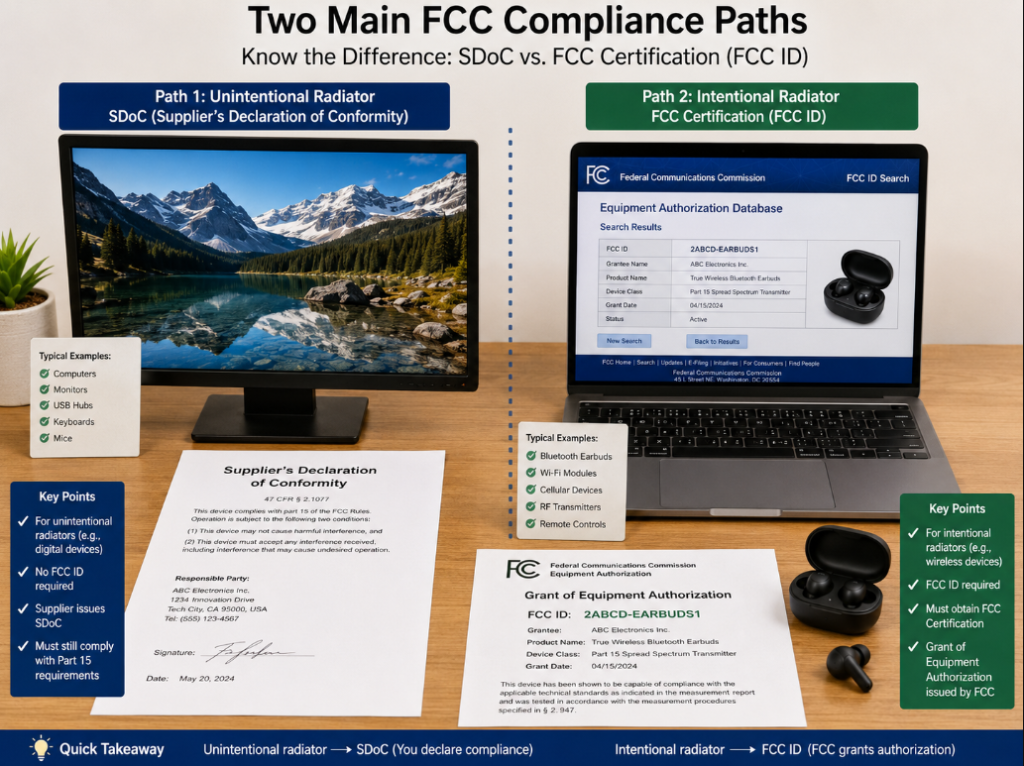
3.4 Core Differences Between SDoC and Certification
For your convenience in comparison, I have organized the core differences between the two into a table:
| Comparison Item | SDoC (Supplier’s Declaration of Conformity) | Certification (Official Certification, with FCC ID) |
|---|---|---|
| Applicable products | Most unintentional radiation devices (such as ordinary monitors, LED lights, power adapters) | Most active wireless transmission devices (such as Bluetooth earbuds, Wi-Fi routers, mobile phones) |
| Review method | The responsible party declares on its own and retains evidence such as test reports; no official pre-review is required | Technical documents are reviewed by an FCC-recognized TCB, and authorization is issued after passing |
| Number identification | No FCC ID, not entered into the official FCC database | Has a unique FCC ID, which can be publicly queried on the FCC official website |
| Core responsible entity | US-based responsible party (importer, distributor, brand owner, etc.) | The applicant/authorization holder is responsible for the authenticity of authorization materials and product consistency; overseas applicants must designate a US agent/contact; TCB is responsible for technical review and issuing the Grant; the product seller must ensure that labels, manuals, and models are consistent with the actual sales configuration and authorization requirements |
| Verification method | Check SDoC documents, test reports, and US responsible party information | Directly query the FCC ID matching status in the official FCC database |
3.5 Clarification of Old Rules: Verification and DoC Have Been Adjusted
If you have come into contact with older FCC documents, you may see categories such as Verification and Declaration of Conformity (old version DoC). These are past rules that have now been integrated and adjusted. In current practice, it is sufficient to focus on the two paths of SDoC and Certification.
It should be noted that old reports, old certificates, and old labels cannot be directly applied to new products. It is necessary to confirm whether the rule version, product model, hardware configuration, and sales time match. Beginners don’t need to memorize these old terms, but when you see suppliers present old documents, you should be more careful and confirm whether they are still applicable.
3.6 Under What Circumstances Will the Path or Conclusion Change?
FCC compliance paths are not static. As long as a product is modified, the original conclusion may become invalid. Common situations include:
- Adding a Wi-Fi module to an ordinary desk lamp: It changes from a simple unintentional radiation electronic product to a wireless product, which may require an FCC ID, and attention must also be paid to the complete device’s EMI.
- Replacing the antenna or adjusting the power of a Bluetooth product: The original certification may no longer cover it, requiring a change assessment or re-certification.
- Multiple models sharing a report: Models with only minor differences in color, packaging, or appearance are usually easier to cover. If there are differences in chips, PCB, antenna, power supply, or frequency band, re-judgment is required.
- OEM/private label sales: It must be confirmed whether the original certification is authorized for use by the brand, model, label, and manual. You cannot just use a mismatched report casually.
4. What Exactly Does FCC Certification Test? A Plain-Language Explanation of Core Test Items
Now that you understand the two core compliance paths of FCC, many people will be curious: What exactly do these certifications test? Why do some products pass the test once, while others require repeated rectifications? In fact, whether it’s SDoC or Certification, the core is to verify that the product complies with rules in terms of electromagnetics, wireless, RF exposure, etc., and that labels and manuals also meet requirements. We’ll break down the core test items in plain language. Even if you don’t understand technology, you’ll know what the core of compliance is and where problems are likely to occur.
4.1 Electromagnetic Interference (EMI): No Excessive Electromagnetic Noise Allowed
You may have encountered this situation: as soon as you turn on a poor-quality LED light at home, the radio crackles; when you plug in a cheap charger, the speaker makes noise — these are all caused by electromagnetic interference from electronic products.
The electromagnetic interference (EMI) referred to by FCC, in plain terms, means that electronic products emit various electromagnetic “noises” outward during operation. If these noises are too severe, they will affect the normal operation of other devices. FCC’s requirement is simple: these noises must not exceed the specified limits. It does not require the product to have “zero radiation”, but that the interference level must be within an acceptable range under standard test conditions.
There are two main types of electromagnetic interference:
- Conducted interference: Interference transmitted through power lines and signal lines. For example, interference from a poor-quality charger runs along the wire into the power grid, affecting speakers and routers on the same power strip — this is a typical conducted interference problem.
- Radiated interference: Interference transmitted directly through the air. For example, when a poor-quality LED light is operating, electromagnetic noise directly drifts into the nearby radio, causing unclear reception — this is radiated interference.
For different usage scenarios, FCC also divides the limits into two categories: Class A is for commercial and industrial environments, with relatively looser limits; Class B is for residential environments, because home devices are close to people and there are many small appliances, so the limits are usually stricter. Ordinary consumer electronics sold to home users generally need to meet Class B requirements.
4.2 Wireless RF Testing: Frequency, Power, and Bandwidth Must Not Be Arbitrary
For wireless products with Bluetooth, Wi-Fi, or remote control functions, testing only electromagnetic interference is not enough; the parameters of the wireless RF itself must also be tested — after all, these devices actively emit signals. If they occupy frequency bands randomly or have too high power, they will not only interfere with other devices, but may also violate spectrum management rules.
In plain terms, wireless RF testing checks one thing: whether your device stays honestly in the permitted frequency band, transmits signals with the permitted power, and does not “cross the line”.
Core test points include: whether the transmit power is sufficient or exceeds the limit, whether the operating frequency is within the specified frequency band, whether the occupied bandwidth will crowd other people’s channels, whether the frequency is stable or will drift to other frequency bands, whether out-of-band and spurious emissions will interfere with other devices, and whether high-order harmonics will illegally occupy other frequency bands.
There are actually many common examples of violations in daily life: for example, privately modified high-power routers have transmit power far exceeding the limit, which will make neighbors’ Wi-Fi so slow that it’s unusable; there are also some smuggled walkie-talkies that use public frequency bands not allowed in the US; another example is merchants casually replacing wireless modules with high-gain antennas without re-evaluating compliance — these are all problems that wireless RF testing will catch.
Here is a special reminder of a boundary: products with different frequency bands, different technologies, and different usage distances have different limit requirements. There is no “unified safe power” applicable to all wireless products at all; it must be judged based on the specific frequency band and product type.
4.3 Human RF Exposure: SAR and MPE
Many people worry about “whether radiation will harm the body” when buying wireless products. The corresponding part in FCC rules is called human RF exposure assessment. It does not prove that the product “has no radiation”, but proves that during normal use, the RF energy absorbed by the human body is lower than the safety limit specified by the rules.
According to different product usage scenarios, there are two main assessment methods:
- SAR (Specific Absorption Rate): For devices that are usually used close to the human body, such as mobile phones, smart watches, Bluetooth earbuds, and handheld walkie-talkies. SAR measures the rate at which human tissue absorbs RF energy. The lower the value, the less energy the human body absorbs under the same conditions.
- MPE (Maximum Permissible Exposure): For devices that are usually at a certain distance from the human body, such as home Wi-Fi routers, gateways, outdoor wireless base stations, and fixedly installed industrial wireless devices. MPE assesses whether the RF exposure level at the human body’s position exceeds the limit based on usage distance and transmit power.
There are many factors that affect the results of RF exposure assessment: the higher the transmit power and the higher the antenna gain, the higher the exposure level usually is; the farther the usage distance and the farther the device is from the skin when worn, the lower the exposure level; in addition, the position of the antenna and the simultaneous transmission of multiple wireless modules in the product will also affect the final result.
4.4 Labels and Manuals Are Also Part of Compliance
Many people think that FCC compliance only requires passing the test. In fact, labels and manuals are also a very important part of compliance requirements — if the test passes but the label is affixed incorrectly or the corresponding statement is not written in the manual, the product may still be removed from the platform or detained by customs.
Label requirements vary for different compliance paths:
- Wireless products going through Certification: Usually need to mark the unique FCC ID on the product body or electronic label, to facilitate supervision and consumer queries.
- Complete devices using certified wireless modules: Cannot directly use the module’s FCC ID as their own. A common marking method is “Contains FCC ID: XXXXX”, indicating that the product has a built-in certified module. At the same time, the manual must also include relevant statements required by the module’s authorization.
- Ordinary electronic products going through SDoC: Generally do not need to print the FCC ID on the product, but must provide an FCC compliance statement, as well as the name, address, and contact information of the US responsible party in the manual or accompanying documents, to facilitate contact during spot checks.
In addition, the user manual usually needs to include several common statements: for example, the Part 15 interference statement (stating that the device may cause interference and may also be interfered with by other devices), a warning against unauthorized modification (users privately changing power or replacing antennas may cause compliance to become invalid), and handling suggestions when interference occurs (such as changing position, changing channel, contacting the merchant).
A pitfall many sellers have fallen into is: the test clearly passed, but the model on the label was written wrong, the responsible party information was missing from the manual, or the FCC ID on the platform page did not match the physical product. As a result, the platform review directly failed, wasting shelf time for nothing.
4.5 Key Factors Affecting Test Passing
Why do some products pass the test once, while others still fail after several modifications? In fact, whether a product can pass is basically determined from the product design stage. The main influencing factors are divided into three categories:
- Hardware factors: This is the most core. For example, whether the PCB layout is reasonable, whether the clock frequency is high, whether sufficient filter circuits are added, whether shielding is done properly, whether grounding is good, whether the antenna design is standardized, and what the quality of the power adapter is — these will directly affect EMI and RF test results.
- Software factors: Especially for wireless products, the transmit power settings in the firmware, channel selection strategy, signal duty cycle, whether legal frequency bands are locked, and whether users are allowed to privately modify power parameters — these will also affect test results and compliance.
- Structural factors: Whether the housing is plastic or metal, the position of internal metal parts, how internal wiring is routed, the distance between the antenna and the motherboard and battery, and the consistency of product assembly — these may also change the radiation situation and affect test results.
If the test fails, common rectification directions include: adding filter capacitors and magnetic rings, adding shielding covers, adjusting PCB routing, replacing with a better-quality power supply, appropriately lowering the transmit power, and adjusting the antenna position. However, note that as long as rectifications that affect electromagnetic or RF performance are made, re-testing and confirmation are usually required; you cannot go directly to market after modification.
5. How to Check the Authenticity of FCC Certification: Operable Steps for Ordinary Users
FCC marks on the market are mixed, with many fakes. In fact, as long as you master a few simple methods, ordinary users can also initially judge authenticity.
5.1 Step 1: First Find Product Marks and Documents
First find clues from the product itself. Common mark locations are on the bottom nameplate of the product, battery compartment, packaging box, and manual. Some digital products also put electronic labels in the “About This Device” section of system settings.
- Key points for wireless products: Whether there is FCC ID, model, brand, applicant or manufacturer information
- Key points for SDoC products: Whether there is an FCC compliance statement, name/address/contact information of the US responsible party, and test report
Here is a special reminder: No FCC ID does not mean it is definitely non-compliant, because SDoC products do not have an FCC ID by nature; but if a product that actively emits wireless signals (such as Bluetooth earbuds, routers) does not have an FCC ID, you should be highly vigilant.
5.2 Step 2: Official FCC ID Query
If the product has an FCC ID, the most direct verification method is to check the official FCC database.
The FCC ID is the unique authorization number for Certification products, usually consisting of two parts: the first part is the Grantee Code (certificate holder code, 3 characters for the old version, 5 characters for the new version), and the second part is the Product Code. The FCC ID on the label may be displayed continuously or separated by a hyphen, and there is no unified fixed writing format; when checking, use the complete characters on the product label, manual, and in the FCC database as the standard, compare digit by digit, and pay attention to distinguishing easily confused characters such as 0 and O, 1 and I.
For the query entry, you can directly search for “FCC ID Search” or “FCC ID Query” and find the official FCC Equipment Authorization Search page.
After finding it, focus on checking these points:
- Whether the characters of the FCC ID are completely consistent, whether there are missing letters or numbers, or misreading (such as taking 0 for O, 1 for I)
- Whether the applicant information is reasonable. For example, if the brand is A and the applicant is foundry B, there is no problem as long as there is an authorization relationship, but if the applicant has nothing to do with the brand at all, you should be careful
- Whether the product type, frequency band, and technical description are consistent with the physical product. For example, if you are checking a Bluetooth earbud but the result is a router, it must be a stolen ID
- Whether the appearance photos, label position, user manual, and model information match
If the corresponding FCC ID authorization record cannot be found, common reasons are: misreading characters when inputting (such as taking 0 for O, 1 for I), the ID is forged, the product actually follows the SDoC path instead of Certification, or the product model does not match the authorized model. Don’t casually use “database delay” as an excuse; basic authorization records can usually be found very quickly after FCC authorization is passed.
It should be specially noted here: if the basic authorization can be found for the FCC ID, but test reports, photos, or schematic diagrams cannot be seen, it may be that the applicant has applied for short-term or long-term confidentiality. However, the authorization record itself should usually still be queryable, and confidentiality cannot be used as a reasonable explanation for “the ID cannot be found”.
5.3 How to Verify SDoC Products Without an FCC ID
For SDoC products without an FCC ID, you can ask the merchant to provide the following documents for verification: SDoC declaration of conformity, test report for the corresponding model, US responsible party information, FCC statement in the manual, and label photos.
Ordinary users don’t need to understand complex test curves. Just grasp 4 core points to eliminate most fake reports:
- Consistent product model: The model on the report must completely match the model you are buying or selling
- Corresponding test standards: The test standards must correspond to relevant FCC rules, such as Part 15 Subpart B and the like
- Test conclusion passed: The final conclusion of the report must be Pass (qualified), not failed or test only
- Complete report information: The laboratory name, signature, date, and sample description must be clear, not blurry copies
In addition, be sure to check the responsible party: SDoC documents must have information about the responsible party within the US. If there is only the name of a Chinese factory or trader, it does not meet the requirements.
5.4 Common FCC Fraud Schemes
The common FCC fraud schemes on the market are basically these few. If you encounter them, directly raise a question mark:
- Scheme 1: Only print the FCC text or icon: There is only an FCC mark on the product, without any report, declaration, or FCC ID — pure deception
- Scheme 2: Use someone else’s FCC ID: Use the FCC ID of other manufacturers, other models, or other wireless modules to impersonate your own — misattributing the wrong identity
- Scheme 3: Call SDoC official certification: Deliberately confuse concepts, calling SDoC self-declaration “FCC official certification”, misleading buyers into thinking there is an FCC ID
- Scheme 4: Use module ID as complete device ID: The module has an FCC ID, but the complete device does not cite it according to rules, nor has it completed a complete device assessment. It directly uses the module ID for promotion of the complete device
- Scheme 5: Report model does not match physical product: The model on the test report is different from the actually sold model, or the test sample has a different configuration from the mass-produced product
Finally, here is a simple credibility formula: FCC ID is queryable or SDoC documents are complete + model/photo/frequency band match + US responsible party is clear + labels and manuals are consistent. Only products that meet these conditions have relatively reliable compliance.
6. Beginner’s Guide to FCC Certification Processing: Practical Guide for Small Sellers and Entrepreneurs
If you are a small seller or entrepreneur doing business in the US market and want to handle FCC compliance for your products, following these steps will basically not cause big mistakes.
6.1 Step 1: Confirm the Product’s Regulatory Path
Before processing, first figure out which path your product should take. Don’t just randomly inquire about prices right away.
- First use the 10-second quick judgment method above for initial screening: whether it enters the US, whether it has wireless, whether it has digital circuits, whether it has a telephone interface, whether it is an ISM RF device
- Before inquiring about prices from institutions, prepare the following information: product function, wireless technology type, frequency band, power, antenna situation, power supply method, sales model, usage distance
- Key principle: Be sure to freeze the final sales configuration before testing, to avoid “testing version A but selling version B”, which ends up being a waste of effort
- Simultaneously confirm platform requirements: For example, platforms such as Amazon may require FCC ID, test report, SDoC, product photos of labels and manuals. Preparing them in advance saves you from having to supplement later.
6.2 Step 2: Prepare Basic Materials
After confirming the path, you need to prepare the materials required for testing and certification. Requirements vary slightly for different products, but basic materials roughly include:
- Product samples: Must be close to the mass-produced version, not randomly assembled engineering prototypes. The quantity depends on the test items and laboratory requirements.
- Technical materials: Product specification sheet, manual, circuit diagram, PCB diagram, BOM (Bill of Materials), block diagram, working principle description, antenna specification sheet
- Wireless materials (only required for wireless products): operating frequency band, modulation method, maximum transmit power, channel list, test mode software (that can make the device transmit continuously for convenient testing), antenna gain
- Enterprise materials: Applicant information, contact person, US responsible party/agent information, trademark, model list
- Multi-model materials: If multiple models are processed together, list the differences between each model and explain whether they only differ in color, packaging, housing, or sales channel
6.3 Step 3: Choose a Testing and Certification Institution
When choosing an institution, don’t just look at the price. Cheap ones often have the most pitfalls. Focus on these points:
- If taking the Certification path: Pay attention to the laboratory’s qualifications, the service capability of the cooperating TCB, whether it has experience with similar products, and whether it can provide rectification support (many products fail the first test and require rectification)
- If taking the SDoC path: Pay attention to whether the laboratory can test according to the corresponding FCC rules, and whether the report can be recognized by platforms and customers
Several pitfalls that must be avoided:
- Don’t believe claims like “100% guaranteed pass”, “extremely low price guaranteed certification”, “certification can be issued without samples”. The vast majority of formal tests require physical samples or samples that can represent the mass-produced configuration; wireless Certification especially cannot issue an FCC ID relying solely on paper documents. If an institution claims no samples are needed, no technical materials are needed, and 100% pass is guaranteed, you must be highly vigilant. After all, the core of testing is to verify the performance of the actual product; without samples, it’s impossible to talk about it at all.
- Don’t just look at the total price. Clearly see the test standards included in the quotation, sample requirements, whether rectification re-testing is included, and whether label and manual review is included.
- If making wireless products, be sure to confirm that you can finally get an official Grant that can be queried in the FCC ID database. Don’t fool yourself with a fake certificate.
If you want to check the institution’s qualifications, you can directly go to the FCC official website to query the list of TCBs and recognized laboratories.
6.4 Step 4: Testing, Rectification, Obtaining Certification or Issuing Declaration
The processes for different paths are different:
- SDoC process: Confirm applicable standards → Send samples for testing → Issue test report → US responsible party issues SDoC declaration → Complete labels and manuals → All documents are filed for inspection
- Certification process: Confirm applicable standards → Pre-test (optional, recommended, to find problems in advance and save money wasted on formal testing) → Formal testing → Prepare technical materials → Submit to TCB for review → Grant is issued after review passes → Obtain FCC ID → Complete labels and manuals
Time reference: The following are only empirical cycles for common projects when samples are stable, materials are complete, testing basically passes once, and laboratory scheduling is normal. They are not official fixed time limits. Ordinary SDoC products take about 1-2 weeks; ordinary single-wireless products (such as only Bluetooth) take about 2-4 weeks; multi-band, cellular products, products that require rectification or have incomplete materials will take longer.
Common reasons for delay include: unstable samples, test mode cannot be set up, missing materials, label errors, incomplete antenna materials, and test failure requiring rectification.
6.5 Step 5: Maintenance and Change Management After Obtaining Certification
Many people think that once you get the certification, it’s done once and for all. In fact, subsequent change management is the place where problems are most likely to occur.
- Document storage: Test reports, Grant, SDoC, technical materials, label drawings, manuals, and model difference descriptions must be systematically stored. Don’t lose them; you need to be able to produce them immediately when inspected.
- Change assessment: As long as you replace the chip, replace the PCB, replace the antenna, modify the power, modify the housing, replace the power adapter, or modify the firmware, you must re-evaluate whether it will affect compliance. You can’t change whatever you want.
- Certification changes: Different modifications correspond to different change types, such as Class I permissive change, Class II permissive change, or re-certification is required. This must be judged by a professional institution; don’t decide randomly by yourself.
- SDoC changes: The responsible party must confirm that the modified product still complies with the rules, and re-test if necessary.
- Platform spot check response: Ensure that the platform page model, packaging model, physical label, report model, and FCC ID/SDoC documents are completely consistent, otherwise it is easy to be rejected.
6.6 Correct Understanding of Costs and Cycles
Many people ask “how much does FCC certification cost” right away. In fact, there is no unified fixed price, because the differences between different products are too great.
The general logic of cost is: ordinary SDoC products < single Bluetooth/Wi-Fi products < multi-wireless coexistence products < cellular/high-power/complex RF products.
There are also many factors affecting the cycle: sample maturity, completeness of materials, whether the test passes once, whether there are problems with TCB review, whether confidentiality is applied for, and whether the platform requires supplementary materials.
My decision advice for everyone is: find 2-3 formal institutions, get quotations based on your specific product, and require the quotation to clearly state the test standards, delivery documents, cycle, and cost boundaries for re-testing and rectification. Don’t just look at the total price, otherwise there will be many places where you have to pay extra later.
7. Common Misconceptions and Differences from Other Certifications: From Beginner to Semi-Proficient
The previous part solved basic judgment problems. The following advanced misconceptions are more suitable for sellers, procurement staff, and brand owners to focus on checking in actual compliance management, helping you avoid deeper pitfalls and learn to judge compliance boundaries.
7.1 Breakdown of High-Frequency Advanced Misconceptions
There are several easily overlooked misconceptions that many sellers who have been in the business for a long time may get wrong:
- Misconception 1: FCC is globally applicable
Truth: FCC is a US market access rule, mainly applicable to the US market. A few countries and regions may refer to it, but it cannot of course replace local regulations. For example, Canada has ISED, and the EU has CE. - Misconception 2: With FCC, there will absolutely be no interference
Truth: FCC only ensures compliance with limits under specified test conditions. Interference may still occur in extreme environments, after product aging, or after unauthorized modification by users. - Misconception 3: FCC is valid for life once processed
Truth: Changes in product configuration, rule updates, changes in authorization conditions, changes in enterprise information or labels may all affect the validity of compliance. It is not a once-and-for-all matter. - Misconception 4: All products sold on platforms are compliant
Truth: Platforms will spot check and remove non-compliant products, but there are still many that slip through the net. You can’t think there’s definitely no problem just because others are selling them. - Misconception 5: If the module has an FCC ID, the complete device is all set
Truth: The module’s authorization conditions must be met, and the complete device-level labels, manuals, and necessary test assessments must also be completed. Otherwise, it is still non-compliant.
7.2 Differences Between FCC and CE, UL, RoHS, ISED
Many people confuse FCC with other common certifications. Here’s a table to clarify:
| Certification/Rule | Applicable Region | Core Regulatory Scope | Mandatory Attribute |
|---|---|---|---|
| FCC | United States | Electromagnetic interference, radio frequency, communication terminal compliance | Federally mandatory (for products within regulatory scope) |
| CE | European Union | Multiple directives such as safety, electromagnetic compatibility, wireless, health, environmental protection | Mandatory in the EU market |
| UL/ETL | US/North America | Electrical safety, fire protection, electric shock prevention | Not federally mandatory, but often required by channels/insurance/procurement |
| RoHS | EU/many countries | Restriction of hazardous substances in electrical and electronic products | Usually mandatory within the scope of electrical and electronic products covered by applicable regulations such as the EU; requirements vary by market |
| ISED | Canada | Electromagnetic compatibility, radio frequency, telecommunications equipment compliance | Mandatory in the Canadian market |
Simple memory:
- For interference, frequency band, and wireless compliance, look for FCC (US) or ISED (Canada)
- For EU market access, look for CE
- For electrical safety, fire and electric shock prevention, look for UL/ETL
- For environmental hazardous substances, look for RoHS
If a product is sold in multiple markets at the same time, it usually needs to meet the requirements of the corresponding regions separately. Some test data may be shared, but certificates and labels cannot be confused. It should be noted that RoHS has its own independent regulatory system and document requirements in different markets such as the EU, the UK, and China. RoHS compliance documents from one region cannot of course be regarded as globally applicable.
7.3 Common Reasons for Compliance Failure
Many products were originally compliant, but later became non-compliant due to various operations. The common reasons are as follows:
- The actual sales configuration is inconsistent with the test report or authorized configuration
- After replacing RF chips, antennas, power supplies, PCBs, or software power parameters, no compliance assessment was conducted
- Multiple models share a report, but the differences exceed the coverable scope
- Wrong FCC ID or wrong model is used on labels, manuals, packaging, and platform pages
- When citing module certification, the module’s authorization conditions are not met
If you suspect there is a problem with product compliance, you can troubleshoot in this order: platform page → physical nameplate → packaging and manual → test report model → FCC ID database → supplier authorization chain. Checking step by step, you can basically find the problem.
7.4 What to Do When Encountering Non-Compliant Products
Different roles handle non-compliant products differently:
- Individual consumers: If the product obviously causes interference (such as slowing down Wi-Fi as soon as it’s turned on, affecting the radio), prioritize stopping use, contact the merchant for return or exchange, and keep good records of orders, photos, and interference phenomena.
- Sellers: Once a product is found to be potentially non-compliant, immediately suspend sales of high-risk products, check documents against physical products, and if necessary, conduct supplementary testing, rectification, and re-certification to avoid platform penalties, cargo detention, or regulatory fines.
- Procurement/brand owners: Clearly require suppliers to provide FCC ID or SDoC documents for the corresponding model in the cooperation contract, and agree on the model, responsible party, change notification obligation, and non-compliance compensation liability.
- Large-volume import: Conduct document pre-review and label review before shipment. Don’t wait until customs or platform spot checks find the problem to remedy; by then, the loss has already been caused.
8. Practical Summary: What You Can Do Independently After Reading
FCC certification looks complicated, but its core logic is actually very simple: don’t interfere with others, don’t occupy the wrong frequency band, and keep good compliance evidence. After reading this article, you can already make many basic judgments independently.
8.1 Five-Step FCC Compliance Checklist
You can save this checklist and check against it when you encounter products you’re unsure about:
- Is the product sold, imported, or placed on the US market?
- Does the product have wireless transmission, digital circuits, switching power supplies, ISM RF functions, or a telephone interface?
- For wireless transmission, usually check FCC ID; for no wireless but with electronic circuits, usually check SDoC; for telephone interfaces, check Part 68/ACTA; for ISM devices, check Part 18.
- Are the models on the FCC ID, SDoC, test report, label, manual, and platform page consistent?
- Is the current sales configuration consistent with the certified/tested configuration, and have there been changes such as chip replacement, antenna replacement, or power modification?
As long as the answer to any key node is “unclear”, you cannot easily conclude that it is “definitely compliant”.
8.2 Minimum Action Recommendations for Different Roles
- Ordinary consumers: Check the FCC ID first when buying wireless products; don’t just look at whether the FCC text is printed on the product.
- Small cross-border sellers: Confirm the FCC path during the product selection stage, freeze the configuration before mass production, and prepare a complete evidence chain before sales.
- Procurement/product selection: Require suppliers to provide FCC ID or SDoC documents for the corresponding model, and check against physical labels and manuals.
- Brand owners: Establish a change assessment process to prevent small R&D modifications from invalidating original FCC documents.
- Overseas shoppers: When buying wireless products, pay attention to frequency bands, power, and FCC ID to avoid buying devices that are not suitable for the US environment.
8.3 3 Things You Can Do Independently Right Now
- When buying products: You can initially judge whether a product is credible through FCC ID query or SDoC documents, avoiding most fake products.
- When doing business in the US market: You can initially judge whether the product should take SDoC, Certification, Part 18, or Part 68/ACTA, and won’t be easily fooled by institutions.
- When reviewing supplier documents: You can check whether the model, label, responsible party, test rules, and physical configuration are consistent, and won’t unknowingly receive misattributed fake documents.
8.4 When You Must Find a Professional
Of course, FCC rules have many boundaries and special situations, and not all products can be judged with beginner knowledge. It is recommended to directly find a professional institution in the following situations:
- Unclear product classification: such as medical, automotive, aviation, industrial control, security, children’s electronics, and telephone network interface products
- Multi-wireless coexistence: such as having multiple wireless functions at the same time like Wi-Fi, Bluetooth, cellular, UWB, NFC, LoRa, Zigbee, etc.
- Modifiable or high-risk design: such as replaceable antenna, adjustable power, open firmware, metal housing, worn close to the human body, high-power transmission
- Large-volume import or brand sales: requiring formal compliance opinions, label review, document review, and change management
The core of being semi-proficient is not knowing everything, but being able to judge the general direction and also knowing where your own boundaries are — when in doubt, confirm first, don’t forcefully apply experience to all products.