
If you have bought electronic products, children’s toys, clothing, or even furniture imported from the EU, you may have seen words like “RoHS compliant” or “REACH qualified” on the packaging or product detail pages. Many people regard them as “environmental certifications” and think that having this mark means the product is non-toxic and harmless—but the actual situation is far from that simple.
RoHS and REACH are the two most important environmental compliance requirements for the EU market. From a small charging cable to a large set of industrial equipment, almost all products entering the EU market have to deal with them. For ordinary consumers, understanding these two rules can help you avoid “fake environmental protection” publicity and reduce the risk of exposure to harmful chemicals; for cross-border sellers and small importers, sorting out compliance requirements in advance can avoid unnecessary losses such as customs detention, platform delisting, and fines.
This article will expand on basic concepts, scope of application, restricted substances, test reports, and common misconceptions, using plain language to help consumers, cross-border sellers, and small importers establish a basic compliance judgment framework. Whether you are shopping or doing cross-border business, you can find useful information.
Basic Understanding: First, Figure Out What RoHS and REACH Are
Let’s start with the most basic definitions. The full name of RoHS is the Directive on the Restriction of the Use of Certain Hazardous Substances in Electrical and Electronic Equipment, which is a hazardous substance limit rule issued by the EU for electrical and electronic products. Simply put, it regulates that “there must be no excessive specific harmful chemical substances in electrical products.” The full name of REACH is the Regulation on the Registration, Evaluation, Authorisation and Restriction of Chemicals, with a much broader scope of control, covering the full-chain risks of chemical substances from production, import, use to placing on the market. Whether it is chemical raw materials, mixed-formula glues and paints, or finished products such as clothing, furniture, and electronic products, as long as they contain chemical substances, they may be subject to REACH constraints.
The core goals of the two regulations are the same: to reduce the harm of hazardous substances to human health, the ecological environment, and the waste recycling process. They are not ordinary commercial “certifications”, but mandatory market access compliance requirements for the EU market—products to be sold in the EU market must meet the corresponding requirements, otherwise they may face penalties such as sales bans, recalls, fines, and e-commerce platform delisting.
If you use one sentence to quickly distinguish them: RoHS is more like a “hazardous substance limit rule exclusive to electrical and electronic equipment”, and REACH is more like a “chemical risk management rule that almost all products must comply with”.
Regarding these two regulations, there are three most common basic misunderstandings that need to be clarified first:
First, RoHS and REACH themselves do not have a unified official certification logo. The “RoHS certification” and “REACH certification” marks printed on many product packaging are designed and printed by merchants themselves, and cannot be used alone as proof of product compliance.
Second, compliance obligations are not only for large enterprises. The responsible subjects of the regulations are mainly operators such as manufacturers, EU importers, authorized representatives, and distributors, but ordinary consumers are the direct protected objects of the regulations and also have the right to request relevant compliance information in accordance with the law.
Third, these two rules are not global unified standards. RoHS and REACH are the EU’s regulatory system. After Brexit, the UK has independent UK RoHS and UK REACH; China has China RoHS; California in the US has Proposition 65; South Korea has K-REACH; Japan has J-MOSS (Japanese version of RoHS). The requirements of different regions are not exactly the same and cannot directly replace each other.
For beginner readers, you can first remember a simple judgment mnemonic to quickly identify applicable rules: as long as it is a product that is powered and relies on electric current or electromagnetic fields to achieve its functions, first judge whether it needs to comply with RoHS, and at the same time be sure to evaluate REACH requirements; if it is a non-electrical product but contains materials such as plastics, coatings, glues, dyes, metal plating, rubber, leather, and textiles, usually focusing on REACH is sufficient; if it is a special category such as children’s products, food contact materials, cosmetics, medical devices, or battery products, in addition to RoHS and REACH, special regulations for the corresponding category are often superimposed, and compliance cannot be judged by only one of them.
Core Rules of the RoHS Directive: How Electrical and Electronic Products Are Regulated
Since RoHS is specifically for electrical and electronic products, let’s first explain its rules thoroughly.
Which Products Must Comply with RoHS?
The core control object of RoHS is electrical and electronic equipment placed on the EU market—that is, products that rely on electric current or electromagnetic fields to achieve at least one intended function.
Common covered categories include almost all electrical civilian and commercial products: large household appliances (refrigerators, washing machines, air conditioners), small household appliances (hair dryers, electric toothbrushes, rice cookers), IT and communication equipment (mobile phones, computers, routers, headphones), consumer electronics (TVs, speakers, game consoles), lighting equipment (LED lights, desk lamps, ambient lights), electric tools (electric drills, screwdrivers), toys and sports and leisure electronic equipment (children’s electronic watches, remote control cars), vending machines, medical equipment, monitoring instruments, and so on.
From a small charging cable with a chip, a luminous keychain, a decorative item with lights, to a complete set of security systems, as long as they meet the definition of “working by electricity”, they are basically within the scope of RoHS control.
In terms of region, RoHS applies to the 27 EU member states and relevant markets of the European Economic Area; after Brexit, the UK implements independent UK RoHS, with requirements similar to the EU, but its update, enforcement, and certification systems are separate.
There is an important boundary to note here: RoHS regulates homogeneous materials related to the body, cables, and spare parts of electrical and electronic equipment. The outer packaging of products is usually not included in RoHS’s body requirements, but the packaging itself may be subject to EU packaging regulations, REACH, or e-commerce platform compliance requirements, so it cannot be completely ignored.
Which Products May Not Need to Comply with RoHS?
RoHS does not regulate all electrical products, and there are some clear exclusion categories, such as equipment for military and security purposes, aerospace equipment, large stationary industrial tools, large stationary installations, some means of transport, non-road professional mobile machinery, active implantable medical devices, etc.
But here is a special reminder: you cannot arbitrarily label your product as “industrial use” or “professional use” to claim exemption. Whether it falls within the exclusion scope depends on the designed use, installation method, sales target, whether it is a stationary installation, and whether it is in the exclusion categories clearly listed in the regulations. For example, for the same electric screwdriver, handheld and freely movable civilian/industrial models still need to comply with RoHS; only those fixed on large industrial production lines and part of large stationary installations may be excluded.
There are also several common misconceptions:
- Handmade custom or small-batch electronic products, as long as they are placed on the EU market and do not fall within the clearly excluded categories, still need to comply with RoHS; there is no such thing as a “small batch exemption”.
- Maintenance spare parts and second-hand products have corresponding special rules such as transition periods, original placement time, and maintenance purposes, and cannot directly apply the compliance requirements of new products; specific situations require specific analysis.
What Are the 10 Hazardous Substances Restricted by RoHS?
At present, there are a total of 10 core hazardous substances restricted by RoHS, added in two batches:
The first batch is the original 6 items: lead (Pb), mercury (Hg), cadmium (Cd), hexavalent chromium (Cr(VI)), polybrominated biphenyls (PBB), and polybrominated diphenyl ethers (PBDE). These are all widely concerned harmful chemical substances that, under specific forms, doses, and exposure conditions, may bring risks such as neurotoxicity, nephrotoxicity, reproductive toxicity, carcinogenicity, or endocrine disruption; children, pregnant women, and people with long-term exposure are relatively more sensitive; the purpose of RoHS is precisely to reduce foreseeable exposure risks during the product use stage and waste recycling process.
The second batch is 4 phthalates (abbreviated as phthalates) added in 2015: DEHP, BBP, DBP, DIBP. Phthalates are commonly used plasticizers that can make plastics soft and elastic, and are commonly found in soft PVC plastics, cable sheaths, rubber, and adhesive materials. They have endocrine disruption risks, especially great impact on children.
The limit standards are also very clear: the limit for cadmium is 0.01% (that is, 100 ppm), and the limit for the other 9 substances is 0.1% (that is, 1000 ppm).
You can roughly remember the common sources of these harmful substances to facilitate risk judgment: lead may come from solder, glass, ceramics, alloys; cadmium may come from pigments, batteries, metal plating; hexavalent chromium may come from anti-corrosion plating; PBB/PBDE may come from flame-retardant plastics; phthalates are basically in soft plastics, rubber, and adhesive materials.
Here is a common misconception to correct: RoHS is a “limit requirement”, not a requirement that these substances cannot be present in products at all—as long as the content in homogeneous materials is below the legal threshold and other applicable conditions are met, it is considered compliant. After all, there are trace amounts of heavy metals in nature, and complete zero detection is unrealistic.
Homogeneous Materials: What Exactly Are RoHS Limits Calculated Based On?
Many people think that the RoHS limit is calculated based on the total weight of the entire product, for example, the lead content of the entire mobile phone does not exceed 0.1%—this is completely wrong. RoHS limits are calculated based on “homogeneous materials”.
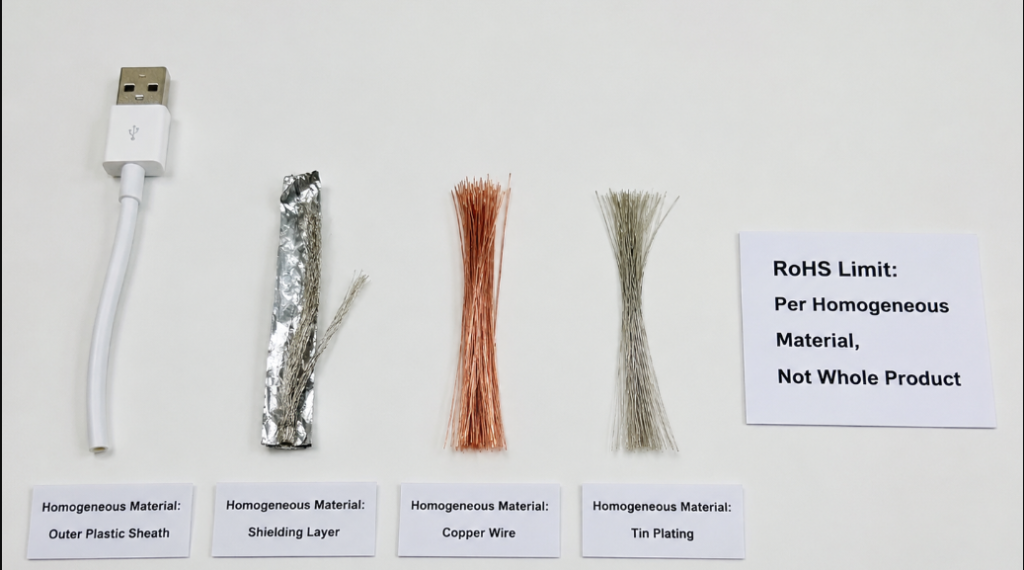
What is a homogeneous material? In plain terms, it is a single material that cannot be further split into different materials by mechanical means (such as unscrewing, cutting, scraping, grinding).
For example: an ordinary charging cable can be split into the outer plastic sheath, the middle shielding layer, the inner copper wires, and the tin plating layer on the surface of the copper wires—each of these single materials that cannot be split further is an independent homogeneous material. Another example: a plastic shell is a homogeneous material, a plating layer is a homogeneous material, a solder joint is a homogeneous material, and the metal base material of a screw is also a homogeneous material.
The requirement of RoHS is: the content of harmful substances in each homogeneous material must not exceed the limit, and cannot be diluted by the total weight of the entire product.
For example, the total lead content of an entire computer may seem very low, but if the solder (homogeneous material) of a solder joint inside exceeds the lead limit, then this computer is not compliant with RoHS. This is why some seemingly cheap electronic products may use inferior solder or recycled plastics: the total content test on the surface is fine, but when disassembled and tested for individual materials, they exceed the limit.
How Do Enterprises Prove Product Compliance with RoHS?
Many people think that RoHS requires third-party institutions to do “certification”, but that is not the case. RoHS is a compliance system based on self-declaration. Manufacturers do not need to mandatory obtain third-party certification, as long as they can prove that the product meets the requirements through risk assessment, supply chain material declarations, test reports, and technical documents.
The technical documents that enterprises need to prepare usually include: product description, bill of materials (BOM), risk analysis of materials and components, supplier compliance declarations, necessary test reports, applicable standards, conformity assessment records, etc.
If third-party testing is to be done, the commonly used test method for RoHS is the IEC 62321 series of standards. A formal test report should clearly state the test items, sample information, material splitting method, test method, and final conclusion.
Many people confuse RoHS with the CE mark, so here we need to clarify the relationship: RoHS is part of the CE conformity of most electrical and electronic equipment—that is to say, electrical and electronic products usually need to meet RoHS requirements first before affixing the CE mark. Conversely, the CE mark itself cannot directly prove RoHS compliance; you need to check whether the product’s EU Declaration of Conformity (EU DoC) lists the RoHS directive (such as Directive 2011/65/EU and its amending directives) and the corresponding harmonized standards.
Enterprises need to properly keep these technical documents to respond to spot checks by market supervision. Under the RoHS/CE framework, manufacturers should generally retain the EU DoC and technical documents for 10 years after the product is last placed on the market; if the product category has other special regulations or e-commerce platform requirements, stricter rules shall be followed, and the specific duration shall be subject to the actual requirements of the regulations and products.
RoHS Exemptions: In What Cases May Exceeding the Limits Be Allowed?
Since RoHS is a limit requirement, does exceeding the limit necessarily mean non-compliance? Not necessarily, because there are “exemption” rules in the regulations.
Exemption means: for certain restricted substances for specific uses, because there is temporarily no feasible alternative technology, the regulations allow their use under specific conditions.
For example, common exemptions include: lead in certain high-temperature solders, lead in specific glass or ceramics, mercury in some lamps, specific substances in some medical and monitoring equipment, etc.
But exemptions are by no means a “universal pass”. Each exemption has clear uses, corresponding substances, applicable product categories, validity periods, and other restrictive conditions. Moreover, the EU regularly evaluates these exemptions. Once alternative technologies mature, it may narrow the scope of exemptions, not renew them upon expiration, or even directly cancel them.
So if you are a seller, or looking at the compliance instructions of a product, you cannot just see “applicable RoHS exemption” and believe it. You must ask clearly: what is the exemption number? Which component is it used on? What is the corresponding use? When does the validity period expire? Is there relevant evidence to support it—missing any one may be a fake exemption.
Core Rules of the REACH Regulation: Chemical Risk Management for Almost All Products
After talking about RoHS, which is specifically for electrical and electronic products, let’s talk about the REACH regulation, which has a wider coverage and is easier for people to confuse. Many people’s impression of REACH is only scattered terms like “SVHC” and “environmental testing”, but in fact its rule system is much larger than RoHS. Almost all products entering the EU market may be related to it, whether it is chemical raw materials, daily consumer goods, or industrial equipment.
REACH Applicability Boundary: Why It Is Broader Than RoHS
Many people think that REACH only regulates chemical raw materials, but in fact its control objects are divided into three categories, with a much wider scope than RoHS: the first category is chemical substances themselves, such as pure lead powder and pure phthalates; the second category is preparations, that is, products made by mixing several substances, such as glues, paints, and detergents; the third category is articles—that is, various finished products we usually buy, such as a T-shirt, a chair, a charging cable, as long as they have a fixed shape, appearance, and specific use function, they are considered articles. As long as these things contain chemical substances, they may be subject to REACH constraints.
In terms of regional scope, REACH applies to the EU market and relevant obligations of the European Economic Area; after Brexit, UK REACH applies, with independent substance lists, declaration systems, and supervision, and EU compliance documents cannot be directly used to replace them.
Even ordinary finished products may be regulated: what you sell is a pure cotton T-shirt, a solid wood chair, a plastic charging cable, as long as they contain chemical substances, they may involve SVHC information transfer or restricted substance requirements. It is not only chemical companies that need to care about REACH.
Of course, there are a few special boundaries: food, medicine, waste, etc. are managed by special regulations, but related packaging, food contact materials, production chemicals, or restricted substances in finished products may still involve REACH requirements. In addition, it should be noted that special products such as cosmetics, toys, medical devices, and food contact materials are usually also subject to special regulations, and REACH alone cannot be used to judge full compliance.
Four Major Mechanisms of REACH: Registration, Evaluation, Authorisation, Restriction
The name REACH includes four core mechanisms, which sound very complicated, but for ordinary consumers and small sellers, most of the time they only come into contact with part of them, so don’t be intimidated by professional terms:
- Registration: This is a requirement for the chemical production and import end. If manufacturers or importers in the EU produce or import a certain chemical substance in an amount of more than 1 ton per year, they need to submit complete registration materials to the European Chemicals Agency (ECHA) to explain the risks of the substance and safety management methods. Ordinary consumers do not need to deal with registration at all, and even many small sellers will not trigger registration obligations if the total amount of a certain substance they import per year is less than 1 ton.
- Evaluation: That is, the regulatory authority reviews the registration materials submitted by enterprises, evaluates the risks of substances, and if they feel that the materials are incomplete or the risks are too high, they will require enterprises to supplement data or take further control measures.
- Authorisation: For some substances with particularly high risks, they will be included in the authorisation list. After the specified “sunset date”, if enterprises still want to use this substance for specific uses, they must apply for authorisation to prove that the risks of use are controllable, and at the same time actively seek alternative solutions.
- Restriction: This is the most direct control method. The regulatory authority will set limits on specific substances, specific uses, specific product categories, or concentrations, and in severe cases will directly ban them from being placed on the market.
For ordinary users and small sellers, the most commonly contacted are not registration or evaluation, but SVHC information transparency, consumer inquiry rights under REACH Article 33, Annex XVII restricted substance requirements, and product recall information—these are the parts most related to daily consumption and sales.
SVHC (Substances of Very High Concern): The Most Commonly Heard REACH Term for Ordinary People
The “REACH testing” that people usually hear about mostly refers to SVHC testing. The full name of SVHC is “Substances of Very High Concern”. Simply put, it is a category of chemical substances identified by the EU as having particularly high risks. These substances may have carcinogenicity, mutagenicity, reproductive toxicity, or be difficult to degrade and accumulate in organisms, and some may interfere with the endocrine system.
SVHC has a “Candidate List”, which is dynamically updated, generally about twice a year. As of 2024, it has exceeded 240 entries. The specific number and substance names must be subject to the latest list on the ECHA official website, do not memorize fixed numbers.
Many people are confused about what the 0.1% threshold of SVHC is calculated based on. Here is a clarification: the SVHC information obligation is judged at the article level, and the threshold is 0.1% w/w of the weight of the article, that is, one thousandth. The “article” here is the independent component with a specific shape and function we mentioned earlier, and cannot be diluted by the total weight of the entire product.
For example, a mobile phone consists of hundreds of independent articles: the glass of the screen, the plastic of the frame, the outer skin of the charging cable, the silicone cover of the earphone, the plating of the screw—each is a separate article. As long as the SVHC content of one of the articles exceeds 0.1% of the weight of the article itself, it triggers the information obligation—you cannot say that the SVHC in the entire mobile phone is only 0.05% so it’s fine; if the outer skin of the charging cable alone counts as 0.2%, then the notification obligation still needs to be fulfilled.
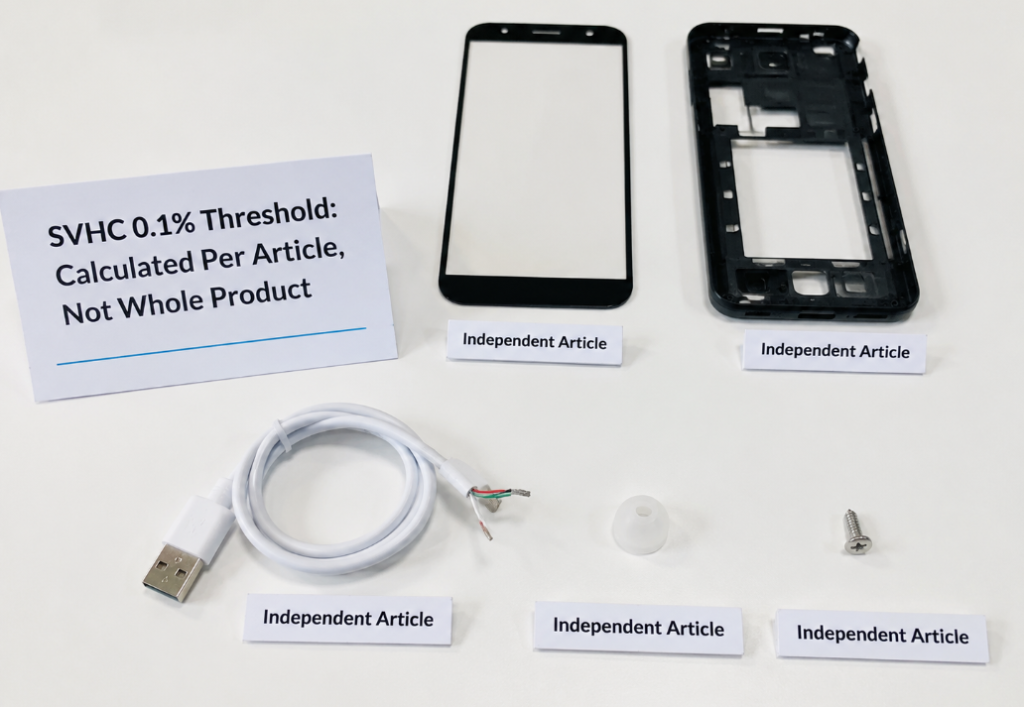
There are two corresponding enterprise obligations: first, to provide sufficient safe use information to downstream recipients; second, if ordinary consumers make inquiries, suppliers must provide relevant SVHC information free of charge within 45 days.
Here is another special reminder: the SVHC Candidate List does not mean that these substances are immediately fully banned. Its core function is to improve transparency and let everyone know that there are these high-risk substances in products. These substances may subsequently enter the authorisation list, be included in the restriction list, or remain on the Candidate List due to insufficient risk evidence. Not all SVHCs will be banned from use.
Three Types of REACH Lists: How to Distinguish Candidate, Authorisation, and Restriction Lists
There are three common lists in REACH, which many people easily confuse. In fact, their control intensity and functions are completely different, in a progressive relationship:
- Candidate List: That is the SVHC list we just mentioned. Its main function is information transparency, triggering obligations such as information transfer, consumer inquiry response, and SCIP notification, and does not directly prohibit the use of substances.
- Authorisation List (Annex XIV): It is the substances with the highest risks selected from the Candidate List that require key control. Once included in the Authorisation List, after the specified sunset date, unless the enterprise obtains authorisation for a specific use, it can no longer continue to use it.
- Restriction List (Annex XVII): This is the most strictly controlled list, which directly stipulates that certain substances shall not be used or placed on the market under specific products, specific uses, or specific concentrations, equivalent to a “ban list”.
Not all SVHCs will enter the Authorisation List or Restriction List. The regulatory authority will comprehensively consider factors such as the risk level of the substance, human exposure scenarios, whether there are feasible alternatives, and the impact on society and the economy to decide the next control measures.
Here are some familiar examples of the Restriction List: phthalates have very strict restrictions in children’s toys and childcare articles; azo dyes are prohibited in textiles and leather products that may be in long-term contact with the skin; nickel release has strict concentration limits in metal products such as jewelry and piercing jewelry that are in long-term contact with the skin. These are all clear requirements in Annex XVII.
SCIP Database: What Is the Difference Between It and REACH Article 33?
Many sellers may have heard of “SCIP notification”, which is easily confused with the consumer inquiry right under REACH Article 33. In fact, the two are related but completely different obligations.
The full name of SCIP is “Information Database of Articles Containing Substances of Very High Concern”. In plain terms, it is a special database built by the EU to collect product information containing excessive SVHC, mainly serving the waste treatment, recycling industry and regulatory authorities, so that they know which products contain dangerous substances, and pay attention to protection and classification during treatment, to reduce harm to the environment and recycling personnel.
The conditions for triggering SCIP notification are consistent with the SVHC information obligation: for articles placed on the EU market, if the SVHC content at the single article level exceeds 0.1% w/w, relevant EU suppliers (such as EU importers, manufacturers within the EU) usually need to submit SCIP notifications to ECHA.
The difference between it and REACH Article 33 is: the right of consumers to receive a reply to SVHC information within 45 days comes from Article 33 of the REACH Regulation itself; while SCIP notification comes from the information requirements under the EU Waste Framework Directive. One is the right to know for consumers, and the other is a database for waste management. The two are related but not the same thing.
For ordinary consumers, there is no need to specifically look for a “SCIP mark”, and ordinary consumer goods on the market usually do not have this mark. Sellers should also note: having a REACH test report does not mean that the SCIP notification is automatically completed. It also depends on whether the product has SVHC exceeding the threshold and whether you are the responsible subject who needs to perform the notification obligation.
Common Types of REACH Compliance Documents
Many people get REACH-related documents from merchants and don’t know which are useful and which are not. Common REACH compliance documents fall into the following categories, each with different functions and scopes of application:
- REACH Declaration of Conformity: This is a declaration issued by the enterprise itself, stating that the product meets the relevant requirements of REACH, such as complying with the information obligations of the SVHC Candidate List and the requirements of Annex XVII restricted substances. When you get the declaration, you should clearly see its coverage: whether it only mentions SVHC, or also covers the Restriction List, and which version of the regulatory list it uses.
- SVHC Test Report: It is a test report for the SVHC Candidate List. A formal report should list the version of the Candidate List, whether the test object is a finished product or a component, a detailed description of the sample, test method, detection limit, and final conclusion. If the report does not state which version of the list is used, its reference value is very low.
- Annex XVII Restricted Substance Report: This is a test for the Restriction List. It must match the product category and specific restriction clauses. For example, textiles need to be tested for azo dyes, soft plastics for phthalates, and metal jewelry for nickel release. You cannot use a general SVHC report to claim compliance with restriction requirements.
- SDS (Safety Data Sheet): SDS is mainly applicable to chemical substances and preparations, such as glues and paint raw materials, to tell users the risks of substances and safe operation methods. Ordinary finished products (such as clothes, chargers, furniture) generally do not need SDS. SDS cannot be used as REACH compliance proof for all finished products. Many merchants will use SDS of raw materials to fool people, so pay attention to this.
- Supply Chain Material Declaration: It is a material compliance declaration issued by upstream suppliers to downstream parties, which can be used as evidence for risk assessment. But for high-risk materials, such as soft PVC, leather, dyes, and plating, a declaration alone is not enough, and usually test reports or stronger evidence are needed to support it.
Comparison of Core Differences Between RoHS and REACH
After understanding the respective core rules of RoHS and REACH, comparing the two in the same table will be clearer, to help you quickly grasp the core differences.
| Comparison Dimension | RoHS Directive | REACH Regulation |
|---|---|---|
| Core Positioning | Limit rules for specific hazardous substances in electrical and electronic equipment, focusing on reducing hazardous substance exposure from e-waste | Risk management rules for the full life cycle of chemical substances, covering almost all products containing chemical substances |
| Applicable Products | Electrical and electronic equipment and related cables and spare parts, with a focused scope | Almost all products containing chemical substances, including electronics, textiles, toys, furniture, building materials, packaging, etc. |
| Number of Restricted Substances | 10 core restricted substances, relatively fixed | The SVHC Candidate List has over 240 entries and is continuously updated; the Restriction List has a large number of specific clauses, with different limits for different substances |
| Calculation Unit | Limits are calculated based on homogeneous materials | SVHC information obligations are calculated at the article level; restriction clauses are judged according to specific regulations |
| Main Compliance Methods | Conformity assessment under the CE framework, self-declaration, technical documentation, necessary testing | Registration, supply chain information transfer, SVHC notification, SCIP notification, compliance management of restricted substances |
| Direct Consumer Rights | No universal personal information access requirements | Article 33 grants consumers the right to inquire about SVHC information and receive a free reply within 45 days |
After reading the table, you should quickly draw two conclusions:
First, electrical and electronic products usually need to comply with both RoHS and REACH—because RoHS only regulates 10 harmful substances in electrical and electronic products, while REACH has many other chemical substance requirements.
Second, non-electronic consumer goods usually do not need to worry about RoHS, but almost all need to consider REACH—for example, clothes, furniture, tableware, etc., although they are not electrical, as long as they contain materials such as plastics, glues, and dyes, they may involve REACH requirements.
Finally, another reminder: special products such as cosmetics, food contact materials, toys, and medical devices also have special regulatory requirements, and you cannot judge that a product is fully compliant only by RoHS and REACH.
Quick Judgment for Common Consumption Scenarios
Just looking at the table may still be a bit abstract. Let’s take several types of products that people often buy as examples to help you apply directly:
- Mobile phones, headphones, power banks, chargers: They belong to electrical and electronic products, usually need to comply with both RoHS and REACH. In addition, they may also involve other requirements such as battery regulations, radio equipment directive, low voltage directive, and EMC directive.
- Pure cotton T-shirts, shoes, bags: They are non-electrical, usually not applicable to RoHS. Focus on relevant requirements in REACH such as azo dyes, phthalates, heavy metals, and PFAS. You can also refer to third-party textile certifications such as OEKO-TEX.
- Children’s electronic toys: They are both electrical and electronic products and children’s products, so both RoHS and REACH need to be checked. They also need to comply with EU toy safety regulations, and restrictions on children’s products are usually stricter than ordinary products.
- Cosmetics: They are non-electrical, not applicable to RoHS. Some requirements of REACH may be relevant, but the core compliance basis is the EU Cosmetics Regulation, and you cannot only look at REACH declarations.
- Tableware, food contact materials: Not applicable to RoHS. In addition to relevant REACH requirements, they also need to comply with EU food contact material regulations, focusing on migration testing and material declarations.
- Large stationary industrial equipment: RoHS may be excluded or exempted because it belongs to “large stationary installations”, but REACH obligations for materials and chemical substances still need to be evaluated.
To summarize the judgment skills: for products with electronic functions, first check RoHS plus REACH; for non-electronic products, focus on REACH and special regulations for the corresponding category; for children’s products, food contact products, and products that are in long-term contact with the skin, raise the risk level by one level and pay more attention to relevant restriction requirements.
Practical Guide for Ordinary Users: How to Judge Whether a Product Is Reliable
After talking about so many rules, some people may ask: I’m just an ordinary buyer, how can I know if what I buy is really compliant? Don’t worry, you don’t need to do testing. As long as you master these methods, you can avoid most pitfalls.
How to Check Compliance Information When Shopping?
First, look at the information on the product page and packaging, pay attention to these points:
First, look at the CE mark but don’t blindly believe it. Most electrical and electronic products sold in the EU should have the CE mark, but the CE mark can be abused, and some merchants even print it casually. It can only be used as a clue, cannot directly prove compliance, and must be judged in combination with other information.
Second, be wary of self-printed “certification logos”. As we said before, RoHS and REACH do not have an official unified certification mark. The “RoHS certification” and “REACH certification” printed on the packaging are made by merchants themselves and cannot prove compliance alone.
Third, check whether the declaration text is standardized. Truly compliant merchants usually clearly state the specific regulations they comply with, such as “comply with Directive 2011/65/EU (RoHS 2) and its amending directives, including the 4 phthalate requirements added by (EU) 2015/863”; the version incorporating this amendment is sometimes colloquially referred to as RoHS 3 on the market, but formal compliance documents shall be based on the officially published directive number. If it only writes “environmental protection and non-toxic” or “complies with EU standards” without a specific regulation number, the credibility is relatively low.
Fourth, check whether the product model matches. The model on the compliance declaration and test report must be consistent with the model of the product you actually buy. You cannot use reports of similar models, old models, or other series to replace.
Fifth, look at the sales channel. Products from正规 brands, authorized channels, with compliance pages in the EU and traceable importer information are much more reliable than those unbranded low-price links where you can’t even find seller information.
Active Verification: 3 Things Ordinary Users Can Do
If you have doubts about the compliance of a product, you can take the initiative to do these 3 things without spending a penny:
First, ask the merchant for REACH SVHC information. According to the provisions of REACH Article 33, if the SVHC content of an article in the product exceeds 0.1%, the supplier must provide you with relevant safe use information free of charge within 45 days after you make an inquiry. If the merchant hesitates and refuses to give it, or says they don’t know what SVHC is, then be careful.
Second, request basic compliance documents. If it is an electrical and electronic product, you can ask the merchant to provide the EU Declaration of Conformity (EU DoC), RoHS declaration, or test summary; if it is a non-electronic product, you can ask for a REACH declaration of conformity, SVHC declaration, or relevant restricted substance test report. Regular merchants will generally provide these documents, at least a declaration.
Third, check recall information. You can query through the EU’s Safety Gate (the original RAPEX system) to see if the product you bought has been notified and recalled due to chemical risks, electrical risks, or other safety issues.
Finally, here is a risk warning: products that are particularly cheap, have no brand, no importer information, have a pungent smell when opened, have rough materials, especially products that children can put in their mouths, usually have higher chemical compliance risks. But also note: no odor does not mean compliance—many heavy metals, flame retardants, and plasticizers are colorless and odorless, and cannot be smelled.
Key Points to Avoid Pitfalls When Shopping for Different Categories
Different categories of products have different high-risk harmful substances. You can focus on them according to the category:
- Electrical and electronic products: Prioritize products with formal CE marks, traceable EU DoC, and complete brand and importer information. Try not to buy unbranded chargers, inferior cables, or unknown second-hand e-waste. The solder and plastic sheaths of these products are prone to excessive lead, cadmium, and phthalates.
- Children’s products: Focus on harmful substances such as phthalates, heavy metals, migratable elements, and azo dyes, especially parts that children will bite or put in their mouths. Children’s toys also need to comply with EU toy safety regulations, not just RoHS and REACH.
- Textiles and clothing: Pay attention to azo dyes, formaldehyde, heavy metals, PFAS (per- and polyfluoroalkyl substances, commonly used in waterproof and oil-repellent finishing, coatings and some packaging materials, difficult to degrade and with cumulative toxicity), flame retardants, and nickel release. For intimate clothing, you can refer to third-party textile certifications such as OEKO-TEX Standard 100, but also pay attention to the scope of application and validity period of the certification.
- Furniture and home decoration: Focus on formaldehyde, flame retardants, polycyclic aromatic hydrocarbons (PAHs, often from processing residues of rubber, plastics, carbon black, and oils, with carcinogenic risks), heavy metals, and SVHC in boards, paints, adhesives, leather, and foam. Newly bought furniture must be fully ventilated before use.
- Food contact materials: In addition to REACH requirements, also check the requirements of EU food contact material regulations, focusing on migration test reports and material declarations, especially plastic tableware, silicone products, and pots with non-stick coatings.
- Cosmetics: The core is to look at EU cosmetics regulations, ingredient labels, and prohibited and restricted substances. REACH can only cover some relevant requirements, and you cannot only use REACH declarations to judge the safety of cosmetics.
How to Read RoHS/REACH Test Reports?
If the merchant gives you a test report, you may feel that it is full of professional terms and you can’t understand it. In fact, just look at these key points to judge whether the report is useful:
First, look at what the report is for. Does the report test finished products, parts, raw materials, or packaging? Do the tested model, batch, color, and material match the product you bought? If the report tests the white model and you bought the black one, then this report cannot be used directly, because the pigments of different colors may be different.
Second, check whether the regulation version is the latest. For RoHS reports, check whether they cover all 10 hazardous substances and whether they include the 4 phthalates added in 2015; for REACH reports, check which version of the SVHC Candidate List it corresponds to, or the specific Annex XVII restriction clauses. If it uses an old list from three or five years ago, it is definitely useless.
Third, check whether the test scope covers high-risk materials. For example, a RoHS report cannot only test the shell without testing high-risk materials such as solder and cable sheaths; if a REACH report is for textiles, it must test azo dyes, if it is for soft plastics it must test phthalates, if it is for metal jewelry it must test nickel release—if the tested items are wrong, no matter how thick the report is, it is useless.
Fourth, check whether the test method is standardized. RoHS testing commonly uses the IEC 62321 series of standards; different REACH substances have different test methods, and formal reports will state the test method, detection limit, and judgment basis.
Fifth, check the date and validity of the report. Because the REACH SVHC list and restriction clauses are constantly updated, and the RoHS exemption list and harmonized standards will also be dynamically adjusted, the older the report date, the more necessary it is to review its validity: if the regulatory list is updated, or the product’s material, color, supplier, production process, or batch changes, even if the report was issued less than two or three years ago, it may need to be re-tested or supplementary evaluated; conversely, if the product formula, process, and applicable regulation version have not changed, the old report can still be used as historical compliance evidence, but usually it needs to be matched with the supplier’s latest compliance declaration to confirm current validity.
Sixth, look at the boundary of the conclusion. The test report is only responsible for the few samples submitted for testing, and cannot automatically cover materials of all batches, all colors, and all suppliers. If the merchant says “we have a report so there is absolutely no problem”, that is not rigorous.
There are also several common cases of fraud or invalidation to note: changing raw materials or suppliers but not updating the report; only testing appearance parts without testing the high-risk soft glue and solder inside; using the packaging test report to replace the product itself report; using a report of a similar model to replace the actual model; the report has no laboratory information, or the sample description is vague.
How to Protect Your Rights When You Suspect a Product Is Non-Compliant?
If you suspect that the product you bought is non-compliant, for example, it has a particularly strong smell, rough materials, and the merchant cannot produce compliance documents, you can protect your rights according to the following steps:
Step 1, first keep all evidence. Including order records, invoices, product photos, packaging labels, model numbers, merchant’s promotional pages, and chat records with the merchant—these are all the basis for subsequent rights protection.
Step 2, first contact the merchant for negotiation. Request a return or exchange, and at the same time ask the merchant to provide a declaration of conformity, REACH SVHC information, or relevant test reports. If the merchant can produce compliance evidence, you can judge again; if they cannot produce it and still refuse to return or exchange, proceed to the next step.
Step 3, complain to the e-commerce platform. Explain that the product is suspected of violating EU chemical or electrical and electronic hazardous substance restriction requirements, and request the platform to intervene and delist the relevant link.
Step 4, feedback to the local market supervision authority or consumer protection agency. If you are in the EU, you can contact the market supervision department of the member state; if you are in the UK, you can contact Trading Standards.
Step 5, check the Safety Gate/RAPEX system to see if similar products have been recalled for the same problem. If so, you can use this as a basis for complaint.
Here is a reminder: ordinary consumers usually do not have the ability to test whether chemical substances exceed the standard by themselves, so the focus of rights protection is not to prove that the product is unqualified by yourself, but to require the merchant to provide compliance evidence, and then use the power of the platform and supervision to handle it.
Basic Compliance Steps for Entry-Level Cross-Border Sellers/Small Importers
If you are engaged in cross-border e-commerce or small import business, just getting in touch with RoHS and REACH, and don’t know where to start, you can follow these 7 steps for basic compliance:
Step 1, first determine the product category. Judge whether it belongs to electrical and electronic equipment, whether it involves special categories such as children, food contact, cosmetics, and medical treatment, and whether there are additional special regulatory requirements.
Step 2, clarify your responsible role. Are you a manufacturer, EU importer, authorized representative, distributor, or platform seller? Different roles bear different compliance obligations. For example, EU importers are mainly responsible for product compliance, while distributors have relatively fewer obligations.
Step 3, disassemble the high-risk materials and components of the product. For example, solder, cable sheaths, soft PVC, rubber, paint coatings, metal plating, adhesives for electrical and electronic products; dyes, plastic accessories for textiles; paints, adhesives, foam, leather for furniture—list these high-risk parts first.
Step 4, request compliance documents from upstream suppliers. Including RoHS declarations, REACH declarations, SVHC declarations, Annex XVII related test reports, bill of materials (BOM) and material information.
Step 5, determine the testing strategy according to the risk level. High-risk materials are prioritized for third-party testing, and low-risk materials can be archived in combination with supplier declarations and historical data. You don’t need to test everything, spend money on the cutting edge.
Step 6, establish technical files and update mechanisms. Organize and archive all compliance documents, test reports, and supplier declarations, and update them regularly—for example, when the regulatory list is updated, the supplier changes materials, the product color is changed, the process is changed, or the batch is abnormal, the compliance must be re-evaluated.
Step 7, prepare corresponding compliance documents. Electrical and electronic products need to prepare EU DoC, CE-related documents and RoHS technical materials; if there are articles with SVHC exceeding the threshold in the product, it is also necessary to evaluate the information transfer obligation under REACH Article 33 and the SCIP notification obligation.
Finally, remember: compliance is a continuous management process, not a one-time purchase of a report. Many sellers think that spending a few hundred dollars to buy a report will make them worry-free, but when regulatory spot checks are done, they are caught every time, and the loss is even greater.
Clarification of Common Misconceptions: Don’t Be Fooled by False Publicity
Finally, let’s clarify the 8 most common misconceptions to help you avoid false publicity by merchants.
Myth 1: RoHS and REACH are the same thing, both are environmental certifications
This is the most common mistake. RoHS and REACH are two completely different regulations, with different control objects, calculation methods, enterprise obligations, and document systems. RoHS only regulates 10 harmful substances in electrical and electronic products, while REACH regulates the chemical substance risks of almost all products. If a merchant confuses RoHS and REACH and can’t even figure out the basic concepts, then its compliance professionalism must be questionable.
Myth 2: Having a RoHS/REACH mark means it must be compliant
We have repeatedly said before that neither of these two regulations has an official unified certification logo, and the marks printed by merchants themselves prove nothing. The real compliance evidence is the declaration of conformity, technical documents, test reports, and supply chain materials, and they must correspond to the correct regulation version and product model. If the merchant only shows you the logo on the packaging and cannot produce specific documents, the credibility is very low.
Myth 3: Complying with RoHS means complying with REACH
Completely wrong. RoHS only restricts 10 specific hazardous substances, while REACH has more than 240 SVHCs and a large number of restriction clauses, covering far more substances. For example, an electronic toy, even if all 10 RoHS items are qualified, may still be unqualified due to REACH-restricted phthalates, polycyclic aromatic hydrocarbons, or other chemical restrictions for children’s products. The two cannot replace each other.
Myth 4: Having the CE mark means both RoHS and REACH are compliant
The CE mark is a conformity mark required by many EU directives. RoHS is indeed part of the CE conformity of most electrical and electronic products, but most of the requirements of REACH are not within the direct certification scope of the CE mark. That is to say, the CE mark can be used as a clue for RoHS compliance of electrical and electronic products, but it cannot replace RoHS technical documents, let alone prove all the requirements of REACH. The correct approach is to ask to check whether the RoHS directive is listed in the EU DoC, and then separately request REACH-related declarations or documents.
Myth 5: REACH is only related to chemical companies
This is completely wrong. REACH not only regulates chemical raw materials and chemical factories, but also regulates the chemical substance risks in finished products (articles). Clothing, toys, furniture, electronic products, stationery, packaging, leather products, as long as they contain plastics, glues, paints, dyes, coatings, metal plating, rubber, they may involve REACH requirements, regardless of whether they are chemical companies.
Myth 6: Compliance means completely free of harmful substances
Many merchants will promote “100% chemical-free” and “absolutely non-toxic”, which is actually unscientific. Regulations usually set limit requirements, use restrictions, or information obligations, not requiring zero detection of all substances. After all, there are trace amounts of heavy metals in nature, and as long as many chemical substances are within the safety limit, they will not cause harm to the human body. On the contrary, those publicity that shout “absolutely non-toxic” and “zero harmful substances” should be more cautious, because they are likely to be false publicity.
Myth 7: The more reports, the more compliant
Some merchants will take out a thick stack of test reports, which look very professional, but in fact most of them have nothing to do with the product you buy. The number of reports is not important. What is important is whether the object of the report corresponds to the product, whether the regulation version is the latest, whether the test items cover high-risk materials, whether the test method is standardized, and whether the samples are consistent. A report that accurately covers high-risk materials and applicable regulations is far more useful than ten irrelevant old reports.
Myth 8: EU compliance means it can be sold globally
Chemical regulations, labeling requirements, declaration requirements, test methods, and responsible subjects vary from country to region. EU RoHS and REACH cannot automatically replace the requirements of other regions such as China RoHS, UK REACH, South Korea’s K-REACH, and California’s Proposition 65 in the US. If you want to sell to multiple countries, you have to establish a separate compliance matrix according to the requirements of each target market, and you can’t think that passing the EU’s requirements will make everything fine.
Boundaries and Exceptions: Things You Must Know for Advanced Judgment
If you have mastered the basic content above and want to go deeper to make more accurate judgments, then you need to know these boundaries and exception conditions.
Regional Differences: Requirements Vary by Region
We mentioned earlier that RoHS and REACH are EU regulations, but similar regulations in different regions have quite a lot of differences, and cannot be generalized:
- EU: EU RoHS and EU REACH apply. ECHA manages the SVHC and restriction lists, and recall information is released through Safety Gate/RAPEX.
- UK: After Brexit, UK RoHS and UK REACH apply, with requirements similar to the EU, but the substance list, registration system, supervision, and transition arrangements are independent. EU compliance documents cannot directly replace UK ones.
- China: There is China RoHS, which requires the labeling of hazardous substance content in electrical and electronic products, and some products are included in the conformity assessment system; China RoHS and EU RoHS have differences in system design, labeling disclosure, compliance management catalog, conformity assessment rules, and some implementation calibers. Some limit or controlled substance requirements may be similar, but EU RoHS compliance documents cannot directly replace the judgment of China RoHS, and corresponding requirements need to be checked separately.
- United States: There is no federal unified chemical regulation similar to REACH, but California has Proposition 65, which requires warning labels for products containing known carcinogenic or reproductive toxic substances, and TSCA (Toxic Substances Control Act) regulates chemicals, which require separate evaluation.
- South Korea, Japan, etc.: South Korea has K-REACH, Japan has J-MOSS (Japanese version of RoHS), which have similarities with EU requirements, but the specific substances, limits, and declaration requirements are not completely consistent.
Product Exceptions and Overlay of Special Regulations
In addition to regional differences, the attributes of the product itself will also bring many exceptions and superimposed requirements:
- RoHS exclusions and exemptions must be judged strictly according to product category, use, installation method, exemption number, and validity period, and the scope cannot be expanded by oneself.
- The REACH registration threshold is 1 ton per substance per year, but below this tonnage only means that the registration obligation is not triggered. Obligations such as restriction, authorisation, SVHC information transfer, and SCIP notification may still need to be borne. You cannot say that you don’t need to worry about REACH because the quantity is small.
- Children’s products usually need to meet REACH, toy safety regulations, mechanical and physical safety requirements, migratable element limits, and age warning requirements at the same time, which are much stricter than ordinary products.
- For food contact materials, REACH is not the only basis. The core also depends on the migration test and material requirements of food contact material regulations.
- The core basis for cosmetics is the EU Cosmetics Regulation. REACH can only solve the cross-problems of supply chain or restriction of some substances, and cannot cover all compliance requirements.
- In addition to RoHS and REACH, battery products also need to comply with the requirements of EU battery regulations, including relevant regulations on labeling, recycling, and transportation.
Impact of Dynamic Regulatory Updates
Neither RoHS nor REACH is static, they are constantly being updated dynamically:
The RoHS restricted substance list, harmonized standards, and exemption validity period will be adjusted regularly, and old compliance documents may become invalid. The REACH SVHC Candidate List is usually updated twice a year, and the restriction clauses of Annex XVII will also be continuously added or revised. Here is a special note: when new substances are added to the SVHC Candidate List, they usually first affect transparency obligations such as information transfer, consumer response, and SCIP notification, and do not necessarily immediately make products unsaleable; only when Annex XVII restriction clauses are added or revised, or authorisation list requirements change, or RoHS exemptions expire, may it directly affect whether products can continue to be placed on the market.
Therefore, compliance documents must indicate the corresponding regulation version, list date, report date, and applicable product scope. In addition, even for products of the same model, if the supplier is changed, the color is changed, the plastic formula is changed, or the coating process is changed, the compliance conclusion may be changed and re-evaluation is required.
Consequences of Non-Compliance
Finally, let’s talk about the consequences of non-compliance. Whether for enterprises or consumers, there must be a clear understanding:
- For enterprises, non-compliance may lead to product sales bans, recalls, fines, and border detention. E-commerce platforms will delist links and freeze inventory, and they may also face customer claims and brand reputation losses.
- For platform sellers, in severe cases, they may be restricted from account permissions, or even permanently banned, and all previous investments will be wasted.
- For consumers, buying non-compliant products may expose them to excessive harmful substances, especially for children, pregnant women, or products with long-term skin contact or possible entry into the mouth, the risk is higher.
- For the environment, non-compliant products will release heavy metals, flame retardants, plasticizers and other harmful substances during the recycling and waste stages, polluting soil and water bodies, and also harming workers in the recycling industry.
Summary
After reading this article, you should have a relatively comprehensive understanding of RoHS and REACH, and at least be able to make these judgments independently:
First, you can distinguish the core differences between RoHS and REACH: one focuses on specific hazardous substances in electrical and electronic equipment, and the other focuses on the full life cycle of chemicals and chemical risks of finished products.
Second, you can judge which regulations apply to common products: electrical and electronic products usually need to check both, and non-electrical products such as clothing, furniture, and toys focus on REACH and special regulations for the corresponding category.
Third, you can understand key concepts: such as RoHS’s 10 hazardous substances, homogeneous materials, REACH’s SVHC