
Quick Summary
- Testing standards define the pass/fail rules for products; testing procedures lay out how tests are run; test reports record the final results. They are not the same as official product certifications.
- Global standards follow a layered system: international universal rules, regional market access laws, and industry-specific specs like USB-IF for chargers and cables.
- A credible lab test follows six repeatable stages, from planning to final report. When products fail, labs run root-cause analysis to guide design fixes before retesting.
- ISO/IEC 17025 accreditation, calibrated equipment, and independent third-party testing are the strongest signs that test results are trustworthy.
- You do not need an engineering degree to judge a test report. Check the lab accreditation, standard number, test conditions, and actual measured values to avoid marketing hype and pick reliable products.
1. The Basics: What Are Testing Standards & Procedures?
If you have ever wondered if a “240W fast charging cable” really delivers full power, or if a “waterproof portable charger” can survive a rainstorm, you are asking the exact questions that testing standards were created to answer. Think of them as the universal rulebook for product quality — they turn vague marketing claims into measurable, verifiable facts.
1.1 Three Core Concepts Defined
- Testing Standard: A formal technical document published by authoritative bodies. It sets uniform pass/fail thresholds, test conditions, and judgment rules for products. In simple terms, it answers: What counts as good enough?
- Testing Procedure: The full set of standardized step-by-step rules from sample receipt to final report. Its job is to make sure results stay consistent no matter when, where, or who runs the test.
- Test Method: The detailed operational instructions for a single test item — for example, where to attach temperature sensors to a charger, or how fast to plug and unplug a USB-C connector. It answers: How exactly do we collect the data?
1.2 How They Relate (And How They Differ)
| Dimension | Testing Standard | Testing Procedure | Test Method |
|---|---|---|---|
| Core role | Defines the acceptance threshold | Defines the execution path | Defines the operational details |
| Question it answers | “What level must we reach?” | “What steps do we follow?” | “How do we measure it?” |
| Real example | IEC 62368-1, USB-IF specifications | Sample tracking, three-level review | Temperature rise test, bend life test |
1.3 Testing Standard vs. Certification vs. Test Report
This is one of the most common points of confusion for shoppers. They are three separate things:
| Item | Testing Standard | Product Certification | Test Report |
|---|---|---|---|
| Core purpose | Sets the technical requirements | Proves a product meets required standards | Records how a specific sample performed |
| Issued by | Standard bodies (IEC, ISO, USB-IF) | Independent certification bodies (UL, TÜV) | Testing laboratories |
| What it covers | Universal rules for a product category | A specific product model and its production line | A single batch of test samples |
| Common example | IEC 62368-1 safety standard | UL listed charger | A 10-page lab report with test data |
1.4 In-House Lab vs. Third-Party Lab
Not all “lab tested” claims carry the same weight.
| Factor | In-House (Brand-Owned) Lab | Third-Party Independent Lab |
|---|---|---|
| Primary use | R&D optimization and production QC | Independent verification, certification, market proof |
| Speed | Fast, flexible for iterative testing | Slower, with formal processes and scheduling |
| Public credibility | Lower — results are self-reported | Higher — impartial, accredited, and audited |
| Typical use case | “Tested during development” | “Certified” or “third-party verified” marketing claims |
1.5 Why Standardized Testing Matters
- For consumers: It verifies whether advertised specs are real, reduces safety risks and early failures, and helps you cut through “military-grade” style marketing fluff.
- For brands: It catches design and manufacturing flaws early, cutting warranty and recall costs down the line.
- For global trade: It creates a shared technical baseline, so products from different brands and regions can be compared fairly.
1.6 Four Common Misconceptions for Beginners
- Compliant ≠ durable: Passing a standard only means the product meets the minimum safety or performance bar — it does not guarantee top-tier long-term reliability.
- Has a report ≠ fully tested: Watch out for “selected item only” reports. Some brands only publish the tests they pass.
- Sample pass ≠ batch pass: Laboratory testing applies only to the submitted samples, not necessarily every unit off the production line.
- “Military-grade testing” ≠ better: Without a specific standard number and test conditions, the phrase is almost always just marketing.
2. Global Testing Standards for Consumer Electronics
Around the world, products do not follow one single rulebook. Instead, there is a layered system of international, regional, and industry-specific standards. Here is how it breaks down for electronics, chargers and cables.
2.1 Major International Standard Organizations
These are the rule-making bodies whose standards are recognized nearly everywhere.
- IEC (International Electrotechnical Commission) The global benchmark for electrical and electronic products. It covers environmental reliability, electrical safety, and electromagnetic compatibility. The IEC 60068 series is the most widely used environmental testing framework for electronics, while IEC 62368-1 (replacing the older IEC 60950-1 standard for IT and AV equipment) is the modern safety standard for chargers and consumer electronics.
- ISO (International Organization for Standardization) Covers quality management, mechanical reliability, automotive electronics, and general industrial fields. ISO 9001 is the best-known quality system standard, while ISO/IEC 17025 is the gold standard for laboratory competence itself.
- ASTM International The leading authority for material performance, mechanical strength, and corrosion protection tests. ASTM B117 salt spray testing is the global reference for metal connector and coating corrosion resistance — a key test for USB cable plugs and charger housings.
- MIL-STD (US Military Standards) Represent extremely harsh environmental requirements. While originally for military gear, high-end consumer and industrial products often cite MIL-STD-810 as a premium reliability benchmark.
2.2 Regional Market Access Standards
Selling into a specific country or region almost always means meeting local mandatory requirements.
| Region | Key Standards / Certifications | Main Focus for Electronics |
|---|---|---|
| North America | UL safety standards, FCC EMC rules, ASTM material standards | Safety compliance, electromagnetic emissions |
| European Union | EN harmonized standards, CE framework, RoHS | Safety, environmental protection, EMC |
| Japan | JIS industrial standards, PSE electrical safety | Electrical safety, quality consistency |
2.3 Industry-Specific Standards for Chargers & Cables
For USB and charging products, global industry standards define far more than just basic safety.
- USB-IF Compliance Testing: The official specification for USB Power Delivery (PD), USB-C cables and connectors. It covers power capability, protocol communication, signal integrity, and cross-device compatibility. A cable that passes USB-IF PD EPR testing is verified to safely handle 240W.
- Qi Wireless Charging Standards: The global benchmark for wireless charger performance, safety and interoperability.
- Battery Safety Standards: UN 38.3 for transport safety, IEC 62133 for rechargeable battery safety, covering overcharge, short circuit and temperature cycling.
2.4 How to Read a Standard Number at a Glance
Every standard has a built-in identity code:
[Prefix] + [Topic number] + [Publication year]
For example: IEC 60068-2-1:2025 means the 2025 edition of IEC standard 60068, part 2-1 (cold test).
Note: New editions usually reflect updated requirements, clarified procedures, or improved testing methods. They are not always “stricter” — sometimes they fix errors, add clarity, or remove outdated rules.
2.5 Quick Reference Table of Common Standards
| Test Type | Core Standards | Typical Products |
|---|---|---|
| Environmental reliability | IEC 60068 series, MIL-STD-810 | Chargers, cables, automotive electronics |
| Electrical safety | IEC 62368-1 (replaces IEC 60950-1) | Consumer electronics, power adapters |
| Salt spray / corrosion | ASTM B117, ISO 9227 | Metal connectors, housings, hardware |
| Electromagnetic compatibility (EMC) | IEC 61000 series, CISPR | All powered electronic devices |
| Ingress protection (IP rating) | IEC 60529 | Outdoor devices, waterproof products |
| Plastic flammability | UL 94, IEC 60695 | Charger housings, insulation materials |
| USB power & data | USB-IF PD & Type-C specifications | USB cables, chargers, hubs |
3. How Laboratory Testing Works: The 6-Stage Workflow
A trustworthy test report is not produced by flipping a switch. It follows a strict, repeatable workflow designed to eliminate bias, error, and cutting corners. Here is how a professional lab takes a product from sample to final report.
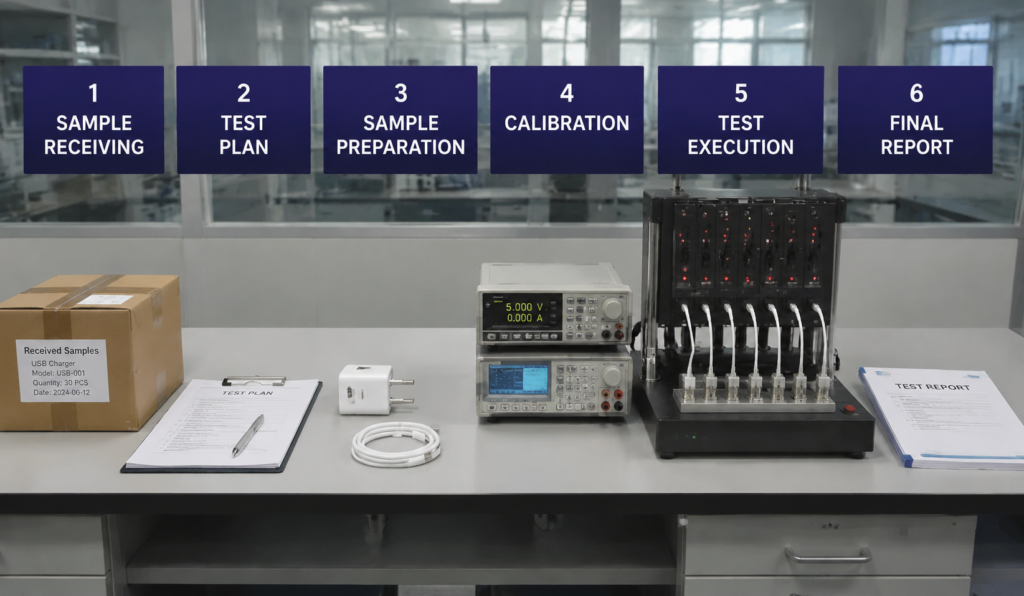
Stage 1: Requirement Confirmation — Why Are We Testing, and By What Rules?
Before any equipment turns on, everyone must agree on the ground rules.
- Define the test goal: R&D validation, production QC, certification, or failure analysis. Each goal has a different level of rigor.
- Match the right standard: Pick the correct standard number and edition based on product type, target market, and test purpose.
- Clarify pass/fail rules: Lock in acceptance thresholds and failure criteria upfront to avoid disputes later.
Stage 2: Test Design — Building a Fair and Rigorous Plan
This is where the test team turns a standard into an actionable project.
- Write the formal test plan: Define test items, severity levels, sample quantity, timeline, and budget.
- Design fixtures and jigs: Make sure the way stress is applied matches exactly what the standard requires.
- Assess risks and contingencies: Anticipate safety hazards, equipment failures, and exception handling rules.
Stage 3: Sample Preparation — From Sampling to Baseline Measurement
Poor sample handling can ruin an otherwise perfect test.
- Formal sampling: Samples are selected according to standard rules, with full records of model, batch, firmware version, and initial appearance.
- Unique identification and traceability: Every sample gets a unique ID, and its full journey through the lab is logged.
- Baseline performance test: Critical step — initial performance is measured before any stress is applied, so you can tell later if the product degraded.
- Preconditioning: Samples are stabilized at standard temperature and humidity to eliminate environmental bias.
Stage 4: Equipment & Environment Calibration — Making Sure the Ruler Is Accurate
You cannot trust a test if you cannot trust the tools.
- Verify calibration status: Confirm all test equipment is within its valid calibration cycle, and that measurements can be traced back to national or international metrological benchmarks. In simple terms: Calibration ensures that a “10V measurement” really means 10V, not 9.7V or 10.3V because of equipment drift.
- Pre-calibrate the environment: Stabilize temperature, humidity, electromagnetic background, and vibration levels to match the standard’s required conditions.
- Intermediate checks: Run quick stability verification on key equipment before use to catch drift early.
Stage 5: Test Execution — Following the Rules, Documenting Everything
This is where the actual testing happens — and where discipline matters most.
- Standardized operation: Technicians follow written standard operating procedures (SOPs) step by step. Parameters are never changed on a whim.
- Real-time data logging: Environmental conditions, sample status, and any anomalies are recorded continuously, with raw data and photos preserved.
- Checkpoint controls: Intermediate performance checks at key stress transitions to track how the product is holding up.
- Exception handling: If something goes off-script, the deviation is recorded, the test may be paused, and restart requires formal approval. No data is silently erased.
Stage 6: Data Judgment & Report Issuance
- Data validation: Raw data is organized and checked for validity; invalid outliers are removed according to pre-defined rules.
- Pass/fail determination: Measured values are compared one by one against standard limits to produce a clear Pass / Fail / or formally documented deviation outcome.
- Failure analysis: For failed items, root cause investigation and verification are carried out to explain why it failed.
- Three-level review and issuance: The report goes through drafting → review → authorized signatory approval before being officially stamped and released.
- Archiving and retention: Test records and report copies are stored, and post-test samples are sealed or disposed of per rules — typically retained for 6+ years for full traceability.
4. What Happens When a Product Fails Testing?
Testing does not end with a “Fail” stamp. For product teams, failure is where the real improvement work starts.
The standard follow-up workflow is:
- Document the failure: Record exactly when, how, and under what conditions the product failed, with photos and performance data.
- Root cause analysis (RCA): Engineers use tools like X-ray imaging, microscopic inspection and electrical testing to find the actual reason for failure — for example, a cracked solder joint inside a charger after temperature cycling.
- Design or process correction: The brand fixes the issue — reinforcing a connector, changing a material, adjusting a circuit.
- Retesting: Updated samples go back through the same test procedure to confirm the fix works.
- Verification closeout: Once the product passes consistently, the failure and correction cycle is formally closed.
This cycle is why professional product development rarely passes testing on the first try. Each failure makes the final product more reliable.
5. What Makes Test Results Trustworthy?
Any lab can print a “Pass” on a piece of paper. What separates credible labs from the rest is a formal quality system that governs everything they do.
5.1 ISO/IEC 17025: The Global Gold Standard for Laboratories
ISO/IEC 17025:2017 is the international benchmark for testing and calibration laboratory competence. It covers both management systems and technical capability, and requires labs to demonstrate impartiality, consistency, and technical validity in every result they produce.
A lab accredited to ISO/IEC 17025 does not just “have good equipment” — it proves it follows consistent rules for personnel, equipment, environment, methods, and data integrity.
5.2 Four Pillars of Laboratory Quality Control
- Personnel control: Test technicians must be trained, examined, and formally authorized. Critical reports can only be signed off by authorized signatories. Labs also regularly participate in inter-laboratory proficiency tests.
- Equipment control: Full lifecycle management from purchase through calibration, maintenance, and retirement, with an unbroken traceability chain.
- Environment control: Temperature, humidity, cleanliness, ESD protection, and electromagnetic interference are monitored in real time. If conditions go out of spec, testing pauses.
- Document control: A three-tier document system — quality manual → procedure documents → SOPs — so every action follows a written rule, and every change is recorded.
5.3 Measurement Uncertainty: No Test Is Perfect
No measurement is 100% exact. Measurement uncertainty is the scientific estimate of the error range around a test result. Professional reports include uncertainty information, and when a result sits right on the pass/fail line, uncertainty is factored in to avoid false passes.
5.4 International Mutual Recognition: The ILAC MRA
The ILAC Mutual Recognition Arrangement (ILAC MRA) is what helps test results travel across borders. As of 2024, it has 114 signatory bodies covering 118 economies.
Reports from labs accredited by an ILAC MRA member are more likely to be recognized internationally, although specific market regulations may still require additional compliance steps such as local registration or product certification.
Common accreditation marks you may see: CNAS (China), A2LA (USA), UKAS (UK), TÜV (Germany). All carry equivalent weight under ILAC MRA.
6. Common Test Types, With Real-World Examples
You do not need to memorize every standard number, but knowing the main test categories will help you understand what a product has — and has not — been verified for.
6.1 Environmental Reliability Testing
- What it checks: Whether a product works and survives in hot, cold, humid, bumpy, or corrosive environments.
- Common items: High/low temperature, temperature cycling, damp heat, salt spray, vibration, drop.
- Standards: IEC 60068 series, MIL-STD-810.
- Real example — charger temperature cycling:
- Baseline: Test output power at 25°C room temperature.
- Test: Cycle between -20°C and 60°C for 100 cycles.
- Checks after test: Output power stability, insulation integrity, plastic housing condition.
- Common failures: Charger stops working, plastic cracks, output power drops.
6.2 Electrical Safety Testing
- What it checks: Protection against electric shock, fire, and insulation breakdown.
- Common items: Withstand voltage (hi-pot) test, insulation resistance, ground continuity, leakage current.
- Standard: IEC 62368-1.
- Why it matters: This is the absolute safety floor. Any powered product that skips safety testing is a genuine hazard.
6.3 Performance & Function Testing
- What it checks: Whether advertised power, speed, and features actually work as claimed.
- Common items: Output power, data transfer speed, protocol compatibility, internal resistance, voltage drop.
- Standards: Industry protocol specifications such as USB PD specifications.
- Why it matters: It catches “100W labeled, 60W actual” style spec inflation.
6.4 Mechanical Durability Testing
- What it checks: Resistance to repeated physical use and wear.
- Common items: Insertion/extraction life, bend/flex life, tensile strength retention.
- Why it matters: It tells you whether your USB cable will fray in 3 months or last 3 years.
6.5 EMC Testing
- What it checks: That a product does not emit excessive electromagnetic interference, and that it keeps working when exposed to interference from others.
- Common items: Radiated emissions, conducted emissions, electrostatic discharge (ESD) immunity.
- Standards: IEC 61000 series, CISPR standards.
- Why it matters: It is why your Wi‑Fi does not crash every time you turn on your charger.
6.6 Example: How USB Cables & Chargers Are Actually Tested
To make this concrete, here is what a full test program looks like for the products we cover most.
USB-C Cable Testing Program
- Electrical performance: Continuity test, DC resistance test, voltage drop test at full load, E-Marker chip verification.
- Signal integrity: High-speed data transmission test, impedance matching check.
- Mechanical durability: Bend/flex life test, insertion/extraction cycle test, tensile strength test.
- Environmental: Temperature cycling, salt spray corrosion on connectors.
- Compliance: USB-IF PD protocol compliance test.
Wall Charger Testing Program
- Safety: Withstand voltage, insulation resistance, leakage current, abnormal condition test.
- Performance: Maximum output power test, PD protocol negotiation test, load regulation test.
- Thermal: Temperature rise test at full load, 外壳表面温度测试。
- Efficiency: Energy efficiency test at different load levels.
- Protection: Over-voltage, over-current, over-temperature protection function test.
- Environmental: Temperature cycling, vibration test.
7. How to Read a Test Report & Avoid Marketing Traps
You do not need an engineering degree to spot a weak test claim. With three quick checks, you can separate credible proof from empty advertising.
7.1 Three Steps to Read Any Test Report
- Check the accreditation mark first Look for an ILAC MRA member logo (CNAS, A2LA, UKAS, etc.) on the report header. No accreditation mark means the report has no independent credibility.
- Check the standard and version Confirm the full standard number and publication year. Make sure it actually covers the feature being advertised. A “safety test pass” means nothing if you are buying a high-speed data cable.
- Check conditions and measured values Do not stop at “Pass.” Look at the actual test conditions (temperature, load, speed) and compare the measured value against the standard limit. A product that barely scrapes past the limit is not the same as one with a large safety margin.
7.2 Four Classic Marketing Traps to Spot
- “10,000 bends / insertions” with no context Bend angle, insertion speed, and applied load completely change the meaning of a cycle count. Without those details, the number is meaningless.
- “Military-grade standard” without a number If it does not name the exact MIL-STD number and severity level, it is a buzzword, not proof.
- “Certified factory ≠ certified product” A factory having ISO 9001 does not mean every specific product it makes has been tested and certified.
- “Lab tested” without naming the lab In-house testing by the brand itself is useful for R&D, but it does not carry the same weight as independent third-party testing.
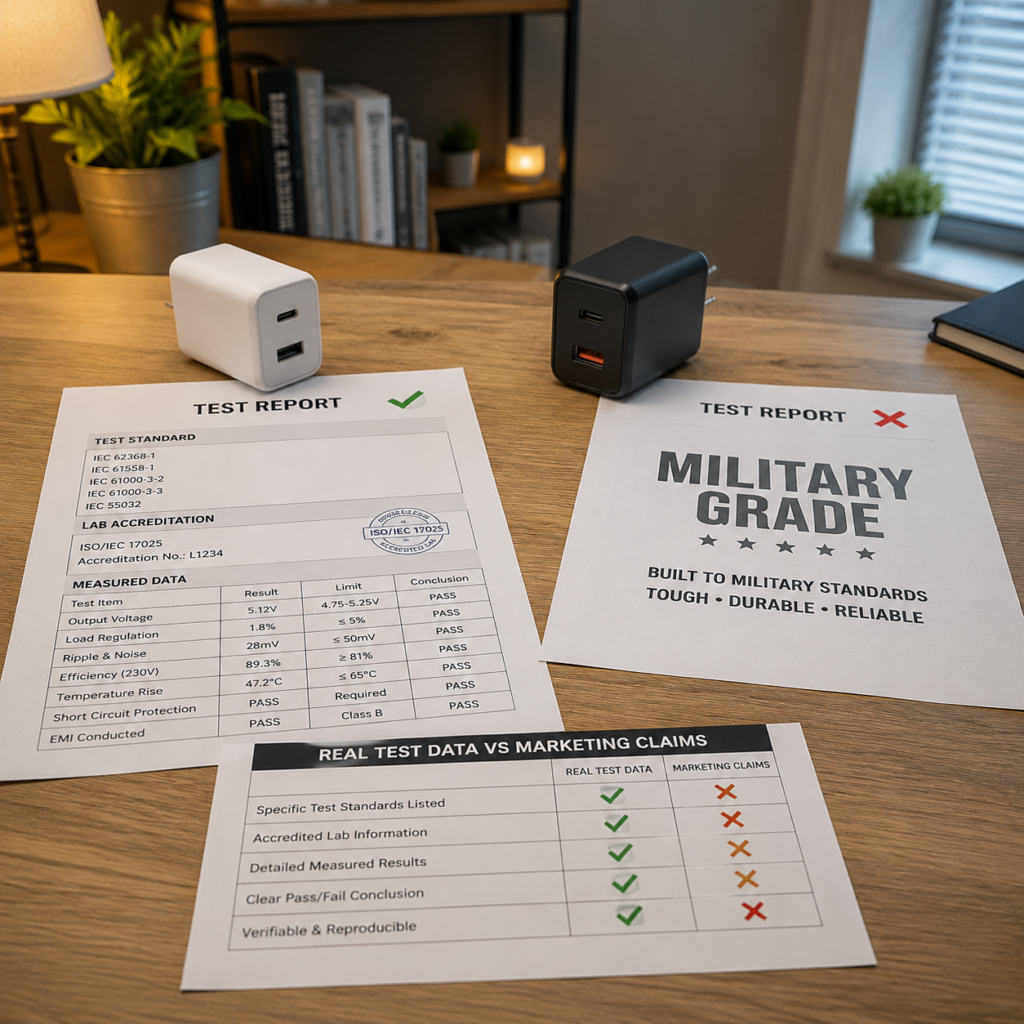
7.3 Shopping by Test: What to Look For by Use Case
- Everyday charging: Prioritize electrical safety and temperature rise tests. These are the basics that keep you safe.
- High-speed data transfer: Focus on signal integrity tests and USB-IF protocol compliance. Compatibility and speed depend on them.
- Outdoor / automotive use: Look for environmental reliability and IP ingress protection ratings.
- Heavy daily use: Check insertion life, bend life, and temperature cycling data to estimate real-world durability.
7.4 Real-World Example: Fast Charging Cables & Chargers
- For a 240W USB-C cable: Verify it has USB-IF PD EPR compliance testing, plus temperature rise and internal resistance data.
- For a wall charger: Prefer products tested to IEC 62368-1 safety standards with published efficiency and thermal performance results.
8. The Future of Product Testing
Testing does not stand still. As products get more powerful and complex, the labs that test them are evolving too.
8.1 Digitalization and Automation
Laboratory Information Management Systems (LIMS) are becoming standard, handling sample registration, task scheduling, automated data collection, and report generation in one unified digital workflow. Scripted automated test runs reduce human error, improve consistency, and enable 24/7 unattended testing.
8.2 AI-Assisted Analysis
Artificial intelligence is starting to assist with visual defect detection, failure root-cause analysis, and life prediction modeling. It does not replace human judgment, but it speeds up analysis significantly and spots patterns humans might miss.
8.3 Rising Bar for New Technologies
- Higher power densities (240W and beyond) are driving tighter thermal and safety test standards.
- Faster data speeds (USB4, Thunderbolt 5) demand more precise signal integrity testing equipment.
- The boom in EVs and automotive electronics is rapidly expanding demand for automotive-grade reliability testing.
9. Frequently Asked Questions
Q1: Are testing standards and product certification the same thing?
No. A testing standard is the technical rulebook. A product certification is a formal declaration by a third party that a product meets those standards.
Q2: Can test standards from different countries replace each other?
Under the ILAC MRA framework, equivalent test results are widely recognized. However, mandatory local market access standards generally cannot be directly substituted — products still need to meet local requirements to be sold legally.
Q3: The more steps a test procedure has, the more reliable the result?
Not necessarily. Reliability comes from standardized procedures and disciplined execution, not from adding unnecessary extra steps. Redundant steps can actually introduce more sources of error.
Q4: Can I run my own simple “standard” tests at home?
You can do basic functional and visual checks, but professional safety, reliability, and performance tests require calibrated equipment and controlled environments that home setups cannot provide.
Q5: Why does one product have multiple different test reports?
Different countries require different standards, and different stages of a product’s life (R&D, production, post-market) have different testing goals.
Q6: If a product is certified, is it guaranteed to never fail?
No. Certification only proves that tested samples met the minimum standard requirements. It does not guarantee zero defects in mass production, nor does it mean the product has top-tier performance or maximum lifespan.
Q7: What does a test report actually prove?
A test report proves that a specific set of samples, tested under specific conditions by a specific lab, met (or failed) the requirements of a specific standard. It is strong evidence of quality, but not a universal guarantee for every unit.
Q8: How do I verify if a lab test report is real?
Look for an accreditation mark and report number. Many accreditation bodies and certification companies offer online verification tools where you can look up report numbers and check validity.
Q9: Does CE certification mean a product is safe?
Not necessarily by itself. CE marking is a manufacturer’s self-declaration that the product meets EU rules. It does not always mean independent third-party testing was performed. For higher confidence, look for additional third-party test evidence from accredited labs.
Final Thoughts
Testing standards are the universal language of product quality, and testing procedures are the guardrails that keep results honest.
You do not need to become a standards expert to shop smarter. You just need to remember four simple checks: look for accredited labs, look for specific standard numbers, look for test conditions, and look for actual measured data. With those, you can cut through marketing noise and choose products that deliver on their promises.
For professionals, understanding how standards and test workflows work is the foundation of solid quality control, smarter sourcing, and better product planning. At the end of the day, standardized testing is not about red tape — it is a scientific way to balance cost, safety, and reliability.