
From quick at-home checks to lab-grade testing: learn how to tell if your charger’s no-load power draw is normal
Reading Guide
- Home users: Focus on definitions, quick at-home testing, electricity cost calculations, and energy-saving tips.
- Product reviewers: Focus on test equipment, sampling methods, scenario control, and error notes.
- Manufacturers and quality assurance teams: Focus on applicable standards, sample sampling protocols, retest rules, and reporting requirements.
- Cross-border sellers: Verify current regulations for China, the EU, and the U.S. separately for your target market; never apply limits from one region to another.
Standards, Regulations, and Limits
Standard systems and regulatory requirements vary by market, and limit values, product scope, and standard versions may be updated over time. Always refer to the current official text of the applicable standard for your target market for the most accurate requirements.
2.1 Standard Basis
Consistent test methods are the foundation of comparable results, whether for at-home checks or professional lab testing. Test methods may follow the current valid version of IEC 62301 or methods specified by the target market. Always verify the standard version and applicable product scope before testing.
For single-output chargers sold in the Chinese market, focus on GB 20943-2023 Minimum Allowable Values of Energy Efficiency and Energy Efficiency Grades for Single Output AC-DC and AC-AC External Power Supplies. Pay close attention to its applicable product scope, implementation date, energy efficiency grade divisions, and energy labeling requirements.
Important note: Safety standards such as GB 4943.1 and IEC 62368-1 assess risks like electric shock and fire, and cannot replace dedicated standby power test method standards.
2.2 Key Market Requirements
Regulatory requirements for charger standby power vary by country and region. Below are the primary regulatory references for major markets:
- China: Governed by GB 20943-2023 and requirements from the China Energy Label Management Center, applicable to single-output external power supplies.
- EU: Follows EU 2019/1782 Ecodesign Regulation and related amendments, with test methods referencing the corresponding version of EN 62301. Exact requirements depend on current regulations and applicable product scope.
- U.S.: Mandatory requirements follow the U.S. Department of Energy (DoE) External Power Supply Efficiency Rule and corresponding test procedures. California and some other jurisdictions have additional requirements under CEC Title 20. Energy Star is a voluntary certification, with requirements that vary by product category and current certification specifications; some Energy Star requirements are stricter than local mandatory standards, and should be treated separately from mandatory rules.
2.3 China Market Power Segment Reference
GB 20943-2023 divides energy efficiency grades for single-output external power supplies by rated output power, with different standby power limits for each power segment. Refer to the segments below, and always confirm exact limits directly from the standard text:
| Rated Output Power | Applicable Standard Reference |
|---|---|
| ≤20W | Corresponding clauses of GB 20943-2023 |
| >20W and ≤65W | Corresponding clauses of GB 20943-2023 |
| >65W | Corresponding clauses of GB 20943-2023 |
Note: If you cite specific limit values, you must include the corresponding energy efficiency grade, applicable product scope, and standard version. Never create custom “excellent/good/qualified” tiers and present them as equivalent to official regulatory requirements.
2.4 Quick Screening for Regular Users
When shopping for chargers, use these tips for initial screening:
Prioritize products with official safety and energy efficiency certifications, and those with legal energy efficiency labels. If a product lists its no-load power and corresponding test conditions in its specifications, this can be an extra reference point.
Keep in mind: official certifications and energy labels are only for initial screening, and cannot replace actual testing or formal compliance verification. At-home test results are for personal daily use reference only, and have no legal compliance judgment (wait, no—”and carry no legal weight for compliance determinations”).
Quick At-Home Testing for Home Users
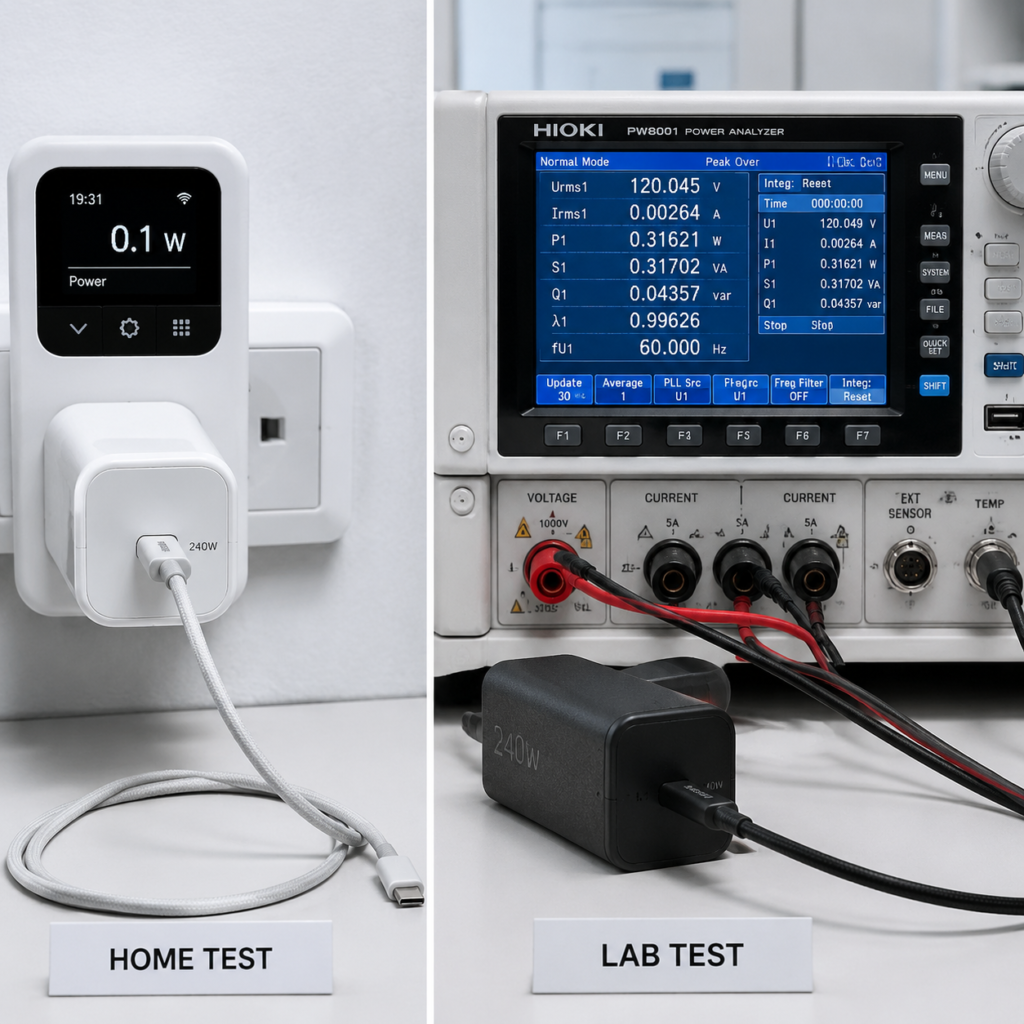
3.1 Tool Requirements
For basic at-home standby power testing, you don’t need expensive professional equipment. A household power meter or smart plug that displays active power will work.
For rough estimates of standby power levels, a device with 0.1W resolution is sufficient for reference. Note that resolution only refers to the smallest display increment of the meter, not its actual measurement accuracy. Real error depends on the device’s specifications, calibration status, and the range used. If you need to compare milliwatt-level differences between chargers, you will need a calibrated professional power analyzer; standard household devices do not have the precision for this level of comparison.
Additionally, devices that only display voltage and current cannot measure active power directly, and calculated results will have large errors—do not use them to estimate electricity costs.
3.2 Recommended Procedure
Follow these steps to improve the reliability of your at-home test results:
- Plug the power meter or smart plug into a wall outlet, confirm the device is zeroed, and select an appropriate measurement range.
- Plug the charger you want to test into the output of the power meter, and leave all of the charger’s output ports empty (no devices connected).
- Wait several minutes for the charger to enter a stable power-saving mode or periodic idle-detection state. Many chargers have startup power spikes or periodic device-check logic, so wait for the work pattern to stabilize before recording.
- Record data continuously for long enough to cover a full cycle of the charger’s periodic detection. For example, if the charger checks for a device every 10 seconds, record for at least 30 seconds to a few minutes.
- Note the average power, maximum power, and minimum power over the test period, along with the test scenario (e.g., no-load, connected to fully charged phone) and input conditions (e.g., 120V/60Hz, 230V/50Hz mains).
3.3 Result Limitations
Test results from household equipment are for personal reference only, and cannot be used as legal basis for compliance judgments. The main reasons for this are:
First, household power meters are less accurate than professional instruments. When measurements are near the meter’s lower limit, error increases significantly, so you cannot definitively declare a product pass or fail based on these results.
Second, if the meter displays 0W, do not assume the charger uses zero power. This is almost always due to the meter’s resolution being too low to detect very low power draw, not a complete absence of energy use.
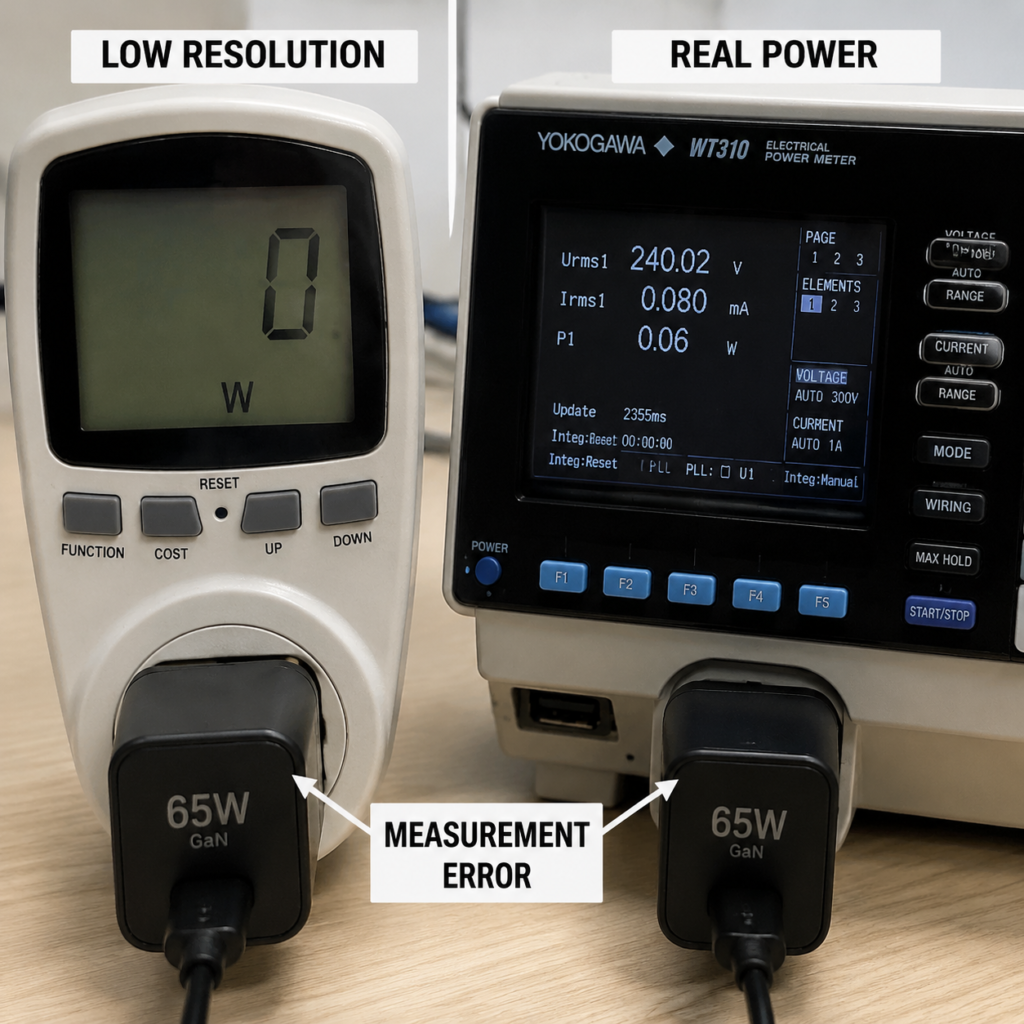
Home test results cannot replace official test reports, nor can they alone prove a product fails compliance requirements. They can, however, be used as a clue to spot abnormalities, support communication with sellers, file complaints, or request further third-party testing.
3.4 Extended Test Scenarios
In addition to the standard no-load test, you can test these more real-world extended scenarios. Results from these tests are for daily use reference only, and are not equivalent to standard-defined standby power:
- Charger connected to a fully charged phone or other device, to test full-charge maintenance power draw.
- Multi-port chargers: test all ports empty, single port connected to a fully charged device, and multiple ports connected to fully charged devices.
- Wireless chargers: test no device on the pad, fully charged phone on the pad, and foreign object detection (e.g., a coin placed on the pad).
- Fast-charge chargers supporting PD (USB Power Delivery), QC (Qualcomm Quick Charge), UFCS (Universal Fast Charging Specification), and other protocols: trigger a protocol handshake then leave the output empty, to test protocol standby power.
Professional Testing Methods
4.1 Samples and Test Environment
Professional testing starts with clear documentation of sample information, including product model, production batch, rated output power, number of test samples, and sampling basis (e.g., random sampling, submitted samples, sampling pool size).
Before testing, pre-treat samples per the requirements of the applicable standard, and control environmental temperature, humidity, input voltage, frequency, and other conditions. Note that different standards may have different requirements for temperature/humidity, warm-up time, and sampling time. When publishing test results, always state the standard name and version you are following—do not present one set of conditions as a universal requirement for all standards.
4.2 Equipment and Calibration
Professional testing requires a power analyzer that supports low-power measurement and can record average power and integrated electrical energy.
Test reports must clearly document the instrument model, accuracy class, used range, calibration status (e.g., within validity period), data sampling rate, integration time, and waveform measurement compatibility.
Since charger standby power is usually very low, and often a periodic, non-linear load, pay special attention to the instrument’s bandwidth, sampling rate, integration time, and waveform capture capability—otherwise test results may have large errors. For scenarios with distorted input waveforms, confirm the instrument’s measurement compatibility upfront.
4.3 Main Test Scenario and Procedure
The primary standard test scenario for standby power is: with AC input stable at the voltage and frequency required by the standard, and the charger’s output ports in no-load state, wait for the product to enter a stable state, then measure the average input active power.
In addition to the standard main scenario, you can set up extended test scenarios based on actual needs, such as connected fully charged devices, protocol hold, multi-port load combinations, wireless charging states, and power draw at different input voltages (e.g., 120V and 230V). Results from these extended scenarios must be labeled separately and are not equivalent to standard-defined standby power. For multi-port chargers, confirm whether the all-port no-load state qualifies as a standby test under the target regulation, based on product structure, output port definitions, and applicable regulatory clauses—do not apply judgment rules for single-output products directly.
The standard test flow is typically: Wiring check → Instrument calibration → Set input conditions → Wait for sample stabilization → Continuous sampling → Repeat measurement multiple times → Calculate average → Record measurement uncertainty.
Important emphasis: Sampling time, number of repeat measurements, environmental conditions, and pass/fail rules must be cited directly from the corresponding standard, or clearly labeled as internal enterprise/reviewer custom rules. Do not present them as universal legal requirements.
4.4 Error and Measurement Uncertainty
Professional tests cannot only provide a single numerical value; they must also evaluate measurement uncertainty. Common sources of uncertainty include: instrument accuracy error, resolution limits, zero drift, input voltage fluctuation, ambient temperature changes, and periodic power fluctuation of the product itself.
Formal professional test reports must provide expanded uncertainty and the corresponding coverage factor, in accordance with applicable measurement uncertainty evaluation standards, to ensure the rigor of results.
4.5 Retesting and Compliance Judgments
If abnormal results are found during testing, troubleshoot the cause before drawing conclusions. Common troubleshooting checks include: loose wiring, inappropriate range selection, faulty instrument, non-compliant environmental conditions, and whether the product has entered a stable standby state.
Retest rules must follow target market regulations, corresponding sampling plans, or enterprise quality specifications. Do not create custom rules like “double sampling” or “pass if deviation is under 5%” and present them as universal legal requirements.
Additionally, clearly separate single-sample test conclusions, batch quality conclusions, and regulatory compliance conclusions. A single sample’s result does not represent the quality level of an entire batch, and at-home test results cannot be used to judge regulatory compliance. Compliance judgments for different scenarios must follow corresponding regulatory requirements: testing for market supervision, mandatory certification, and similar scenarios must be conducted by qualified institutions per legal processes. The validity of testing for consumer rights, internal quality control, and other scenarios depends on the rules of the specific scenario and agreements between involved parties.
Interpreting Data and Calculating Electricity Costs
5.1 Key Metrics
When reviewing standby power test data, focus on these core metrics:
- Average active power: The most commonly used comparison metric, measuring the power draw level of a product in stable or periodic standby state.
- Cumulative electrical energy: Best for long-duration tests, such as 24-hour continuous total power use, for more accurate estimates of real-world consumption.
- Maximum and minimum power: Useful for identifying startup spikes and fluctuation range of intermittent operation modes, to help judge whether a product’s standby control strategy is reasonable.
5.2 Cost Calculation Formula
To estimate annual standby power use and electricity costs for a charger, use the following formula:
Annual energy use (kWh) = Average standby power (W) × 24 hours × 365 days ÷ 1000
Annual electricity cost = Annual energy use × Local residential electricity rate
Example: If a charger has a 0.1W standby power and is plugged in 24/7 all year, annual energy use is 0.1 × 24 × 365 ÷ 1000 = 0.876 kWh. Actual costs depend on local electricity rates and how long the charger is actually plugged in.
5.3 Judgment Principles
Follow these principles when interpreting test data to avoid incorrect conclusions:
First, confirm the test scenario, input conditions, product power segment, and corresponding regulation version. When these conditions differ, limit requirements will also differ, so direct comparison is not valid.
Second, test data from different input voltages, power segments, or load states cannot be compared side by side. For example, no-load power of a 20W charger vs. a 65W charger, or results at 120V vs. 230V, are not directly comparable.
Third, at-home test and third-party review results are for reference only. Formal compliance determinations require official test reports from institutions with corresponding qualifications, tested per applicable standards.
Factors That Affect Standby Power
Many people assume higher-power chargers always have higher standby power, or that GaN chargers are always more efficient than silicon-based chargers. In reality, standby power is affected by multiple factors:
First, core product design: power topology, presence of a dedicated standby control chip, and feedback circuit design are the core drivers of standby power.
Second, feature configuration: more ports mean more protocol chips, indicator lights, displays, and other auxiliary components, which usually increase standby power. Products with wireless modules or multi-protocol fast-charge chips also have higher standby draw.
Third, usage environment and state: input voltage, ambient temperature, load state, and product age can all affect standby power. The direction and magnitude of change depend on the charger’s power topology and control strategy, so controlled variable testing is needed to confirm. Connecting a fully charged device or maintaining a protocol handshake may result in higher or different power than pure no-load, depending on the charger’s output control logic and the device’s leakage current and trickle charge needs; aging can also cause standby power to fluctuate.
Fourth, test-related factors: instrument accuracy, sampling duration, grid fluctuation, and wiring method can all cause differences in test results.
Special note: GaN, SiC, and other new power devices have inherent efficiency advantages, but this does not mean chargers using these components will always have lower standby power. Final performance depends on overall system design and optimization—some high-end multi-port GaN chargers have higher standby power than simple 20W silicon-based chargers.
Buying and Energy-Saving Tips
7.1 Buying Tips
If you want a charger with low standby power, keep these tips in mind when shopping:
First, choose reputable brand products with complete safety and energy efficiency certifications. If the product clearly lists its no-load power and corresponding test conditions, it has higher parameter transparency and is more reliable as a reference.
Second, don’t chase unnecessarily high power or extra ports—buy what fits your actual needs. For example, if you only charge a phone, you don’t need a 100W four-port charger. Higher power and more ports mean higher upfront cost and usually higher standby power.
Third, advertised standby power and efficiency numbers can be a reference, but do not treat them as official compliance conclusions. Independent third-party test data is more reliable.
7.2 Usage Tips
In daily use, follow these tips to reduce standby power use and safety risks:
- Unplug chargers or turn off the power strip switch when you won’t use them for a long time—this is the most direct way to save energy.
- If a charger feels unusually hot when plugged in with no load, smells strange, has discolored casing, or test results show much higher power than when it was new, stop using it and replace it promptly.
- Disconnect car chargers when the vehicle will be parked for a long time, to avoid draining the car battery.
Safety, Lifespan, and Environmental Impact
8.1 Standby Power and Safety
Many people think high standby power means a charger is unsafe, but there is no direct link between the two. Qualified products that pass safety standard tests meet the requirements of those standards, but that does not mean they are risk-free in all usage scenarios, environments, or aging states. Conversely, a low-quality product could have low standby power but still pose shock or fire risks due to poor insulation or flame retardancy.
If a charger’s standby power is consistently abnormally high and accompanied by heat, strange smells, or other issues, stop using it immediately. Product safety must be judged comprehensively across insulation, temperature rise, voltage withstand, flame retardancy, protection functions, and other items—you cannot judge safety solely by standby power.
8.2 Long-Term Plug-In Use
Many people worry that leaving chargers plugged in long-term will damage them or cause danger. Chargers with safety certification are usually designed for reliable long-term use under normal conditions, but they are not suitable for unattended long-term use in all environments. Follow the official product manual guidance for long-term plug-in use, and consider your usage environment and product age.
High temperature, high humidity, frequent voltage surges, or already aged products will experience faster component degradation, shorter lifespan, and even safety risks when left plugged in long-term. For rarely used or poorly conditioned chargers, we recommend unplugging them for storage, and replacing them promptly if they are in bad shape.
8.3 Environmental Benefits
Reducing charger standby power not only saves money on electricity bills, but also cuts carbon emissions, which has clear environmental value.
Some people think 0.1W of power is negligible, but it adds up quickly: if every charger’s standby power drops by 0.1W, 100 chargers running 24/7 for a year would save about 87.6 kWh of electricity. Actual emission reductions depend on the local grid’s emission factor, which varies by region.
Note: Do not trust unsourced claims about the share of global household electricity use from standby power. If you cite such data, verify the authoritative source and statistical scope first.
FAQ and Appendices
9.1 Frequently Asked Questions
- My charger shows 0W on the meter—does that mean it uses no power at all?
A 0W reading almost never means actual zero input power. It is far more likely the power draw is below the meter’s resolution limit, so the device cannot display it. To confirm very low power levels, you will need a higher-precision professional measurement tool. - Can a 0.1W-resolution household power meter tell the difference between chargers at the milliwatt level?
No. Resolution only refers to the smallest display increment on the meter, not its actual measurement accuracy. Real error depends on the meter’s specifications, used range, and calibration status. When measurements are near the meter’s lower limit, results only give a rough trend, and cannot distinguish milliwatt-level differences. For precise comparisons, you must use a calibrated professional power analyzer. - Why is power draw different between no-load and when a fully charged device is connected?
In no-load state, the charger only needs to power its own standby circuits. When a fully charged device is connected, the charger also has to maintain protocol communication with the device and keep output voltage steady, and some devices draw small trickle charges to top up. That means power draw may be higher or different from pure no-load, depending on the charger’s protocol maintenance strategy, output control logic, and the device’s leakage current and trickle charge needs. This is a normal difference between scenarios. - What power segment does a 65W charger fall into?
Per GB 20943-2023’s segmentation rules for single-output external power supplies, rated output power >20W and ≤65W falls into the middle power segment, so 65W is right at the upper limit of that segment. Check the standard’s corresponding clauses for specific limits. Power segment classification for multi-port chargers depends on product structure and applicable regulations. - If a fast-charge protocol is triggered but the output is still empty, is that considered standby?
This is an extended test scenario. Whether it counts as “standby” under a given regulation or standard depends on that standard’s term definitions and test conditions. It is not the standard no-load standby scenario, so test results must be labeled separately and cannot be compared directly with pure no-load results. - Are GaN chargers always more energy-efficient than traditional silicon chargers?
Not necessarily. GaN components have lower switching losses on their own, but final standby power depends on the whole product’s design. For example, a multi-port GaN charger may have higher standby power than a single-port 20W traditional silicon charger, because it has more ports and more protocol chips. - How do you test standby power for multi-port chargers?
Multi-port charger standby testing needs to be done per scenario: test all ports empty, single port with load, multiple ports with load, etc., and clearly record each scenario. Don’t test just one state and claim it represents all cases. Whether the all-port no-load test result can be compared to corresponding standard limits depends on product structure, output port definitions, and the target regulation’s scope—don’t apply rules for single-output products directly. - Can home test results be used for complaints or as compliance proof?
Home test results cannot replace official test reports, and cannot alone prove a product fails compliance requirements. But they can be used as a clue to spot abnormalities, support communication with sellers, file complaints, or request third-party authoritative testing. For market regulatory complaints or legal evidence, you will need to submit official test reports from qualified institutions per relevant rules.
9.2 Appendices
Appendix 1: Home Standby Power Test Record Sheet
| Product Model | Rated Power | Test Scenario | Input Voltage (V) | Input Frequency (Hz) | Meter Model | Average Power (W) | Max Power (W) | Min Power (W) | Cumulative Energy (Wh) | Ambient Temp (°C) | Sampling Period | Fluctuation Notes | Test Duration | Remarks |
|---|---|---|---|---|---|---|---|---|---|---|---|---|---|---|
Appendix 2: Annual Electricity Cost Reference Table
Calculations assume 24/7 plug-in use. Rates are example values; actual costs vary by location.
| Standby Power (W) | Annual Energy Use (kWh) | Annual Cost (at $0.15/kWh) | Annual Cost (at $0.30/kWh) | Annual Cost (at $0.45/kWh) |
|---|---|---|---|---|
| 0.05 | 0.438 | $0.07 | $0.13 | $0.20 |
| 0.1 | 0.876 | $0.13 | $0.26 | $0.39 |
| 0.3 | 2.628 | $0.39 | $0.79 | $1.18 |
| 0.5 | 4.38 | $0.66 | $1.31 | $1.97 |
| 1 | 8.76 | $1.31 | $2.63 | $3.94 |
Appendix 3: Required Fields for Professional Test Reports
A professional standby power test report must include at minimum the following information:
- Sample information: model, batch, rated parameters, sampling basis, number of samples
- Test environment: temperature, humidity, input voltage, input frequency, input waveform requirements
- Test equipment: model, accuracy class, used range, calibration status, sampling rate, integration time, energy measurement method
- Test details: test scenario, sampling parameters, retest rule basis
- Test results: average power, maximum power, minimum power, cumulative energy, expanded uncertainty and coverage factor
- Judgment information: judgment basis, conclusion type (single-sample / batch / compliance), test date, tester name
Appendix 4: Official Standard Lookup Channels
- Chinese national standards: National Standardization Administration of China official website, National Public Service Platform for Standards Information
- International standards: IEC official website
- EU regulations: EUR-Lex official website
- U.S. regulations: U.S. Department of Energy (DoE) official website, California Energy Commission (CEC) official website, Energy Star official website
Charger standby power testing can be as simple or as rigorous as you need it to be. A quick check with a home smart plug takes just a few minutes, and is more than enough for regular users to spot abnormalities and estimate electricity costs. Professional compliance testing, by contrast, requires strict environmental controls and measurement uncertainty evaluation to produce rigorous, defensible conclusions.
For home users, simply getting in the habit of unplugging chargers when not in use is an easy, effective way to cut standby power use and reduce safety risks. For product compliance or quality judgment scenarios, always refer to the current valid standards for your target market, combined with product scope and official test reports—never draw arbitrary conclusions based solely on self-test results.