
Introduction
If you’ve ever packed your go-to charger for an international trip, you may have noticed that it does not always perform exactly the same as it does at home. The plug might fit, but fast charging doesn’t activate, or the rated wattage printed on the label doesn’t match the version sold in your destination country.
These are extremely common questions for travelers:
- Why do US and European versions of the same charger have different output specs?
- Why does fast charging work perfectly in one country but not another?
- The plug fits fine, so why won’t full-speed charging activate?
- Can I use a charger bought in the US directly in Europe?
- Do I need a voltage converter for travel, or just a plug adapter?
Key Takeaways at a Glance
Regional differences in charger output and performance are almost never a sign of poor build quality. They stem from five core factors: local grid standards, safety and efficiency regulations, fast charging ecosystem differences, brand regional product strategy, and multi-port power sharing logic.
For most travelers:
- A genuine 100–240V wide-voltage charger will not damage your devices, even if real-world output varies slightly.
- True global compatibility rests on three pillars: 100–240V wide input, USB PD/PPS universal fast charging, and a properly rated USB-C cable.
What This Article Covers
We break down three central questions:
- Why does the same charger deliver different real-world performance in different countries?
- Why do manufacturers sell different regional versions of the same charger model?
- How do you pick a truly universal international travel charger that works reliably everywhere?
1. What Actually Determines Charging Speed?
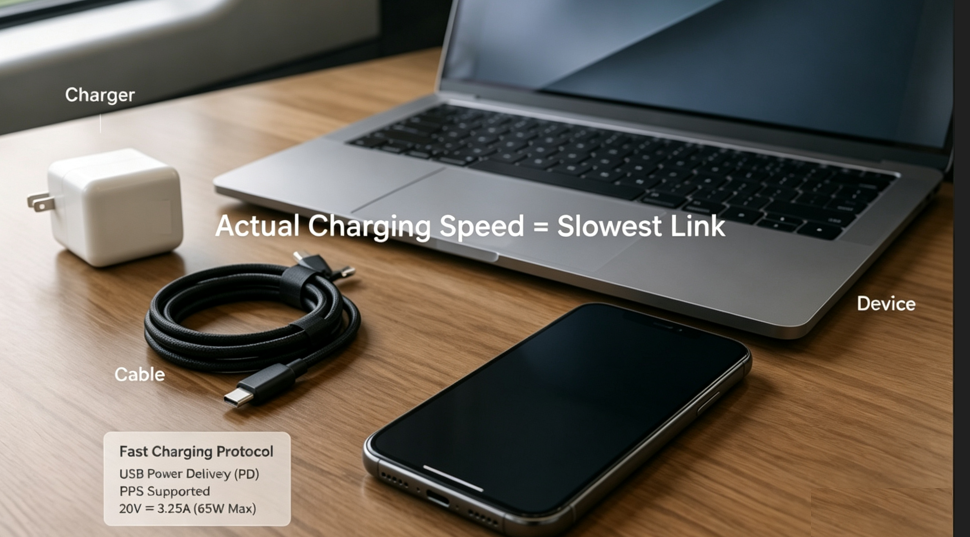
Before diving into regional differences, it’s critical to understand that charging speed is never decided by the charger alone. It’s a full system with multiple limiting factors.
5 Core Pieces of the Charging Puzzle
- Output Voltage: The voltage delivered to your device, most commonly 5V, 9V, 12V, 15V, or 20V for USB-C.
- Output Current: Measured in amps (A), paired with voltage to determine total power delivery.
- Rated Power: Calculated as
Power = Voltage × Current, measured in watts (W). This is the number most people associate with charging speed. - Fast Charging Protocol: The “shared language” the charger and device use to negotiate power levels safely.
- Cable Rating: The cable sets its own current limit, which can cap total power even if the charger is capable of more.
3 Easy-to-Confuse Concepts
Most charging myths come from mixing up these three separate systems:
- Mains input ≠ USB output: Wall voltage and frequency describe power going into the charger, not power coming out to your device.
- Plug fit ≠ fast charging compatibility: A plug that fits the socket only guarantees physical connection — it says nothing about power or protocol support.
- Wide-voltage input ≠ full power everywhere: A 100–240V label means the charger will work safely worldwide, but may not always hit its maximum rated wattage at very low input voltages.
The “Weakest Link” Rule
Real charging speed follows a simple rule: the slowest component in the chain sets the maximum speed.
plaintext
Charger + Cable + Device + Fast Charging Protocol = Actual Charging Speed
Even a 100W charger won’t charge a 25W phone any faster than 25W.
2. Does Wall Voltage Change Charger Output?
The world runs on two primary voltage systems, and this is the most well-known source of regional charging differences — but its impact is often overstated.
Global Voltage & Frequency Reference Chart
| Country / Region | Standard Voltage | Line Frequency | Common Plug Type |
|---|---|---|---|
| United States / Canada | 120V | 60Hz | Type A / B |
| Japan | 100V | 50Hz / 60Hz (varies by region) | Type A / B |
| Taiwan | 110V | 60Hz | Type A / B |
| European Union | 230V | 50Hz | Type C / F |
| United Kingdom | 230V | 50Hz | Type G |
| Mainland China | 220V | 50Hz | Type A / C / I |
| Australia / New Zealand | 230V | 50Hz | Type I |
How Input Voltage Relates to Output Power
Chargers do not create electricity — they convert it. The real-world formula is:
plaintext
Output Power = Input Power × Conversion Efficiency
A small amount of energy is always lost as heat during conversion. For a given output power, a lower input voltage means higher input current inside the charger, which creates more heat and pushes components closer to their limits.
How much this actually affects you depends entirely on the charger’s design:
- 65W and below: Nearly all modern wide-voltage chargers deliver full rated power across 100–240V. Most users will notice zero difference between 120V and 230V.
- High-power models: Some poorly optimized high-wattage designs may reduce maximum output under lower input voltage conditions due to component current limits, thermal constraints, or safety margins.
- Ultra-high-power 140W / 240W PD 3.1 EPR: These designs are more likely to have low-voltage power limiting strategies.
Important clarification: Whether power reduction occurs depends on the charger architecture, component selection, thermal design, and manufacturer specifications. Many premium models maintain full output across the entire input range.
240W note: A 240W label alone does not guarantee 240W charging. The charger, cable, and device must all support USB PD EPR to reach the full rating.
Does 50Hz vs 60Hz Matter?
For modern USB chargers with switching power supply (SMPS) design — almost no effect at all.
Modern chargers run internally at tens of thousands of hertz, so 50Hz vs 60Hz wall frequency is handled automatically. You may see a tiny difference in idle power draw, but nothing noticeable to the user.
Only very old linear transformer chargers or motor-driven appliances are meaningfully affected by line frequency.
Wide-Voltage vs Single-Voltage Chargers
- Wide-voltage chargers are labeled
INPUT: 100-240V~ 50/60Hz. They automatically adapt to any mains system on Earth, and are the only type recommended for international travel. - Single-voltage chargers are built for one region only (e.g., 120V only). Plugging a 120V-only charger into a 230V socket can destroy it instantly and pose a fire risk. Never take single-voltage chargers abroad.
Why GaN Is Common in High-End Travel Chargers
Gallium Nitride (GaN) power devices have lower switching losses than traditional silicon MOSFETs, allowing designers to achieve higher efficiency, less heat, and more compact builds.
GaN does not automatically make a charger globally compatible, but its efficiency and power density make it easier for manufacturers to build compact high-power chargers with wide input ranges. Many premium worldwide voltage chargers use GaN technology for this reason.
Grid Quality Matters Too
In regions with unstable or fluctuating mains voltage, many chargers will automatically reduce output power slightly to protect themselves and extend lifespan.
3. Why Does the Same Charger Have Different Country Versions?
If you compare the US, EU, and Japanese versions of the “same” charger model, you will often find small but noticeable differences. This is not random — there are five clear reasons.
| Difference | What You See | Why It Happens |
|---|---|---|
| Plug shape | Flat US blades, round EU pins, square UK pins | Local socket physical standards |
| Input rating label | Different printed input current values | Local certification and grid labeling conventions |
| Output voltage steps | Slightly different PDO (power delivery object) lists | Market positioning, certification, and efficiency tradeoffs |
| In-box accessories | Included cable type, wattage, or extra adapters | Regional sales and marketing strategy |
| Protocol support | More or less support for proprietary fast-charge modes | Local device ecosystem popularity |
Safety Certifications Drive Design Differences
Certifications never directly mandate a maximum wattage, but they set ground rules for safety that indirectly influence the maximum stable output a product can deliver.
The four most important global certifications:
- UL (US / Canada): The most widely accepted safety certification in North America, governing fire risk, electrical insulation, and temperature limits.
- FCC (US): Mandatory electromagnetic compatibility rules that limit radio interference from electronic devices.
- CE (EU / EEA): A mandatory compliance mark indicating the product meets EU safety, EMC, and environmental requirements.
- PSE (Japan): Mandatory electrical appliance safety certification, with stricter “diamond PSE” requirements for AC adapters.
To meet these standards, manufacturers adjust their circuit designs, component choices, and cooling systems — all of which shape the final output characteristics of each regional variant.
Energy Efficiency Rules Also Play a Role
Global efficiency regulations like US DoE Level VI, EU ErP, and California CEC mostly target idle and low-load power draw, not peak fast-charging speed. To meet these rules, brands may fine-tune output curves at light loads, but peak charging wattage usually stays unchanged.
4. Why Fast Charging Sometimes Fails Abroad
The single biggest reason travelers experience “slow charging” is not voltage — it’s a protocol mismatch. Think of charging protocols like languages: some are universal, some are regional dialects.
USB PD / PPS: The Global Standard
USB Power Delivery (USB PD) is the closest thing to a worldwide fast charging language. It supports standard voltage steps (5V, 9V, 12V, 15V, 20V) and the latest PD 3.1 EPR reaches up to 240W.
Programmable Power Supply (PPS) adds fine-grained voltage adjustment for cooler, more efficient charging.
Many flagship smartphones from Apple, Google, Samsung, and other manufacturers support USB PD and PPS, giving the standard very high global penetration.
Proprietary Protocols: Regional “Dialects”
Many brands use their own exclusive charging systems that only work reliably with first-party chargers and cables:
- Some smartphone brands popular in Asian markets use proprietary high-speed charging systems such as SuperVOOC, SuperCharge, and HyperCharge.
- Other regional brand-specific protocols, like Samsung AFC and MediaTek PE, appear on local device lineups.
When you use a generic PD charger on a phone built for a proprietary system, you often drop to basic PD speeds — sometimes from 65W down to 18–30W. This is the #1 cause of “my charger is slower abroad” complaints, even when the charger itself is fully functional.
The Hidden Bottleneck: USB-C Cable Rating
Cables are the most overlooked link in the charging chain, and they absolutely cause output differences when travelers pack the wrong cord.
Per USB-IF specification:
- Up to 60W (20V / 3A): Standard 3A USB-C cables work fine, no special chip needed.
- Above 60W: Requires a 5A cable with an E-Marker chip — a tiny chip inside the plug that tells the charger the cable can safely carry higher current. Without it, USB PD systems limit current to 3A (60W max at 20V).
- For PD 3.1 EPR (up to 240W): The charger, cable, and device must all support EPR to reach the full power rating.
This is an extremely common travel pitfall: you bring a 100W charger, but pack a basic 60W cable, and wonder why your laptop only charges at 60W.
Device-Side Power Limits
Your device sets the absolute upper ceiling. A 100W charger paired with a 25W phone will never charge faster than 25W — the phone simply won’t ask for more power than it can safely handle.
Policy Push Toward Global Standardization
The EU’s USB-C common charger rules have already mandated USB-C for phones, tablets, and cameras as of late 2024, with laptops following in 2026. Future EU regulations are expected to further encourage USB-C and USB PD interoperability for external power supplies, steadily reducing fragmentation and improving cross-region compatibility.
5. Why Multi-Port Chargers Behave Differently
If you use a multi-port travel charger, you may notice output changes that have nothing to do with the country you’re in — they come down to how the charger shares power.
Dynamic Power Sharing Explained
Nearly all multi-port chargers use dynamic power allocation. For example, a 100W dual-port charger may deliver:
- Single device connected: 100W full power on the active port
- Two devices connected: 65W + 35W split across both ports
This means your laptop may charge at 100W when it’s the only device plugged in, but drop to 65W when you also plug in your phone. Travelers often notice this mid-trip and mistake it for a voltage issue.
Regional Firmware Differences
Some charger models have slightly different power allocation logic in different regional firmware versions. Peak single-port power, total power, and split ratios can all vary by market variant.
Thermal Management
In hotter climates, multi-port chargers may also reduce total output slightly to keep temperatures within safe limits, especially when all ports are running at high power.
6. How to Choose a True Global Travel Charger
How to Check If Your Charger Is World-Compatible
Flip any charger over and look at the specification label. The most important line is the INPUT line:
plaintext
✅ Good Example:
INPUT: 100-240V~ 50/60Hz 1.5A
OUTPUT:
USB-C PD
5V⎓3A / 9V⎓3A / 12V⎓3A
15V⎓3A / 20V⎓3.25A (Max 65W)
If you see 100-240V~ 50/60Hz, the charger is designed for global use.
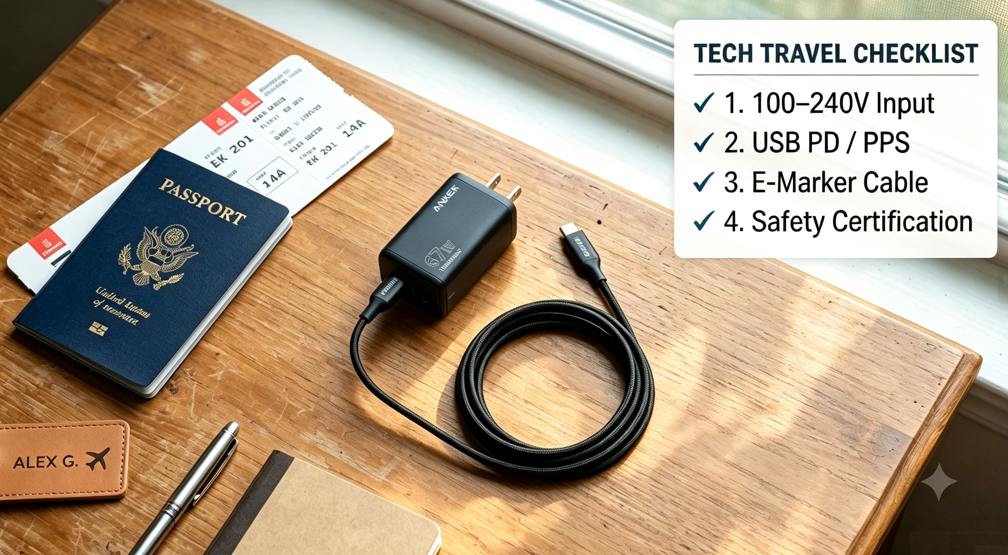
4 Steps to Pick a Great International Travel Charger
- Check the input range: Insist on
100-240V~ 50/60Hz. Anything less stays home. - Prioritize USB PD / PPS: Chargers built around the universal PD standard work with the broadest set of devices worldwide.
- Verify full-voltage power rating: Check the manufacturer’s datasheet to confirm rated power is maintained across the full input range.
- Match certifications to your destinations: Look for UL for North America, CE for Europe, PSE for Japan.
Cable Matching Guide
- Phones and small devices: Basic USB-C cable is sufficient.
- 65W–100W laptops: You need a 5A E-Marker USB-C cable.
- 100W+ ultra-fast charging: Verify the cable’s power rating matches your charger and device.
Ideal Travel Charging Kit
- 1× multi-port wide-voltage charger with at least one 65W+ USB-C PD port
- 1–2× E-Marker 5A USB-C cables matched to your device power needs
- 1× plug adapter set for your destination countries
7. Travel Adapter vs Voltage Converter
This is the travel charging mistake. The two accessories are completely different.
| Accessory | What It Does | Use Case |
|---|---|---|
| Travel plug adapter | Only changes the physical shape of the plug. Does NOT change voltage, current, or power. | All wide-voltage electronics — phones, laptops, tablets. This is the only accessory most travelers need. |
| Voltage converter | Actually steps wall voltage up or down (120V ↔ 230V). | Only for non-wide-voltage high-power appliances like some hair dryers or irons. |
Note: Voltage converters are usually unnecessary for modern USB devices and may introduce additional complexity or compatibility issues. Stick to plug adapters for all phones, laptops, and power banks.
Tips for Use Abroad
- Avoid extended full-power charging in areas with known unstable grids.
- In very hot environments, reduce the number of devices charging at maximum power at the same time.
8. Common Charging Myths, Debunked
| Myth | Fact |
|---|---|
| If the plug fits, the power is the same. | The plug is just physical contact. Output wattage, protocols, and safety behavior can differ widely. |
| “Worldwide” means identical power at every voltage. | Some products only guarantee safe operation across voltages, not full rated power at the low end. |
| Travel adapters slow down charging. | Adapters only change plug shape. They do not alter voltage, current, or protocol. |
| A small voltage difference will burn out my device. | All modern devices have built-in power management chips and tolerate normal output variation. |
| More watts = better global compatibility. | Compatibility depends on input range and protocol support. A high-wattage charger with poor low-voltage optimization can derate more than a lower-wattage one. |
| Different regional versions mean different quality. | Differences usually come from regulations, market positioning, and environmental tuning — not build quality. |
| If the charger is 100W, my device will charge at 100W. | Speed is limited by the cable, the device’s own max charge rate, and the protocol handshake. |
Frequently Asked Questions (FAQ)
Q1: Is charging always slower in 110V countries than 220V countries?
No. For 65W and lower chargers — the most common category — nearly all modern wide-voltage models deliver full rated power at both 110V and 230V. Only some poorly optimized high-wattage designs may see mild derating at low input voltages, and the difference is often too small for most users to notice.
Q2: Is it safe to mix charger versions from different countries?
Yes, as long as it’s a genuine wide-voltage model and the output connector and protocol match your device. Regional variants differ mainly in plug shape, certification, and minor power tuning — core safety standards are equivalent. They will not damage your equipment.
Q3: Can regional output differences damage my phone or laptop?
No, not from a legitimate certified wide-voltage charger. All modern devices have built-in power management ICs that negotiate voltage and current with the charger, and they only draw what they can safely handle. Damage risk only exists with single-voltage chargers used on the wrong grid, or with uncertified no-name products.
Q4: Why do US, EU, and Japanese versions of the same charger have different specs?
It’s the combined effect of four factors: different local grid conditions, separate safety and efficiency certification requirements, regional device ecosystems and protocols, and brand market positioning. Manufacturers optimize each regional variant for its intended market, rather than making one identical global design.
Q5: Does total output change on multi-port chargers in different countries?
Fully optimized models maintain the same total power worldwide. Some designs may see slightly reduced single-port peak power at very low input voltages, but total power often stays close. Power-split ratios between ports can also vary slightly by firmware version.
Q6: Do I need a voltage converter for international travel?
Almost certainly not. Phones, tablets, laptops, power banks, and nearly all modern personal electronics use 100–240V wide-voltage chargers. You only need a simple plug adapter. Voltage converters are only for high-power appliances without wide-voltage support, like some hair tools.
Q7: Why does my 100W charger only charge my laptop at 65W?
Three common causes, in order of likelihood:
- Your laptop only supports 65W charging max.
- You’re using a standard 3A cable without an E-Marker chip, which caps PD power at 60W.
- You’re charging multiple devices at once on a multi-port charger, and power is being shared.
Q8: Does a travel adapter reduce charging speed?
No. A properly made travel adapter is just a physical socket adapter. It does not change voltage, current, or protocol communication. It has no measurable effect on charging speed.
Q9: Can I use a US charger directly in Europe?
If the charger label says 100-240V~ 50/60Hz, yes — you just need a plug adapter. If it only says 120V, do not use it in 230V European sockets.
Q10: Does 50Hz vs 60Hz affect charger lifespan?
No. Modern switching chargers handle both frequencies automatically and operate nearly identically. There is no meaningful impact on reliability or longevity.
Q11: Why does the same charger model show different wattage labels in different countries?
This usually comes down to local certification labeling rules, input current rating conventions, and regional marketing specifications. The core hardware is often very similar, but printed ratings are adjusted to match local standards and testing methods.
Summary & Future Outlook
The 5 Core Reasons for Regional Charger Differences
| Factor | How It Shapes Output & Performance |
|---|---|
| Grid infrastructure | Voltage and frequency set input design constraints; some high-power models may derate at low voltage |
| Regulations & certifications | Safety and efficiency rules influence component choice and thermal limits, indirectly capping stable output and creating regional variants |
| Charging ecosystem | Universal vs proprietary protocols create major real-world speed differences; cable ratings are a common hidden bottleneck |
| Brand regional strategy | Market demand, cost tiers, and climate adaptation lead to different regional product versions |
| Multi-port power sharing | Dynamic allocation changes real-world per-port output, often mistaken for voltage-related issues |
3 Rules for True Global Compatibility
- Foundation: 100–240V wide-voltage input
- Performance: USB PD / PPS universal fast charging
- Detail: Properly rated charging cable matched to your power level
Quick Pre-Trip Checklist
- Verify your charger has 100–240V input on the label.
- Confirm your charger, cable, and device all support matching fast charging protocols.
- Pack the correct plug adapters for your destination.
The Future: Steadily More Unified
- USB-C + USB PD is steadily erasing regional charging fragmentation, driven by regulation and industry alignment.
- GaN technology is making high-power, full-range worldwide chargers smaller, cooler, and more affordable.