
Introduction: Why Travel Charging Always Causes Headaches
Picture this: You land in a foreign city after a long flight, drag your luggage to the hotel room, and reach for your phone charger—only to find it won’t fit the wall socket. Or worse: you force it in with an adapter, flip the switch, and your device goes dark forever.
If you’ve ever faced this frustration, you’re not alone. Global power systems evolved independently over more than a century, leaving travelers with a patchwork of plug shapes, voltages, and frequencies to navigate.
Charging compatibility works on three core levels:
- Physical compatibility: Does your plug physically fit the local socket?
- Electrical compatibility: Does the local voltage and frequency match your device’s requirements?
- Power compatibility: Can the socket and adapter safely handle your device’s wattage and grounding needs?
This guide breaks down every major plug standard, clears up the most common myths, and shows you exactly what gear you need to charge safely anywhere in the world.
Quick Summary: 30-Second Travel Charging Rules
Before we dive into the details, here’s what you need to remember:
- International plug types are commonly identified using the IEC TR 60083 reference system, which classifies national plug standards from Type A to Type O.
- For most international travelers, understanding six major plug families covers the vast majority of common destinations: Type A/B (Americas/Japan), Type C/E/F (mainland Europe), Type G (UK & former British territories), and Type I (China/Australasia).
- The world runs on two dominant voltage blocks: 100–127V (Americas, Japan) and 220–240V (Europe, Asia, Africa, Oceania), with notable exceptions in some countries.
- Most modern USB-C PD and GaN chargers from reputable manufacturers support 100–240V ~ 50/60Hz wide-range input.
- Best travel combo: A wide-voltage USB-C PD/GaN charger + a certified plug adapter = all you need for most trips.
Why Don’t We Have a Single Global Plug Standard?
A Century of Independent Evolution
The mess of global plugs isn’t an accident—it’s a product of history. In the late 1800s, countries built their power grids separately with different priorities:
- North America settled on 110–120V for early consumer safety, paired with 60Hz frequency.
- Europe chose 220–240V for more efficient long-distance power transmission, paired with 50Hz.
As each region designed plugs to match its own grid, standards became locked in. Replacing every wall socket and appliance in a country would cost billions, so the systems stayed. Today roughly 15 major household plug types remain in active use worldwide.
The IEC 60083 Reference System
To bring order to the chaos, the International Electrotechnical Commission (IEC) published IEC TR 60083:2015, a technical report that provides standardized references for plugs and socket-outlets used in different countries.
This is not a mandatory global standard—countries still enforce their own local regulations—but it gives travelers and manufacturers a universal language to describe plug shapes.
3 Quick Ways to Identify Any Plug
You can categorize any plug in seconds using three traits:
- Pin shape: Flat blades, round pins, or rectangular pins
- Grounding: 2-pin (no ground) or 3-pin (with protective earth)
- Current rating: Determines the maximum safe power load
Major Plug Types Around the World
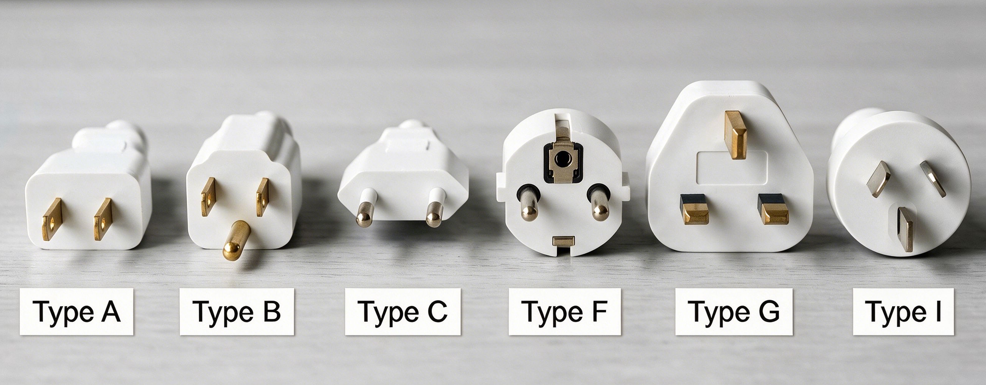
Type A & Type B: North America & Japan
Type A (2 flat parallel pins, ungrounded)
- Design: Two narrow flat blades, no ground pin. Some versions have one wider blade for polarity.
- Used in: United States, Canada, Mexico, Japan, Taiwan, and most of the Caribbean
- Typical voltage: 100–127V
- Travel tip: Only safe for low-power devices like phone chargers. No grounding means higher risk for laptops and other higher-power devices.
Type B (2 flat pins + round ground pin)
- Design: Same flat blades as Type A, plus a round grounding pin below them.
- Used in: United States, Canada (standard for modern buildings)
- Typical voltage: 120V / 60Hz
- Travel tip: Type A plugs fit into Type B sockets (but lose grounding).Grounded Type B connections are preferred for devices that require protective earth, especially some higher-power equipment.
Type C, E & F: Mainland Europe
Type C (Europlug, 2 round pins, ungrounded)
- Design: Two small 4mm round pins, slim and compact.
- Used in: Most of continental Europe, plus South Korea, large parts of South America, Africa, and Asia
- Typical voltage: 220–230V / 50Hz
- Travel tip: One of the most widely used low-power plug designs worldwide. It fits many European socket types, but compatibility depends on socket design and local regulations, and it provides no grounding.
Type E (French standard, socket-mounted ground pin)
- Design: Two 4.8mm round pins; grounding comes from a protruding pin inside the socket (not on the plug itself).
- Used in: France, Belgium, Poland, Czechia, Slovakia
- Travel tip: Type C plugs work here without grounding. While Type E and Type F plugs often fit each other’s sockets mechanically, full grounding reliability depends on the specific socket design.
Type F (Schuko, side-clip grounding)
- Design: Two 4.8mm round pins; grounding is done by two metal clips on the sides of the plug body. Schuko is short for the German Schutzkontakt, meaning “protective contact.”
- Used in: Germany, Austria, Spain, Netherlands, Portugal, Russia, and most of Eastern Europe
- Typical voltage: 230V / 50Hz, rated 16A
- Travel tip: The standard for high-power devices in Europe. Reliable grounding makes it ideal for laptop chargers.
Type G: The British Standard Safety-Focused Plug
- Design: Three thick rectangular pins arranged in a triangle. Every plug contains a built-in fuse, and sockets have shutters to prevent electric shock.
- Standard: Defined by BS 1363; fuses follow BS 1362, typically rated 3A, 5A, 10A, or 13A depending on the device.
- Used in: United Kingdom, Ireland, Singapore, Malaysia, Hong Kong, UAE, and many other former British territories
- Typical voltage: 230V / 50Hz
- Travel tip: Often considered one of the safest household plug designs because of its fuse protection and shuttered sockets. Cannot be forced into other socket types.
Type I: Australia, New Zealand & China-Style Flat Pin Plug
- Design: Two flat blades angled in an inverted V shape, available in both 2-pin ungrounded and 3-pin grounded versions.
- Used in: Australia, New Zealand, China, Argentina, Fiji
- Typical voltage: 220–230V / 50Hz; common ratings are 10A and 15A
- Travel tip: China follows its own national GB 2099 standard, which shares a nearly identical physical form factor with the Type I family. Note that wiring polarity may differ between regions, and a 10A plug fits a 15A socket, but not the other way around.
Less Common Plug Types (Quick Reference)
| Type | Found mostly in | Travel note |
|---|---|---|
| Type D | India, Nepal, Sri Lanka | Large 3-round-pin old British design; adapters are hard to find locally |
| Type H | Israel, Palestinian territories | Unique V-shape; newer sockets accept Type C plugs |
| Type J | Switzerland, Liechtenstein | Compact 3-round-pin; Type C fits but has no ground |
| Type K | Denmark, Greenland | Distinctive half-round ground hole; Type C works ungrounded |
| Type L | Italy, Chile, Uruguay | 3 round pins in a straight line; 10A and 16A versions have different hole sizes |
| Type M | South Africa, Eswatini, Lesotho | Heavy-duty 3-round-pin; looks like an oversized Type D but is not compatible |
| Type N | Brazil, new South African standard | Based on the IEC 60906-1 recommended plug design; similar to Type J but with different pin spacing |
How to Identify a Plug in 10 Seconds
You don’t need to memorize every letter. Use this visual cheat sheet:
- Two flat parallel blades → Type A (North America / Japan)
- Two flat blades + one round pin below → Type B (North America grounded)
- Two small round pins → Type C (Europe / most of the world, ungrounded)
- Two thick round pins + side ground clips → Type F (Schuko, Germany / Central Europe)
- Three thick rectangular pins in a triangle → Type G (UK / Hong Kong / Singapore)
- Two angled flat blades in a V shape → Type I family (Australia / China)
Country-by-Country Plug & Voltage Quick Lookup
North America
| Country | Plug Types | Voltage | Frequency | What you need |
|---|---|---|---|---|
| United States | A / B | 120V | 60Hz | Wide-voltage charger works directly; European devices need an adapter |
| Canada | A / B | 120V | 60Hz | Same as USA |
| Mexico | A / B | 127V | 60Hz | Same as USA |
Europe
| Country | Plug Types | Voltage | Frequency | What you need |
|---|---|---|---|---|
| United Kingdom | G | 230V | 50Hz | Type G adapter required |
| Germany | C / F | 230V | 50Hz | Type C/F adapter; ground for laptops |
| France | C / E | 230V | 50Hz | Type C works for small devices |
| Switzerland | J | 230V | 50Hz | Type J adapter for grounded use |
| Italy | L / C | 230V | 50Hz | Type L adapter recommended |
Asia & Oceania
| Country | Plug Types | Voltage | Frequency | What you need |
|---|---|---|---|---|
| Japan | A / B | 100V | 50Hz (east) / 60Hz (west) | US plugs fit; confirm your device handles 100V |
| South Korea | C / F | 220V | 60Hz | European-style adapter |
| China | I / A | 220V | 50Hz | Type I standard form factor |
| Singapore | G | 230V | 50Hz | UK-style Type G |
| Australia | I | 230V | 50Hz | Type I standard |
| New Zealand | I | 230V | 50Hz | Same as Australia |
Voltage & Frequency: What Actually Damages Your Devices
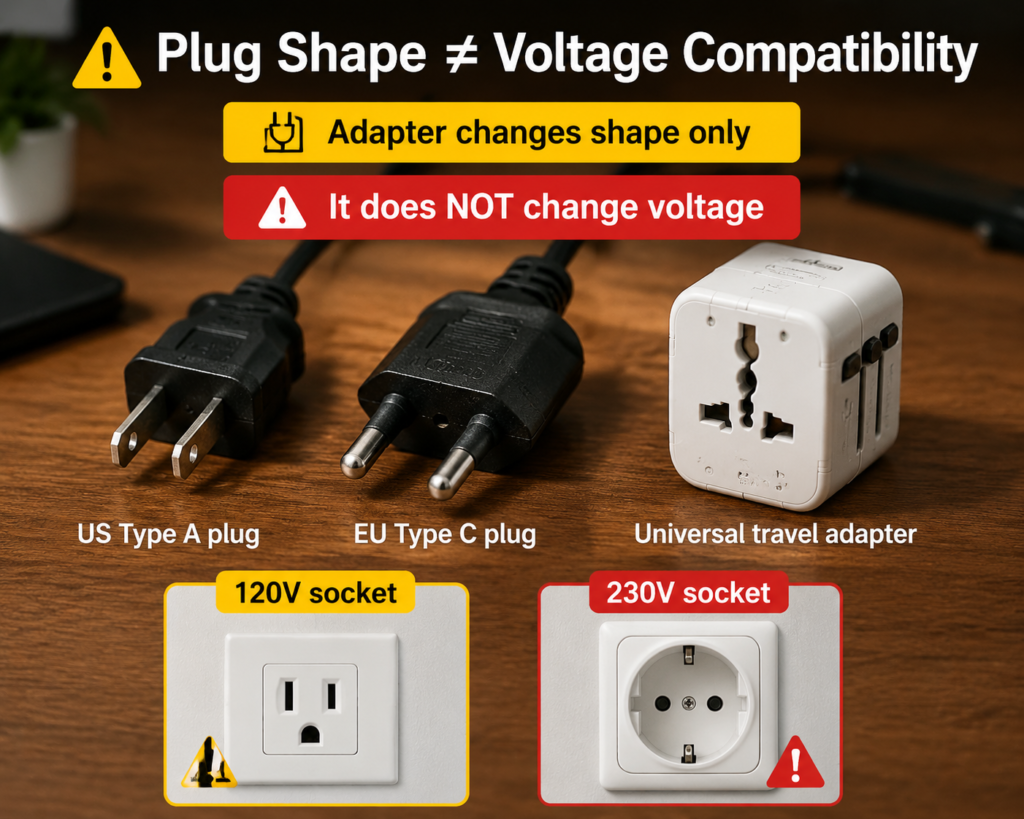
Plug shape is just the first hurdle. The real danger lies in mismatched voltage.
Two Dominant Voltage Camps
The world is largely split into two groups:
- Low-voltage group (100–127V): Americas, Japan, Taiwan. Prioritized early safety.
- High-voltage group (220–240V): Europe, Asia, Africa, Oceania. More efficient for grid transmission.
There are also exceptions: some countries use multiple voltage standards. For example, Brazil has both 127V and 220V regions, Japan uses a unique 100V system, and the Philippines has a historical mix of 110V and 220V infrastructure.
Rule of thumb: If you plug a 120V-only device directly into a 230V socket, you will almost certainly destroy it—often instantly, with smoke or even fire.
Does 50Hz vs 60Hz Matter?
For modern phone chargers, USB-C PD adapters, and GaN chargers: no meaningful effect. These use switching power supply technology that works automatically across both frequencies.
You only need to worry about frequency with:
- Very old devices with linear transformers
- Appliances with AC motors (like certain fans or electric shavers)
- Pure analog clock devices
For everyday travel tech, you can ignore frequency.
How to Tell If Your Charger Works Worldwide
Flip your charger over and look at the label. If you see this exact marking:
INPUT: 100-240V ~ 50/60Hz
Congratulations—your charger is world-ready. It will automatically adjust to any household grid on Earth. You only need a plug adapter to change the shape.
The vast majority of modern smartphone, tablet, and laptop chargers from reputable brands are built with this wide-range input.
Plug Adapter vs. Voltage Converter vs. Transformer
This is the single most confused topic in travel charging. Let’s clear it up once and for all.
| Device | Changes plug shape | Changes voltage | Best for |
|---|---|---|---|
| Plug Adapter | ✅ Yes | ❌ No | All wide-voltage electronics (phones, laptops, GaN chargers) |
| Voltage Converter | ❌ No | ✅ Yes | High-wattage heating appliances (hair dryers, kettles) |
| Transformer | ❌ No | ✅ Yes | Sensitive low-power vintage devices; heavy and bulky |
Plug Adapter
A plug adapter only rearranges the shape of your plug so it fits a foreign socket. It does nothing to voltage, frequency, or power.
- Use when: your device supports 100–240V wide input.
- Don’t use when: your device is rated for only one voltage.
Voltage Converter
A voltage converter steps the local grid voltage up or down to match your device. Most are designed for resistive heating devices like hair straighteners.
- Use when: you must bring a single-voltage high-power appliance.
- Don’t use with: sensitive electronics unless the converter is explicitly rated for them.
Transformer
A traditional wound transformer changes voltage cleanly, but is heavy and expensive.
- Use when: powering vintage or delicate single-voltage gear.
- Not practical for most travel.
Everyday reality: Most modern travelers only need a plug adapter.
Types of Travel Adapters
Not all adapters are built the same. Choosing the right style depends on how many countries you’re visiting and what devices you carry.
Single-Country Plug Adapters
These are dedicated adapters built for one specific plug type conversion (for example, US Type A to UK Type G).
- Pros: Simple construction, more reliable contact, lower electrical resistance, lower cost
- Cons: Only works for one destination pair
- Best for: Single-country trips, high-power laptop chargers
Universal Travel Adapters
These integrate multiple plug styles into one unit, typically covering Type A/B, C/E/F, G, and I in a single device.
- Pros: One unit works for dozens of countries, great for multi-stop trips
- Cons: More complex internal structure; maximum power capacity is often lower than dedicated adapters
- Best for: Multi-country travel, low-to-medium power devices
USB-Integrated Travel Adapters
These combine a plug adapter with built-in USB-A and USB-C charging ports.
- Pros: Reduces the number of devices you carry; charges phones directly without a separate charger
- Cons: Built-in USB ports often have limited power output; may not support fast charging for laptops
- Best for: Light packers, casual travelers with only phones and earbuds
Understanding Travel Adapter Power Ratings
Every adapter has electrical limits printed on its body. Here’s how to read them:
| Rating | What it means |
|---|---|
| 10A / 13A / 16A | Maximum safe current the adapter can carry continuously |
| 250V | Maximum voltage the adapter is insulated to handle |
| Watt limit | Calculated as: Voltage × Current = Maximum power |
For example:
- On a 230V European grid, a 10A adapter can safely carry roughly 2300W total.
- On a 120V North American grid, the same 10A adapter supports roughly 1200W total.
Important: The printed rating is the theoretical maximum. Internal construction of cheap universal adapters may lower the real safe limit. For continuous use, stay below 80% of the rated value. For laptops and other higher-power devices, always use a properly rated, grounded adapter.
Are Universal Travel Adapters Safe?
Quality varies wildly. A well-built universal adapter is extremely convenient; a cheap no-name one can be a fire hazard.
What to Look for in a Good Adapter
- Solid, tight contact: Loose pins cause resistance, heat, and melting.
- Full grounding: 3-pin devices should get a full ground connection.
- Proper safety certifications: Look for CE (EU), UL (USA), UKCA (UK), or SAA (Australia) marks on the packaging.
- Realistic power rating: Don’t trust exaggerated wattage claims on tiny plastic adapters.
Common Risks of Cheap Adapters
- Thin brass plating that overheats under load
- Missing ground connections inside the plastic body
- Fake certification marks
- Internal parts that shift and short-circuit
Pro tip: For laptop chargers 65W and above, always use an adapter with intact grounding.
How USB-C PD & GaN Changed Travel Charging Forever
The Old Days
Not long ago, a typical business traveler carried:
- A phone charger
- A laptop brick
- A tablet charger
- Multiple plug adapters for different countries
It was heavy, messy, and easy to lose pieces.
The Modern Solution
Today, a single GaN (Gallium Nitride) multi-port charger with wide-voltage input can power your phone, tablet, laptop, and headphones at the same time. Pair it with one good universal plug adapter, and you’re set for almost any country.
Recommended Charger Power by User Type
| Traveler profile | Recommended charger | Why |
|---|---|---|
| Phone-only casual traveler | 30W USB-C PD | Small, light, charges phones and earbuds fast |
| Phone + tablet | 45–65W USB-C PD | Covers both devices in one unit |
| Business / laptop user | 65–100W GaN | Powers a laptop + phone simultaneously |
| Multi-device power user | 100W+ multi-port GaN | Charges laptop, phone, watch, and accessories all at once |
Travel Charging Setup Recommendations
Key Features to Look for in a Travel Charger
- First check: Must say 100–240V ~ 50/60Hz on the label.
- Protocols: Look for USB-C PD and PPS support for fastest phone and laptop charging.
- Technology: GaN chargers are smaller, cooler, and more power-dense—ideal for travel.
- Safety: Stick to brands with recognized safety certifications.
- Form factor: Foldable or interchangeable plugs reduce bulk and remove the need for extra adapters.
Key Features to Look for in a Plug Adapter
- Current rating: Make sure it can handle your total device wattage.
- Grounding: 3-pin devices need a 3-pin adapter path.
- Build quality: Firm pins, solid plastic, no wobbly parts.
- Certifications: CE, UL, UKCA, SAA as appropriate for your destinations.
Recommended Kits by Travel Type
Casual Weekend / Vacation Travel
- 30–65W GaN USB-C charger (wide voltage)
- 1 certified universal travel adapter
- 1 USB-C cable
Business Travel
- 100W multi-port GaN charger
- 1 high-quality grounded universal adapter
- 1 spare USB-C cable
Long Multi-Country Trips
- Multi-port PD charger
- Set of region-specific grounded adapters (more reliable than one universal)
- Multiple fast-charge cables
1-Minute Pre-Trip Check Routine
Do this before every international trip:
- Look up your destination: What plug type and voltage does it use?
- Check your charger label: Does it say 100–240V? If yes, you only need a plug adapter.
- Add up your power: Make sure your adapter and charger are rated for the total watts you’ll draw.
Common Myths & Mistakes
Myth 1: “If it fits, it works.”
False. A plug that physically fits is no guarantee the voltage is safe. Many people have burned out devices this way. Always check the voltage label.
Myth 2: “USB-C means it works everywhere.”
False. USB-C is the output side. The wall-plug side and input voltage still have to match the local grid.
Myth 3: “Any universal adapter solves everything.”
False. Cheap universal adapters often skip the ground connection and lie about power ratings. They’re fine for phones, but risky for laptops and high-power gear.
Myth 4: “One country = one voltage.”
False. Japan has two frequencies (50Hz east, 60Hz west). Brazil has both 127V and 220V in different cities. Always confirm the specific city you’re visiting.
The Future of Travel Charging
The plug mess won’t be fixed overnight, but several trends are making travel easier every year:
- USB-C unification: Device-side charging is converging on USB-C PD, so you only need one cable for everything.
- Modular chargers: Swap-out plug heads let one charger work in every country.
- IEC 60906-1 (Type N) adoption: This IEC-recommended plug design is being adopted in Brazil and South Africa to simplify domestic standards, though full global unification remains a long-term goal at best.
- Built-in hotel USB ports: More hotels add USB sockets directly to walls, reducing plug dependency.
Frequently Asked Questions
Do I need a plug adapter for the USA?
If your charger has European/Asian-style pins, yes—you’ll need a Type A/B adapter. If your charger supports 100–240V, that’s all you need.
How many adapters do I need for Europe?
For most of mainland Europe, one Type C/F adapter covers Germany, France, Spain, and many others. Add a separate Type G adapter if you’re visiting the UK or Ireland.
What does “100-240V” actually mean?
It means the charger can safely accept any household AC voltage between 100 volts and 240 volts, at either 50Hz or 60Hz. This is the definition of “worldwide compatible.”
Why can USB-C chargers be used globally?
Nearly all modern USB-C chargers from reputable brands use switching power supply technology designed from the start for worldwide markets. Manufacturers build 100–240V input as standard to avoid making different versions for every country.
Is it safe to charge a laptop through a universal adapter?
Yes—if the adapter is properly grounded, has real safety certifications, and its power rating exceeds your charger’s wattage. Cheap ungrounded adapters are not recommended for laptops.
When do I actually need a voltage converter?
Only when you’re bringing a single-voltage high-power appliance (like a 120V hair dryer) to a 230V country and have no local alternative. For phones and laptops, you almost never need one.
Final Thoughts
Global plug standards can feel overwhelming at first, but the rules are simple once you know them. Remember:
- Plug shape = connection (does it fit?)
- Voltage = safety (will it break?)
- Modern wide-voltage chargers + a good adapter = stress-free travel charging
Stick to certified gear, check the label on every device, and you’ll never have a dead phone—or a fried charger—mid-trip again.