
Quick Summary
✅ Core Verdict: Nearly all modern USB, USB-C PD, and laptop adapters use Switch-Mode Power Supply (SMPS) technology. Most travel chargers rated for 100–240V AC and 50/60Hz work safely in the vast majority of countries. A 100–240V rating solves most voltage compatibility issues, but frequency compatibility must still be confirmed separately by checking the 50/60Hz rating. You will also always need the correct plug adapter and sufficient charging power for your devices.
⚠️ What Actually Matters Most: Frequency is rarely the main barrier for travelers. Before your trip, always confirm three things: input voltage range, plug type compatibility, and output power / charging protocol support.
⚡ 3-Second Compatibility Check: Look at your charger’s input label. If it says Input: 100-240V ~ 50/60Hz, it supports wide voltage and both mains frequencies — it is built for international travel.
Quick Compatibility Table
| Charger Label | Travel Result |
|---|---|
100-240V ~ 50/60Hz | ✅ Worldwide use with a plug adapter |
100-240V ~ 60Hz only | ⚠️ Verify destination frequency before use |
120V ~ 60Hz only | ❌ Not safe for 230V 50Hz countries |
230V ~ 50Hz only | ❌ Not safe for 120V 60Hz countries |
Introduction
You’re packing for an international trip. You grab a plug adapter, double-check your USB-C cable, and then pause. Staring back at you from your charger is a tiny line of text: 50/60Hz.
Most travelers worry about voltage and plug shapes, but few stop to ask what those two numbers actually mean. Will your 60Hz American charger fry in a 50Hz European outlet? Do you need a bulky frequency converter for your laptop? Is Japan’s split grid going to break your phone charger?
If these questions have ever crossed your mind, you’re not alone. This guide breaks down everything you need to know about 50Hz and 60Hz compatibility — in plain English, without unnecessary engineering jargon. We’ll cover why the difference exists, how modern chargers handle it, which devices actually need attention, and how to confirm your gear is ready for anywhere in the world.
1. What Exactly Are 50Hz and 60Hz?
1.1 The Simple Definition of AC Frequency
The electricity coming out of your wall socket is alternating current (AC). Unlike the steady, one-way flow of DC power from a battery, AC flows in a smooth, repeating wave pattern, swinging from positive to negative and back again.
Frequency, measured in hertz (Hz), describes how many complete AC cycles occur every second:
- 50Hz = 50 full cycles per second
- 60Hz = 60 full cycles per second
Think of it like ocean waves: voltage is the height of the wave (the “push” of the electricity), while frequency is how often the waves roll in. To be precise: voltage indicates the electrical potential difference, while frequency indicates how fast the AC waveform repeats. One is about force, the other is about speed — they are completely separate measurements.
1.2 Why the World Has Two Mains Frequency Standards
There is no secret technical advantage to 50Hz or 60Hz. The split is purely a historical accident.
Back in the late 1800s, when electric grids were first being built, different companies and regions picked different engineering standards. Europe standardized on 50Hz, while North America settled on 60Hz. As electrical infrastructure spread across the globe, each region adopted the system of its industrial partners.
Once entire countries had wired their cities for one frequency, switching became prohibitively expensive. Over a century later, both remain fully mature, reliable global standards — neither is “better” than the other.
1.3 Global 50Hz / 60Hz Distribution at a Glance
| Frequency | Primary Regions | Typical Mains Voltage |
|---|---|---|
| 50Hz | Most of Europe, China, Australia, India, most of Africa, the Middle East, most of Southeast Asia | 220–240V |
| 60Hz | United States, Canada, South Korea, Philippines, most of Central America, northern South America | 100–127V |
| Mixed / Dual | Japan, parts of Brazil | 100V / 127V |
1.4 Japan’s Split Grid: A Special Case
Japan is one of the most well-known countries with two different mains frequencies inside its borders.
- Eastern Japan (Tokyo, Tohoku region): 50Hz
- Western Japan (Osaka, Kyoto, Kyushu): 60Hz
This quirk dates back to the late 19th century, when eastern Japan adopted 50Hz equipment from Europe and western Japan adopted 60Hz equipment from North America. The two regional power systems developed independently and continue to operate with different frequencies today.
The good news for travelers: any modern charger marked 50/60Hz works seamlessly across all of Japan.
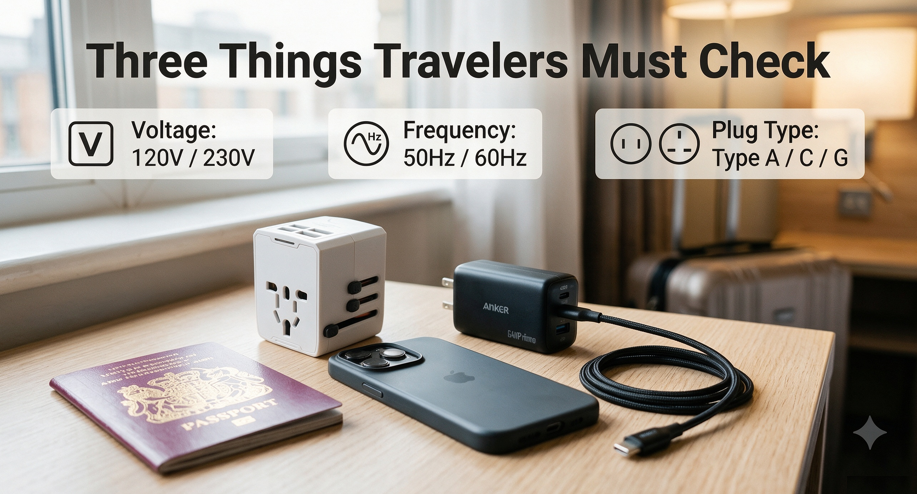
2. Voltage, Frequency, and Plug Type: The Three Factors Travelers Must Check
Confusion between voltage, frequency, and plug shape is the number one cause of travel charging anxiety. They are three completely separate properties, and each is handled differently.
| Factor | What It Describes | How to Adapt for Travel |
|---|---|---|
| Voltage | The electrical “pressure” of the power supply (e.g. 120V, 230V) | Requires a voltage converter for single-voltage devices |
| Frequency | The speed of the AC waveform cycle (e.g. 50Hz, 60Hz) | Requires a frequency converter for frequency-sensitive equipment |
| Plug Type | The physical shape of the socket pins (e.g. Type A, Type C, Type G) | Requires a plug adapter for physical fit |
For most modern consumer electronics, voltage compatibility is the most critical check, plug adapters are the only accessory you need, and frequency differences are largely handled by the charger itself.
3. Voltage vs Frequency: Which One Actually Matters More?
Many travelers ask “will my charger work abroad” and immediately fixate on frequency. In reality, different problems have different root causes:
| Common Problem | Usually Caused By |
|---|---|
| Charger won’t power on or fails immediately | Wrong voltage |
| Plug will not fit the wall socket | Wrong plug type |
| Motorized device runs too fast or too slow | Frequency mismatch |
| Phone or laptop charges slowly | Insufficient output power, cable limits, or protocol mismatch |
For phone chargers, laptop adapters, and USB-C PD devices, voltage compatibility is far more likely to cause issues than frequency. Frequency only becomes a concern for older equipment and devices with built-in motors.
4. How Modern Chargers Handle 50Hz and 60Hz
4.1 Why Frequency Affects Some Devices At All
Frequency doesn’t bother every piece of electronics equally. It causes real problems for two categories of equipment:
- AC motors: Motor speed may change significantly because many AC motors are influenced by mains frequency. Performance, heat, and lifespan can all be affected.
- Traditional line-frequency transformers: These heavy iron-core transformers operate directly at wall frequency, and are sized for one specific standard. Change the frequency, and extra heat, buzzing noise, and lower efficiency can follow.
4.2 Old Linear Power Supplies: The Frequency-Sensitive Design
Vintage chargers and cheap old appliance adapters used a simple, bulky design called a linear power supply:
AC input → heavy iron-core transformer → rectifier (a circuit that converts AC to DC) → DC output
Because the transformer runs directly at wall frequency, the whole unit is tuned for either 50Hz or 60Hz. Use one across frequencies and you’ll likely hear a loud hum, feel excessive heat, and see reduced output power.
These designs are heavy, inefficient, and increasingly rare in consumer electronics. You’ll mostly find them on very old small appliances or antique equipment.
4.3 Switch-Mode Power Supplies (SMPS): Highly Tolerant to Frequency Differences
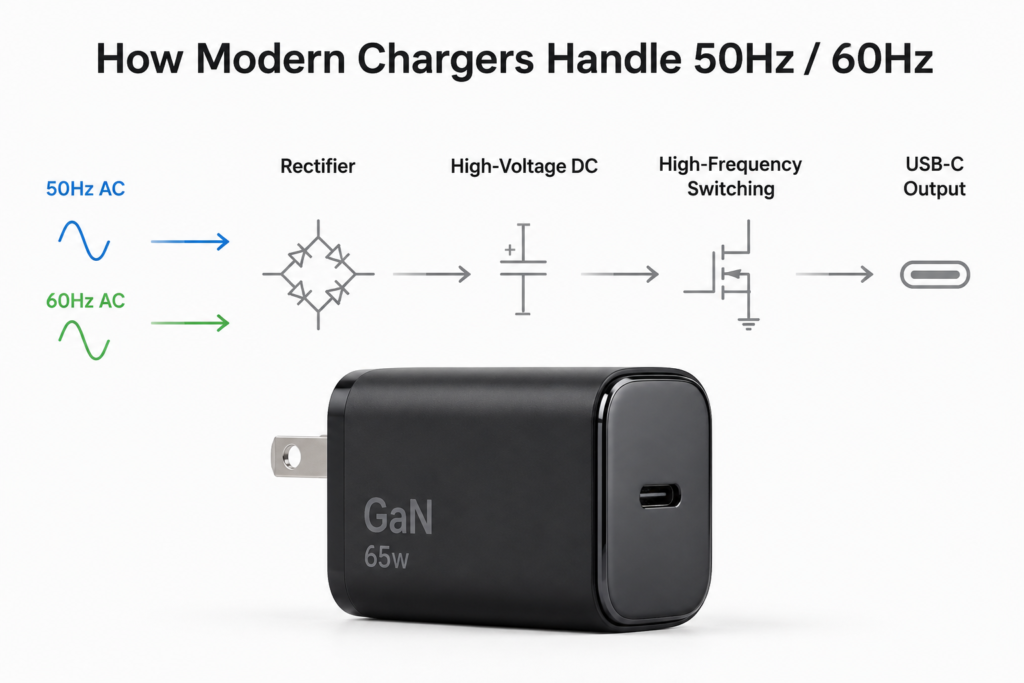
Virtually every modern phone charger, laptop adapter, and USB-C PD charger uses a switch-mode power supply. It works on an entirely different principle:
AC input → rectifier → high-voltage DC → high-frequency switching circuit → regulated low-voltage DC output
Here’s the key insight: the very first step converts 50Hz or 60Hz AC into DC power. After that point, the original mains frequency no longer directly controls the power conversion process. All the actual power conversion happens at internal frequencies of tens or hundreds of kilohertz — thousands of times faster than any mains grid. Think of it as the charger “rebuilding” the incoming electricity into a clean, steady form your devices can use.
The result? The difference between 50Hz and 60Hz barely registers. A well-designed SMPS performs nearly identically on both.
4.4 What Does “47–63Hz” Mean?
Some chargers print 47–63Hz instead of 50/60Hz. This is not a typo — it is a wider tolerance rating.
Real-world grids are not perfectly stable. A 50Hz grid might dip slightly under heavy load, and a 60Hz grid might vary by a small margin. This range covers both 50Hz and 60Hz grids with additional tolerance for real-world frequency variation, aligned with common international testing standards. It is a sign of a robust, well-tested design.
4.5 GaN Chargers and Travel Compatibility
Gallium Nitride (GaN) chargers are famous for being small, light, and efficient — and they are excellent travel companions.
Important note: GaN technology itself does not guarantee worldwide input compatibility. GaN describes the semiconductor material used inside the charger, not the AC input capability. Input range depends on the full power supply design, including PFC circuits and control ICs. That said, many modern GaN USB-C PD chargers include universal 100–240V input, making them popular travel options.
4.6 Why Your Devices Charge at the Same Speed Worldwide
A common question is: if wall voltage ranges from 100V to 240V, why does your phone charge at the same speed in every country?
The answer is the SMPS design. No matter whether the input is 120V 60Hz from an American wall or 230V 50Hz from a European socket, the charger converts it to regulated, fixed DC output (5V, 9V, 15V, 20V, etc.) matched to the USB PD protocol. The end device receives identical power, so charging speed stays consistent — as long as the charger’s output wattage meets the device’s requirements.
5. Do You Need a Converter? Plug Adapter vs Voltage Converter vs Frequency Converter Explained
This is one of the most common points of confusion for travelers. The three devices do completely different jobs, and they are not interchangeable.
| Device | What It Does | What It Does NOT Do |
|---|---|---|
| Plug Adapter | Changes the shape of the plug pins to fit a foreign wall socket | Does NOT change voltage, does NOT change frequency |
| Voltage Converter | Steps voltage up or down (e.g. 230V → 120V) | Does NOT change AC frequency |
| Frequency Converter | Changes 50Hz to 60Hz or vice versa | Bulky, expensive, and unnecessary for most consumer electronics |
For ordinary travel with phones, laptops, and USB chargers, you almost always only need a plug adapter. Voltage converters are only required for single-voltage devices, and frequency converters are virtually never needed for consumer charging gear. They may still be required for specialized equipment such as frequency-sensitive industrial machines, laboratory equipment, or certain medical systems.
6. How to Tell If Your Charger Works Worldwide
6.1 Read the Input Label: The Only Test You Need
Every charger has a printed nameplate, usually on the back or bottom. The most important line starts with Input:.
Example of a fully travel-ready label:
plaintext
Input: 100-240V ~ 50/60Hz 1.5A
Breakdown of each part:
- 100-240V: Accepts every common household voltage on Earth
- ~: Symbol for alternating current input
- 50/60Hz: Certified for both global mains frequencies
- 1.5A: Maximum input current at the lowest voltage
6.2 Three Common Label Types, Ranked
| Label Reading | Compatibility | Travel Advice |
|---|---|---|
100-240V ~ 50/60Hz | ✅ Full worldwide support | Only a plug adapter is needed |
120V ~ 60Hz only | ⚠️ Single-region only | Do not use internationally without full power conversion |
220-240V ~ 50Hz | ❌ Region-locked | Not safe for 120V 60Hz countries |
6.3 The 3-Step Pre-Travel Check
- Find the
Inputline printed on your charger. - Confirm it lists 100-240V for voltage and 50/60Hz for frequency.
- Pack the correct plug adapter for your destination.
That’s it. No special tools, no calculators, no guesswork.
7. Which Devices Actually Care About Mains Frequency?
7.1 Frequency Sensitivity Cheat Sheet
| Device Category | Frequency Sensitivity | Notes |
|---|---|---|
| USB-C PD chargers | Very Low | Almost all mainstream USB-C PD chargers use SMPS designs with 50/60Hz support |
| Standard phone chargers | Very Low | Most modern phone chargers use universal-input SMPS designs and support 50/60Hz |
| Laptop power adapters | Very Low | All major brands use universal input designs |
| Camera battery chargers | Low | Name-brand units use wide-input SMPS |
| Wireless charging pads | Low | Depends on internal power supply; new models are fine |
| Hair dryers / curling irons | High | Built-in motors change speed and performance with frequency |
| Electric shavers / trimmers | Medium | Motor speed and performance may shift; always check the label |
7.2 Real-World Travel Scenarios
Scenario 1: USA → France
You bring a 65W GaN USB-C charger (100-240V 50/60Hz) from 120V 60Hz America to 230V 50Hz France.
- Result: Works perfectly. Just add a Type E/F plug adapter.
Scenario 2: Old US Charger → Europe
You dig up a vintage 120V 60Hz-only linear wall adapter and try to use it in Germany.
- Result: Do not use. Both voltage and frequency are mismatched. The unit will likely overheat and may fail.
Scenario 3: Tokyo → Osaka
You travel from 50Hz Tokyo to 60Hz Osaka with a standard 100-240V 50/60Hz USB-C charger.
- Result: No adjustment needed. The charger handles the frequency switch automatically.
8. Common Myths About Frequency Compatibility
Myth 1: “If the voltage fits, the frequency is fine too.”
Fact: Voltage and frequency are separate specifications. While rare today, a device can be wide-voltage and still be single-frequency. Always check both.
Myth 2: “50Hz makes my phone charge slower.”
Fact: Charging speed depends on output wattage, USB PD protocol support, cable quality, and your device’s internal charging limits. Mains frequency has no measurable effect on USB output power for modern chargers.
Myth 3: “A travel plug adapter changes the frequency.”
Fact: A plug adapter only reshapes the physical pins so they fit the wall socket. It does not change voltage, frequency, or waveform in any way.
Myth 4: “I need to pack a frequency converter for my trip.”
Fact: You do not need a frequency converter for phones, laptops, USB-C chargers, or camera batteries. Frequency converters are bulky, heavy, expensive, and only required for specialized industrial or medical equipment. For ordinary travel, they are a waste of luggage space.
9. How to Pick a Truly Travel-Ready Charger
9.1 The Gold Standard Specs
For worry-free global travel, look for:
- Input: 100–240V ~ 50/60Hz (universal input)
- Output: USB-C Power Delivery (PD) 3.0, ideally with PPS for faster phone charging
- Build: GaN technology for smallest size and best efficiency
- Safety: Recognized third-party certifications
9.2 Recommended Travel Setups
| Travel Style | Recommended Charger |
|---|---|
| Light carry-on / phone only | 30W USB-C PD GaN charger |
| Laptop + phone + tablet | 65W USB-C PD GaN charger |
| Multiple devices / family travel | 100W multi-port GaN charger |
9.3 Safety Certifications to Trust
Reputable chargers are tested to strict standards. Look for these marks:
- UL / ETL (North American safety)
- CE (European compliance)
- FCC (US electromagnetic compatibility)
- Reference standard: IEC 62368-1 (international IT equipment safety)
Certified products are validated to operate reliably across their full rated frequency range.
10. Frequently Asked Questions (FAQ)
Q1: Do USB-C PD chargers need a frequency converter?
No. Most consumer USB-C PD chargers are built with universal-input switch-mode power supplies and support 50/60Hz, but always verify the input label to be certain.
Q2: Can I use a US charger in Europe?
If it supports 100–240V and 50/60Hz, yes. You only need a plug adapter to fit the European socket shape.
Q3: Does 50Hz make fast charging slower?
No. Fast charging performance is determined by output power, charging protocols, and your device. Mains frequency does not alter USB DC output.
Q4: Why does my charger buzz or get hot in another country?
Mild warmth and very faint hum are normal. Loud buzzing combined with excessive heat on an old adapter may indicate frequency mismatch or a low-quality design. High-quality GaN chargers should be nearly silent and run cool.
Q5: Which devices are most affected by 50/60Hz differences?
Devices with AC motors (hair dryers, fans, pumps) and old equipment with line-frequency transformers are the most frequency-sensitive. Modern electronic chargers are barely affected at all.
Q6: Can a 100–240V charger work in Japan?
Yes, as long as it also supports 50/60Hz. Japan uses 100V, which falls within the 100–240V range, and both 50Hz and 60Hz regions are covered by a dual-frequency rating.
Q7: Do I need a transformer for my laptop charger?
Almost certainly not. All major laptop brands ship with universal 100–240V 50/60Hz adapters. Always check the label, but transformers are rarely required for modern laptops.
Q8: Why do some chargers say 50/60Hz and others say 47-63Hz?
50/60Hz means the charger is certified for both standard mains frequencies. 47-63Hz is a wider tolerance rating that adds extra margin for real-world grid fluctuations. Both work for international travel; 47-63Hz indicates a more robust design.
Final Thoughts & Pre-Travel Checklist
At the end of the day, 50Hz vs 60Hz is one of those travel worries that sounds scarier than it is. For anyone carrying phones, laptops, and modern USB chargers, frequency compatibility is a problem that was solved decades ago by switch-mode power supply design.
What you should pay attention to are voltage range and plug shape. Get those right, and your charging gear will work almost anywhere on the planet.
Pre-Travel Checklist
- Confirm your charger’s input says 100–240V
- Confirm it supports 50/60Hz
- Match the plug adapter to your destination socket type
- Verify the charger has enough wattage for your laptop or tablet
- Stick to chargers with recognized safety certifications