
Introduction
Think about the USB devices you use every day. Your phone charger, your keyboard, your external hard drive — they all work perfectly well in your home or office. But what if you needed to use a USB device in a factory filled with dust and vibration? What if it had to operate in freezing cold or scorching heat? What if it needed to survive constant movement and oil splashes?
Consumer-grade USB products aren’t designed for these conditions. They fail — cables crack in the cold, connectors shake loose from vibration, dust gets into ports, and electronics overheat or stop working.
This is where industrial-grade USB comes in. It’s a completely different category of product, built to survive the harsh environments where consumer electronics simply can’t go. This guide explains what industrial-grade USB is, how it differs from consumer-grade, and what you need to know when working with it.
1. What Is Industrial-Grade USB?
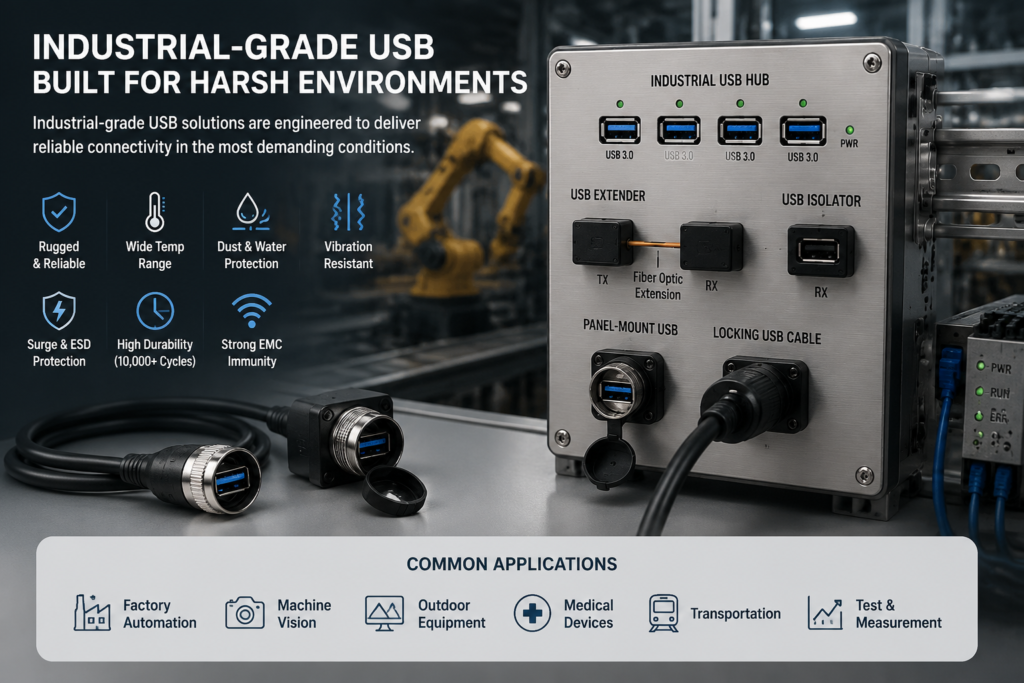
Industrial-grade USB is a specialized USB connection solution designed specifically for harsh industrial environments. It’s not simply a tougher version of consumer USB — it’s engineered from the ground up with different materials, protection circuits, and testing standards.
These products are built to operate reliably in extreme temperatures, high vibration, dusty conditions, humidity, and even exposure to oils and chemicals. You’ll find them in factory automation, machine vision systems, outdoor equipment, medical devices, and transportation applications.
The core goal is simple: keep the connection working and the data flowing, no matter how harsh the conditions.
2. How It Differs from Consumer-Grade USB
Environmental Tolerance
- Consumer-grade: Designed for indoor, room-temperature environments
- Industrial-grade: Built for wide temperature ranges, dust, moisture, vibration, and other harsh conditions
Mechanical Reliability
- Consumer-grade: Typical plug-unplug lifespan of 1,500 to 5,000 cycles
- Industrial-grade: Usually 10,000+ cycles, with locking mechanisms to prevent accidental disconnection
Electrical Protection
- Consumer-grade: Basic ESD (electrostatic discharge — the static electricity that can build up on your body and damage electronics) protection
- Industrial-grade: Includes isolation, surge protection, overcurrent and overvoltage protection
Electromagnetic Compatibility
- Consumer-grade: Meets civil EMC (electromagnetic compatibility) standards for home/office environments
- Industrial-grade: Meets stricter industrial immunity standards to withstand interference from motors, drives, and heavy equipment
Testing Standards
- Consumer-grade: Tested to consumer electronics standards
- Industrial-grade: Subjected to temperature extremes, vibration, and shock testing according to industrial environmental standards
Core Advantages
- Maintains reliable connections and prevents data loss in harsh conditions
- Reduces production line downtime and data packet loss
- Extends equipment service life in industrial environments
3. Common Applications
Factory Automation
- PLC (Programmable Logic Controller — think of it as a tiny computer that controls machines and production lines) programming and debugging
- Sensor connections and industrial control systems
- Production line equipment data communication
Machine Vision
- Industrial cameras and barcode scanners
- Vision inspection systems that require stable data transmission
Outdoor Equipment
- EV charging stations, outdoor displays, surveillance equipment
- Exposed to wide temperature swings, direct sunlight, and rain
Medical Equipment
- Diagnostic instruments, medical imaging equipment, laboratory devices
- Require electrical isolation and high reliability for patient safety
Transportation
- Vehicle-mounted equipment, marine devices, railway systems
- Subject to continuous vibration and significant voltage fluctuations
Test and Measurement
- Data acquisition units, oscilloscopes, signal generators
- Require signal integrity and accurate data transmission
4. Key Components
Industrial-Grade USB Cables
These are the foundation of any industrial USB solution. They feature locking mechanisms, multiple layers of shielding, and industrial-grade jackets that resist oil, chemicals, and temperature extremes.
Industrial-Grade USB Hubs
These expand a single USB port into multiple ports, with independent protection for each port. They’re designed for DIN-rail mounting — simply clip onto a standard metal rail, which is the most common mounting method in industrial control cabinets.
Industrial USB Extenders / Media Converters
These solve the distance limitation of standard USB cables. They use active amplification or fiber optic transmission to extend USB signals over much longer distances.
Panel-Mount USB Interfaces
These are installed flush into equipment housings or control cabinet panels. They typically include protective dust covers to keep contaminants out when not in use.
Locking Adapters
These provide mechanical locking between the cable and the device using screw locks, clip locks, or twist locks. They prevent disconnection caused by vibration.
Industrial USB Isolators
These provide electrical isolation between devices, breaking ground loops (unwanted electrical paths between two devices that can cause interference or damage).
5. Key Technical Requirements
Locking Mechanisms
- Screw locks: High mechanical strength, commonly used in fixed installations
- Clip locks: Easy to plug and unplug while maintaining good reliability
- Twist locks: Similar to aviation-style connectors, offer excellent vibration resistance
Shielding Performance
Multi-layer shielding (typically foil plus braided wire) is essential to block electromagnetic interference from motors, drives, and other industrial equipment.
Data Transfer Rates
- USB 2.0: 480Mbps — suitable for keyboards, mice, and low-speed devices
- USB 3.0 / 3.2: 5Gbps / 10Gbps — suitable for cameras and large data transfers
Power Delivery
Industrial USB must provide stable power to connected devices, even in environments with fluctuating input voltage. Each port typically has independent power regulation.
Signal Integrity
Industrial USB maintains signal quality over longer distances than consumer USB. Two concepts are involved here:
- Impedance matching: Think of it like connecting pipes — the joints need to be the same size for water to flow smoothly. The same principle applies to electrical signals: proper impedance matching ensures stable transmission.
- Signal reflection: When impedance doesn’t match, signals bounce back at the end of the cable like an echo, colliding with incoming signals and causing data errors. Industrial USB is designed to minimize this reflection.
ESD Protection
Electrostatic discharge (ESD) protection prevents static electricity — which can come from operators or the environment — from damaging sensitive electronics during plugging and unplugging.
6. Environmental Design
Wide Operating Temperature
- Consumer-grade: Typically 0°C to 40°C (32°F to 104°F)
- Industrial-grade: Typically -40°C to 85°C (-40°F to 185°F) — covering everything from frozen warehouses to hot factory floors
IP Rating
- IP40: Protects against solid objects over 1mm (like most dust and small tools) — suitable for indoor cabinet use
- IP65 / IP67: Dust-tight and protected against water jets (IP65) or temporary immersion (IP67) — suitable for outdoor or wash-down areas
Vibration and Shock Resistance
Industrial-grade USB meets industrial vibration standards. Cables and connectors stay securely connected and don’t drop out under continuous vibration.
Corrosion Resistance
Cable jackets resist oils, acids, alkalis, and chemical solvents. This is essential in workshops where oils, lubricants, and cleaning chemicals are present.
UV Resistance
Outdoor applications require protection against UV radiation. Industrial cable jackets maintain their flexibility and don’t become brittle or crack after years of sun exposure.
Flame Retardant Materials
Cable jackets and insulation use flame-retardant materials that meet industrial fire safety standards — an important safety consideration in any industrial setting.
7. Electrical Safety and Reliability
Electrical Isolation
Breaks ground loops between the host and connected devices (as mentioned earlier, this prevents unwanted current paths that can cause interference or damage). This protects sensitive electronics in medical and measurement applications.
Independent Port Protection
Each port has its own overcurrent and overvoltage protection. If one connected device fails or short-circuits, the other ports and the host computer are unaffected.
Surge Protection
Industrial USB devices protect against both power surges and signal surges — caused by voltage fluctuations in the industrial environment or induced by nearby lightning strikes.
ESD (Electrostatic Discharge) Protection
Protection against both contact discharge (when you touch the connector) and air discharge (static electricity jumping through the air). This prevents damage during plugging and unplugging.
MTBF (Mean Time Between Failures)
Put simply, this is how long the device can run on average before it fails. Industrial-grade USB products have significantly higher MTBF ratings than consumer products. Design life is typically 5 to 10 years or more.
Accidental Disconnection Protection
Locking mechanisms prevent cables from being pulled out accidentally. This is critical in production environments where an unexpected disconnection could cause expensive downtime.
8. Installation and Deployment
Cable Management
Use cable trays, zip ties, or cable chains to secure cables properly. For moving parts, use high-flex drag chain cables designed for continuous bending.
Connector Orientation
Choose straight or right-angle connectors based on available space. Right-angle connectors reduce stress at the cable root where it enters the connector.
Shielding Grounding
The cable shield must be grounded properly (at one end or both ends, depending on the installation) to provide effective electromagnetic interference protection.
Long-Distance Solutions
The table below shows which solution to use based on distance:
| Distance | Recommended Solution | What It Does |
|---|---|---|
| Up to 5 meters | Standard industrial cable | Direct connection for regular situations |
| 5 to 30 meters | Active extension cable | Built-in signal booster to maintain strength |
| Beyond 30 meters | Fiber optic USB extender | Converts electrical signals to light — virtually no distance limit |
Different transmission distances correspond to different technical solutions.
Redundancy
Keep spare ports available for critical links. For essential equipment, consider dual-path backup to prevent a single cable failure from stopping production.
Installation Environment
Avoid running USB cables in the same cable trays as high-voltage power lines. Keep cables away from variable frequency drives, motors, and other strong sources of electromagnetic interference.
9. Common Misconceptions
Myth 1: Adding a metal shell makes any USB product industrial-grade
True industrial-grade USB requires internal circuit protection, specialized materials, and rigorous testing standards. A metal shell is just the surface — the real differences are inside.
Myth 2: Industrial-grade USB is always faster than consumer-grade
Industrial USB prioritizes reliability and stability over speed. Data rates are actually the same generation standards as consumer USB — it’s not faster, it’s more dependable in difficult conditions.
Myth 3: All industrial USB products are waterproof
IP ratings specify different levels of protection. IP40 is not waterproof at all — it only protects against large particles. Only products rated IP65, IP67, or higher provide water protection.
Myth 4: Locking connectors make disconnection impossible
Locking connectors prevent accidental disconnection from vibration or light pulling. But violent pulling, cable damage, or worn connectors can still cause disconnection. Proper cable routing and regular inspection remain necessary.
Myth 5: Once installed, industrial products need no attention
Industrial environments are harsh — dust, oil, and vibration take their toll over time. Regular inspection and cleaning are still essential to maintain reliable operation.
10. Selection and Maintenance
Selection Matching
- Choose the right temperature range and IP rating for your environment
- Match data rate and power requirements to your connected devices
- Verify that the locking mechanism type is compatible with your existing equipment
Routine Inspection
- Check connector locks for looseness periodically
- Inspect cable jackets for damage, cracking, or wear
- Clean dust and oil from connectors and ports
Spare Parts Management
- Keep spare cables available for critical locations
- Different locking types are not interchangeable — stock the correct type for each location
- Avoid mixing different specifications of the same model
Service Life
- Industrial cables typically have 10,000+ plug-unplug cycles
- In drag chain applications, life is measured by bending cycles
- Replace aging cables on a schedule to prevent unexpected failures
Upgrades and Replacements
- Verify pin definitions and protocol compatibility before replacement
- Never substitute consumer-grade cables — they may work briefly but will fail in industrial conditions
Summary
Industrial-grade USB is a complete engineering solution, not just a tougher version of consumer USB. It’s designed from the ground up for environments where consumer electronics would simply fail.
Key concepts to remember:
- Durability comes from design — locking connectors, multi-layer shielding, wide-temperature components, and strict testing
- Protection matters — isolation, surge protection, independent port protection, and ESD guards are standard features
- Environment determines specifications — temperature range, IP rating, and vibration tolerance must match your application
- Reliability is measured differently — MTBF, plug cycles, and bending cycles are more meaningful than speed specs
- Regular maintenance is still required — even the toughest industrial products need inspection and care in harsh environments
Whether you’re setting up a production line, a machine vision system, or outdoor equipment, industrial-grade USB keeps your connections working when it matters most — in the conditions where consumer products can’t survive.