
1. Introduction: Why Some Cables Last for Years While Others Break Quickly
1.1 Common Cable Damage Phenomena in Daily Life
We often encounter various cable damage issues in daily life. Phone charging cables peel and break within months, headphone wires fail at bending points, home appliance power cords age and crack, and outdoor cables harden and damage after sun exposure. The huge difference in cable service life stems from inherent performance differences rather than accidental damage.
1.2 Flexibility and Durability: Two Cores Determining Cable Lifespan
Most ordinary users only judge cables by appearance and price, ignoring the two key indicators: flexibility and durability. Flexibility affects whether the cable is easy to bend and store; durability determines the cable’s resistance to wear, aging and damage. These two indicators directly decide the service life and user experience of cables.
1.3 Understanding Cable Structure Helps You Choose High-Quality Products
Cable quality is not determined by thickness, hand feel or price, but by internal conductors, outer materials and overall structure. Mastering the basic logic of flexibility and durability allows everyone to avoid inferior cables and pick cost-effective, long-lasting products.
2. Basic Cognition: What Are Flexibility and Durability
2.1 Flexibility: More Than Just Soft Hand Feel
Cable flexibility refers to the ability to bend, twist and fold freely without stiffness, deformation or cracking. High-quality flexible cables remain smooth after repeated bending and winding, while inferior cables stiffen easily and are prone to damage with slight bending.
2.2 Durability: The Full Meaning of Wear-Resistant Cables
Durability is a comprehensive anti-loss capability of cables. It includes mechanical resistance to pulling, friction and extrusion, environmental resistance to high and low temperatures, sunlight, moisture and corrosion, and stable electrical performance during long-term use.
2.3 Correlation and Trade-off: Softness Does Not Equal Durability
Flexibility and durability complement and restrict each other. Excellent cables balance softness and durability, but ultra-soft cables may sacrifice wear resistance, while super durable cables may be relatively hard and not suitable for frequent movement.
3. Factors That Determine Cable Flexibility
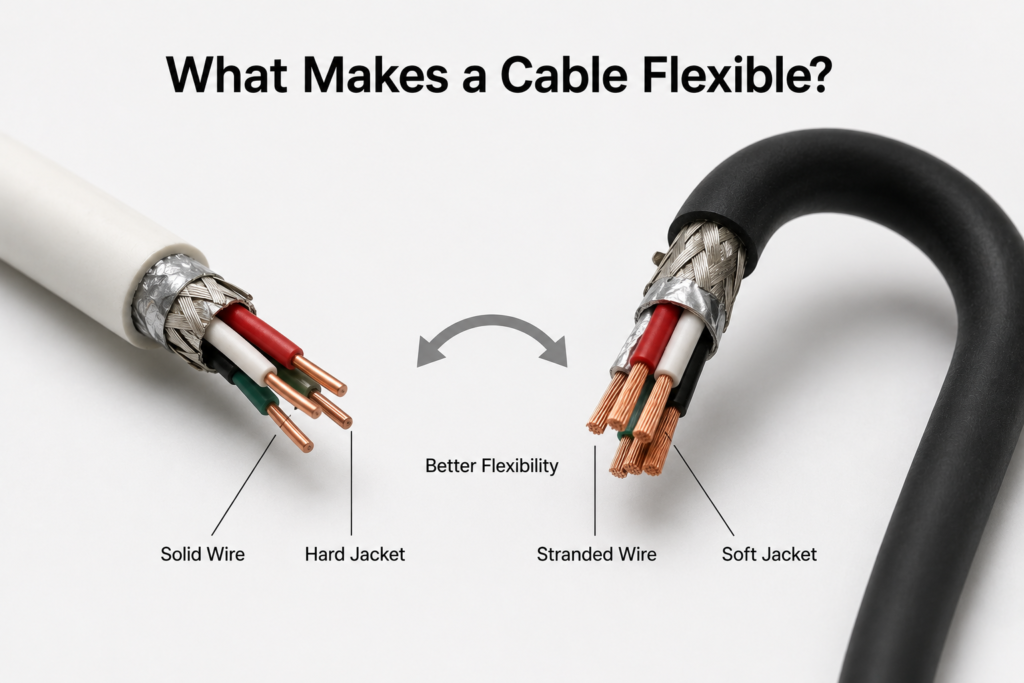
3.1 Conductors: Single-Strand Hard Wire vs Multi-Strand Stranded Wire
Solid single-strand copper conductors are stiff and only suitable for fixed wiring. Multi-strand thin stranded copper wires disperse bending pressure, which can be bent and twisted freely, making them the mainstream choice for flexible cables.
3.2 Influence of Copper Wire Thickness, Strand Number and Stranding Method
Under the same wire gauge, thinner copper strands and more strands bring better flexibility. Regular stranding technology ensures smooth bending and avoids cable jamming and deformation.
3.3 Softness of Insulation and Sheath Materials
Insulation and sheath materials directly affect the overall softness of cables. Hard materials lead to stiff cables that crack easily at low temperatures, while elastic soft materials adapt to repeated bending and winding.
3.4 Influence of Overall Cable Structure and Wire Diameter
Overly thick cables have high bending resistance and poor flexibility. Cables with compact structure, soft filling and reasonable core arrangement are more flexible and user-friendly.
4. Factors That Determine Cable Durability
4.1 Metal Fatigue: The Root Cause of Conductor Breakage
Most cable damage is caused by internal copper wire metal fatigue. Repeated bending, twisting and pulling cause tiny deformation of copper wires, leading to gradual breakage, poor contact and final wire failure over time.
4.2 Mechanical Properties: Tensile, Wear and Extrusion Resistance
High-quality cables resist daily pulling without loose or broken cores. Their outer sheaths are scratch and wear-resistant, and can withstand certain extrusion and trampling without deformation.
4.3 Environmental Resistance: Temperature, Sunlight and Corrosion Resistance
Harsh environments accelerate cable aging. Inferior cables harden and crack in low temperatures, age and deform in high temperatures, and deteriorate rapidly under long-term sunlight, humidity and chemical corrosion.
4.4 Stress Concentration at Interfaces: The Most Vulnerable Position
Cable roots near plugs are the most easily damaged parts. The fixed structure of interfaces causes stress concentration during bending, leading to skin cracking and internal core breakage after long-term use.
5. Comparison of Common Cable Sheath Materials
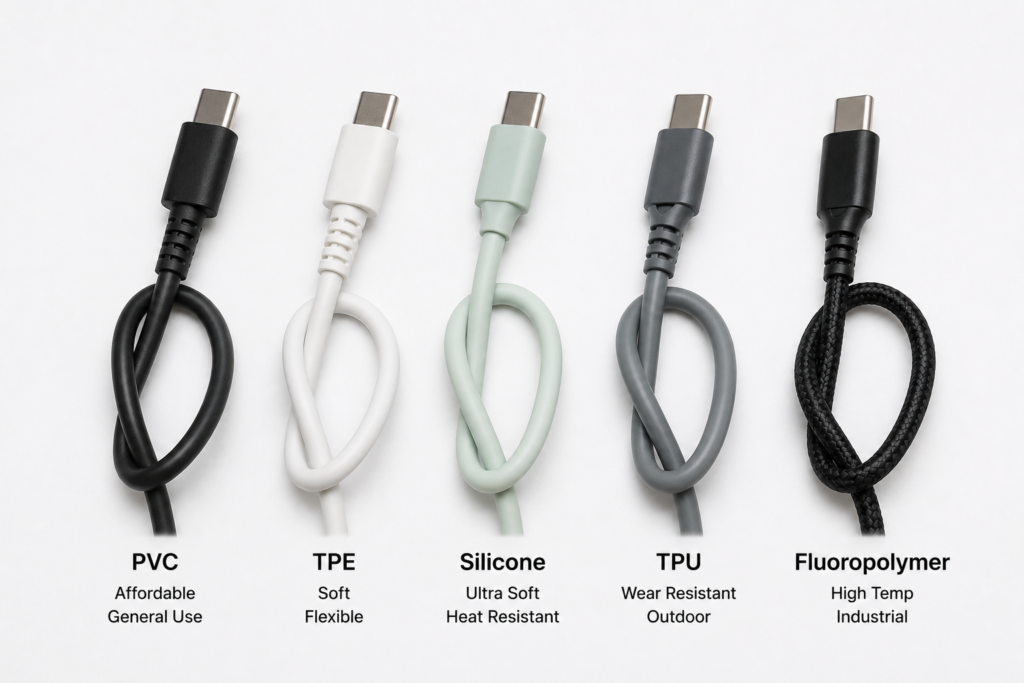
| Sheath Material | Core Features | Applicable Scenarios |
|---|---|---|
| PVC | Low cost, wide versatility, slightly hard, brittle at low temperature, average wear resistance | Indoor fixed wiring, low-frequency daily cables |
| TPE | Soft hand feel, excellent bending resistance, no stiffness, high cost performance | Phone charging cables, data cables, frequently used mobile cables |
| Silicone | Ultra-soft, high and low temperature resistance, good flexibility, average wear resistance | Cables used in extreme temperature environments with frequent bending |
| TPU | Super wear resistance, strong tensile and crush resistance, high toughness | Vehicle-mounted, outdoor and high-friction scenario cables |
| Fluoroplastics | High temperature and corrosion resistance, anti-aging, premium performance, high price | Industrial high-temperature and harsh environment special cables |
6. Balance Between Flexibility and Durability: Design Trade-off Logic
6.1 Why Ultra-Soft Cables Are Not Necessarily Durable
Some ultra-soft cables adopt lightweight soft materials to pursue perfect hand feel, but their toughness and wear resistance are greatly reduced. They are easy to peel and break despite soft touch, leading to short service life.
6.2 Why Thicker Cables Are Not Necessarily Stronger
Cable strength depends on internal materials rather than outer thickness. Many inferior cables thicken the outer sheath deliberately with thin and poor internal copper wires, which look sturdy but break easily in use.
6.3 Performance Focus Rules for Different Purposes
There is no universal cable. Mobile cables such as data lines focus on flexibility; outdoor and industrial cables focus on durability; fixed household wiring prioritizes long-term stability over softness.
7. Cable Performance Test Methods and Industry Standards
7.1 Bending, Swing and Torsion Life Test
These core tests simulate daily use scenarios. Cables are bent, swung and twisted repeatedly to detect peeling, core breakage and poor contact, so as to evaluate the service life and fatigue resistance.
7.2 Tensile, Wear and Environmental Aging Test
Tensile tests detect pull resistance, wear tests simulate daily friction loss, and aging tests simulate long-term environmental erosion to verify the stability and durability of cables.
7.3 Common Standard Systems: IEC, UL and National Standards
Formal cables comply with mainstream industry standards including Chinese GB standards, international IEC standards and American UL standards. Standard-compliant cables have guaranteed safety and performance, while unqualified products have no quality assurance.
8. Cable Selection Guide for Different Scenarios
| Application Scenario | Core Selection Requirements | Recommended Materials & Features |
|---|---|---|
| Consumer Electronics | Soft, easy to store, bending resistant, sturdy interface | TPE material, fine multi-strand copper wire |
| Vehicle & Outdoor Use | Wear-resistant, crush-resistant, weather and temperature resistant | TPU material, high tensile structure |
| Household Fixed Wiring | Stable, anti-aging, good insulation, long service life | Conventional PVC, solid rigid cable |
| Industrial Equipment | High flexibility, repeated movement resistance, corrosion and aging resistance | Special TPE/fluoroplastics, fine stranded copper wire |
9. Common Misconceptions About Cables
9.1 Soft Hand Feel Equals Good Quality
Wrong. Softness is only a material feature, not a quality standard. Many cheap soft cables have poor toughness and wear resistance and age quickly.
9.2 Braided Sheath Means Higher Durability
Wrong. The braided layer only provides anti-scratch and decorative effects and cannot protect internal copper wires. Inferior braided cables still break easily with poor internal materials.
9.3 Thicker Cables Have Longer Lifespan
Wrong. Cable lifespan depends on internal materials and structure, not outer thickness. Thickened outer skin cannot improve durability.
9.4 Higher Price Equals Better Performance
Wrong. High prices often include brand premium and marketing costs. Many expensive cables are not suitable for daily use with low cost performance.
10. Selection and Maintenance: Extend Cable Service Life
10.1 Selection Tips: Check Conductor, Material and Connector
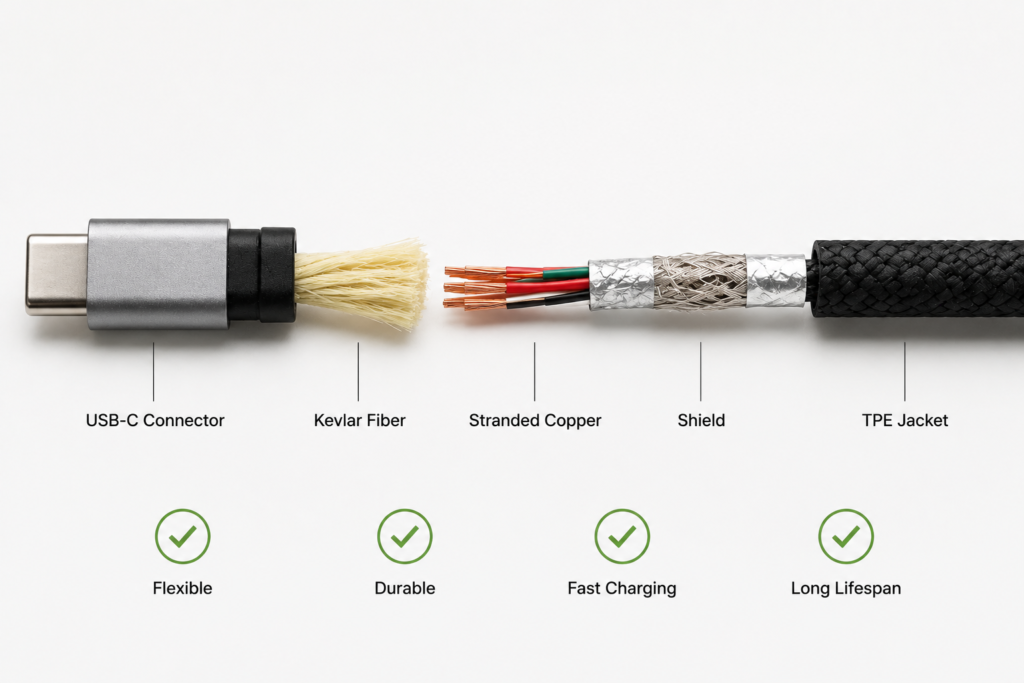
Choose cables with multi-strand fine copper conductors, select TPE/TPU sheath according to scenarios, and prioritize products with reinforced connectors to avoid stress concentration damage.
10.2 Correct Daily Use and Storage Methods
Avoid violent pulling, trampling and sharp bending of cable roots. Store cables with gentle winding instead of tight knotting. Keep cables away from high temperature, long-term sunlight and humid environments.
10.3 Quick Identification of Aging and Damage
Stiff, cracked, yellowed and bulging outer skin, intermittent connection during bending, and loose and hot connectors are all aging signs, requiring timely replacement to avoid safety risks.
11. Conclusion
11.1 Material, Structure and Process Jointly Determine Cable Quality
Cable flexibility and durability are not determined by a single factor. Internal conductor structure, outer sheath material and production process work together to determine the overall quality and service life of cables.
11.2 Scenario-Adaptive Cables Are the Best Choice
There is no absolute best cable, only the most suitable one. Balance flexibility and durability according to actual usage scenarios, and avoid blind pursuit of softness, thickness and high price to select the most cost-effective and durable products.