
Introduction
If you’ve ever plugged your phone into your car’s USB-C port and wondered why it charges slower than your wall charger — or why cheap replacement ports always break — you’re not alone. Most drivers assume all USB-C ports are the same. They’re not.
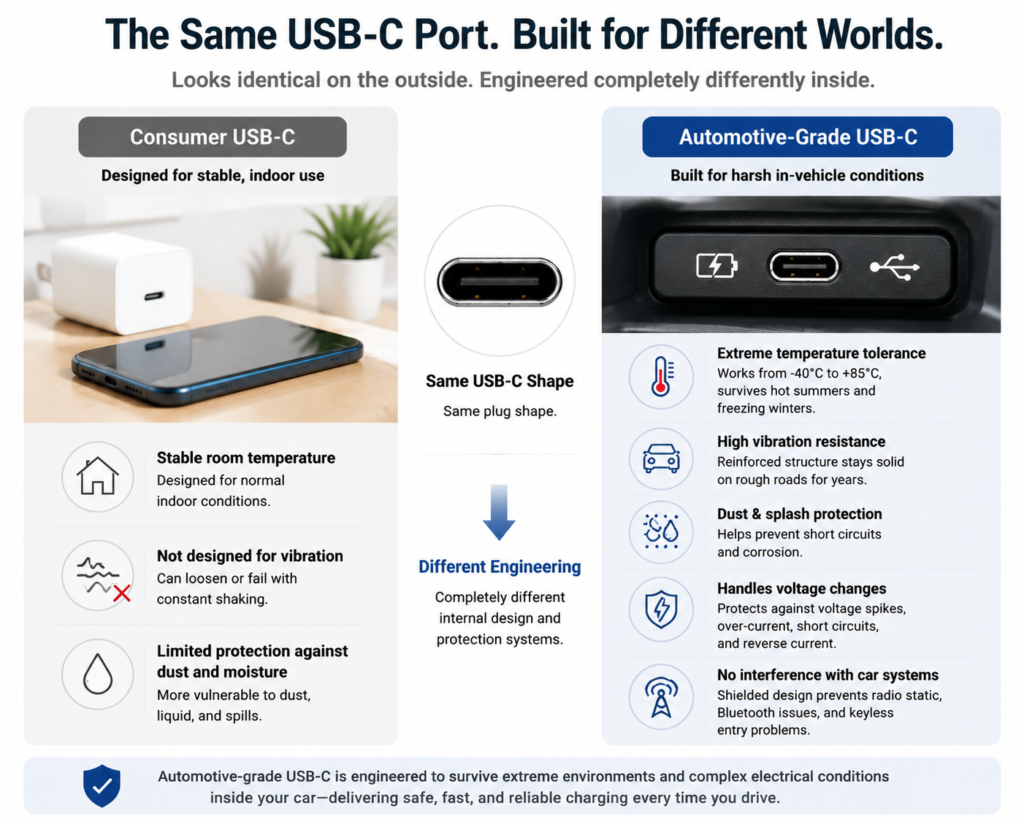
The USB-C port in your dashboard is built to a completely different standard than the one on your phone charger. Consumer-grade USB-C is made for stable, room-temperature indoor use. Automotive-grade USB-C has to survive the brutal environment inside a vehicle: baking summer heat, freezing winters, constant vibration, dirty electrical power, dust, and the occasional spilled coffee.
This guide breaks down exactly what makes automotive-grade USB-C different, why those differences matter for safety and reliability, and how to tell genuine factory-grade ports apart from cheap aftermarket lookalikes.
1. What Is Automotive-Grade USB-C?
1.1 The Difference You Can’t See
From the outside, they look identical. Plug a cable into either one and it fits exactly the same. Under the surface, they’re built for completely different worlds.
A regular consumer USB-C port fails quickly under heat, cold, vibration, or unstable power. An automotive-grade port is purpose-built for vehicle conditions: wild temperature swings, nonstop vibration, sudden voltage spikes, dust, and occasional liquid exposure. It is designed according to strict automotive reliability requirements used by vehicle manufacturers.
1.2 Where You’ll Find Them
- Center console and armrest charging ports
- Rear-seat passenger charging ports
- CarPlay / Android Auto / HiCar data connection ports
- Dashcam and accessory power ports
2. Built for Extreme Environments
Your car goes through conditions no home electronics ever face. Automotive-grade USB-C is designed to handle all of it, reliably, for years.
2.1 Extreme Temperature Tolerance
Inside a parked car, the dashboard can hit 85°C (185°F) in the summer sun — hot enough to soften plastic. In deep winter, it can drop to −40°C (−40°F), cold enough to make ordinary components brittle.
Think of consumer USB-C as a houseplant. It dies if it gets too hot or too cold. Automotive-grade USB-C is a desert cactus — it’s built to handle the full swing.
A regular charger would shut down or burn out in these conditions. Automotive-grade ports work normally across the entire temperature range, even after months of parked exposure.
2.2 Vibration & Durability
Your car vibrates constantly — on rough roads, over speed bumps, during hard acceleration and braking. Over years, that constant shaking destroys ordinary connectors.
Automotive-grade USB-C uses reinforced internal structures. Contacts don’t loosen, connections don’t drop out, and the port doesn’t fail after prolonged vibration.
Plug-cycle rating (how many times you can plug and unplug before the connector wears out):
- Ordinary consumer USB-C: 3,000–5,000 insertions
- Automotive-grade USB-C: 10,000+ insertions
At two plugs a day, an automotive port lasts well over a decade. A cheap replacement goes loose and unreliable in 4–5 years.
2.3 Dust & Splash Resistance
Dust buildup, spilled drinks, and rain through open windows can kill regular ports. Automotive-grade USB-C includes basic dust and splash protection to prevent short circuits (when electricity takes an unintended shortcut — like water bursting from a cracked pipe — causing overheating and damage) and corrosion.
A spilled soda won’t fry the whole system.
3. Electrical Safety Design
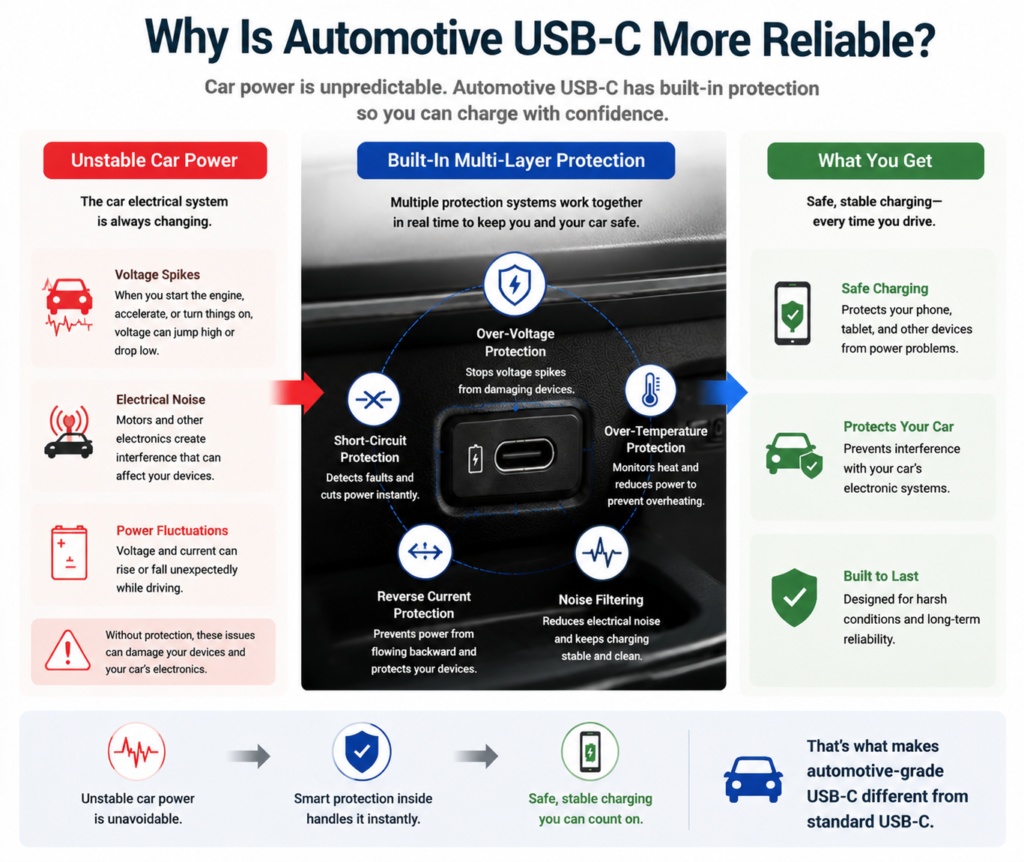
Car power is messy — nothing like the steady wall power in your house. Automotive-grade USB-C is built specifically to ride out that instability.
3.1 Handles Voltage Spikes
When you start the engine, shut it off, or accelerate hard, your car’s 12V battery voltage jumps up and down sharply. Imagine turning on a tap and having the water pressure spike and drop every few seconds — ordinary electronics can’t handle it.
Automotive-grade USB-C absorbs these fluctuations cleanly and delivers steady charging power. Lower-quality chargers may become unstable, restart unexpectedly, or fail prematurely when the engine turns over.
3.2 Five Layers of Protection
High-quality automotive USB-C systems usually include several layers of protection, such as:
- Over-voltage protection — shuts down if voltage climbs too high
- Over-current protection — caps how much current can flow
- Short-circuit protection — cuts power instantly if wires touch where they shouldn’t
- Over-temperature protection — slows charging if things get too hot
- Reverse-current blocking — prevents power from flowing backward into the car’s system
If your cable frays and causes a short, the port kills power instantly. It won’t damage your car’s wiring or blow a fuse.
3.3 Ultra-Low Standby Power
After you lock the car, the USB-C port draws nearly zero power. Most ports shut off completely after a few minutes without a device connected. This prevents your 12V battery from draining during long parking — a common complaint with cheap aftermarket chargers.
4. Charging Speed & Compatibility
Car USB-C ports come in clear power tiers and work with nearly every phone on the market.
4.1 Standard Charging Protocols
All qualified automotive USB-C ports support USB data transfer for phone mirroring and system updates. For charging, they use the universal PD 3.0 standard (short for Power Delivery — the shared “fast-charging language” that all USB-C devices speak). If both the port and your phone support PD, they automatically negotiate the fastest safe speed.
4.2 Three Common Power Tiers
- Low-power data port (5V): Slow charging, built mainly for CarPlay and data connection
- Daily fast-charge port (18W–30W): Ideal for phones and tablets
- High-power emergency port (45W–65W): Can even charge laptops on the go
4.3 Works With Almost Everything
You don’t need a special PD cable. Automotive-grade USB-C works with standard USB-A to C cables, QC (Quick Charge) fast charging, and most brand-specific phone fast-charge systems. All devices charge normally.
5. No Signal Interference (Radio, Bluetooth & Keyless Entry Work Fine)
This is one of the biggest differences between automotive-grade and ordinary chargers — and one most drivers never notice until it breaks.
5.1 Doesn’t Mess With Your Car
Cheap chargers emit messy electromagnetic noise. They cause radio static, weak Bluetooth, and slow keyless entry response.
Automotive-grade USB-C uses strict shielding. It charges your phone without disturbing any of your car’s other electronic systems.
5.2 Doesn’t Get Disturbed By Your Car
Your car’s motor and high-voltage systems generate strong electrical noise while running. Ordinary chargers disconnect or restart randomly in this environment. Automotive-grade ports stay stable no matter how much noise is around them.
5.3 Certified Worldwide
- United States: FCC certification
- European Union: CE & RED certification
- All factory parts pass ISO automotive electronics testing
These aren’t just stickers. They mean the port has been independently verified not to cause signal failures, radio noise, or hidden electrical risks.
6. Build Quality & Materials
The durability difference starts with the components inside.
A smartphone charger may be replaced every few years, but vehicle electronics are expected to survive for the entire life of the car. This completely changes the design requirements.
Automotive-grade USB-C uses gold-plated contacts that resist oxidation and corrosion — the metal doesn’t tarnish or rust even after years of temperature swings. The internal chips and components all meet the strict AEC-Q100 standard for automotive semiconductors (a rigorous stress-testing regime for chips used in cars — consumer chips usually follow different testing requirements designed for less demanding environments). No cheap consumer-grade parts are used.
The internal circuit board uses thickened copper foil. Thicker copper layers help carry electrical current with less heat, similar to using a wider pipe to move water more efficiently. Power and data lines are physically separated for stability.
7. Factory Testing & Certification
Before going into mass-produced cars, every USB-C module passes a battery of tests:
- ISO 16750 — international vehicle environment standard (temperature, vibration, humidity)
- IEC 62680 — the official USB-C international specification
- Internal brand standards from Tesla, Toyota, Volkswagen, BYD, and others
- Long-term road testing and bench simulation
Only modules with proven, stable performance make it into production vehicles.
8. Two Types of Car USB-C Ports
8.1 Charge-Only Ports
Charging only, no data transfer. Simple design, very reliable power delivery.
8.2 Charge + Data Dual-Purpose Ports
Supports both fast charging and wired phone mirroring. Ensures smooth CarPlay / Android Auto without lag or audio sync issues.
All factory ports include automatic device detection — they recognize whether you’ve plugged in a phone, USB drive, dashcam, or laptop. If something abnormal is detected, they limit power or shut off entirely to protect the car’s system.
9. Common Misconceptions
Misconception 1: Same Shape = Same Quality
Truth: Many cheap aftermarket USB-C ports look identical on the outside. Inside, they use low-grade chips with no vibration resistance, no temperature rating, and no safety protection. They are not real automotive-grade products.
Misconception 2: Higher Wattage = Better
Truth: More power isn’t always better. If your car’s internal wiring can’t safely handle high wattage, forcing it creates overheating and fire risk. Match the port to what your car’s wiring supports.
Misconception 3: Aftermarket Mods = Factory Performance
Truth: Most add-on USB-C hubs and expansion ports are consumer-grade. They lack automotive-level vibration resistance, temperature tolerance, and interference shielding. After months in the car, they overheat, drop connections, or fail entirely.
10. How to Choose Safe In-Car USB-C Products
- Factory ports first — the safest option, fully automotive-grade, with the highest compatibility and reliability
- Reputable aftermarket docks — look for AEC-Q100, ISO 16750, and local certification marks on the packaging
- Avoid no-name generic products — unmarked cheap ports are not safe for long-term in-car use
Conclusion
Automotive-grade USB-C is far more than a charging jack. It’s a complete vehicle-specific safety system — engineered to survive extreme temperatures, constant vibration, unstable power, and electromagnetic noise.
Understanding the difference between factory automotive-grade USB-C and ordinary consumer USB-C helps you avoid unsafe aftermarket accessories, protect your car’s electrical system, and enjoy reliable, fast, safe charging every time you drive.