
1 Introduction: Why Your Fast Charger Sometimes Feels Slow
1.1 A Common Everyday Frustration
Almost everyone has run into this: you buy a 65W fast charger, and it charges your phone from 0 to 70% in half an hour. But when you use it to charge a friend’s phone, it only reaches 50% after a full hour. The wattage is identical, but the charging speed is drastically different.
1.2 The Core Truth About Fast Charging
The truth is, fast charging is never just about the wattage number. For high-speed charging to work, the charger and your phone must speak the same “language” — a set of rules called a fast charging protocol. Without a matching protocol, even the most powerful charger will fall back to slow, basic charging speeds.
1.3 What This Guide Covers
In this guide, we break down the three most popular fast charging standards — USB PD, Quick Charge, and UFCS — in plain language, so you can shop for chargers and devices with confidence.
2 Fast Charging Basics
2.1 What Is a Fast Charging Protocol?
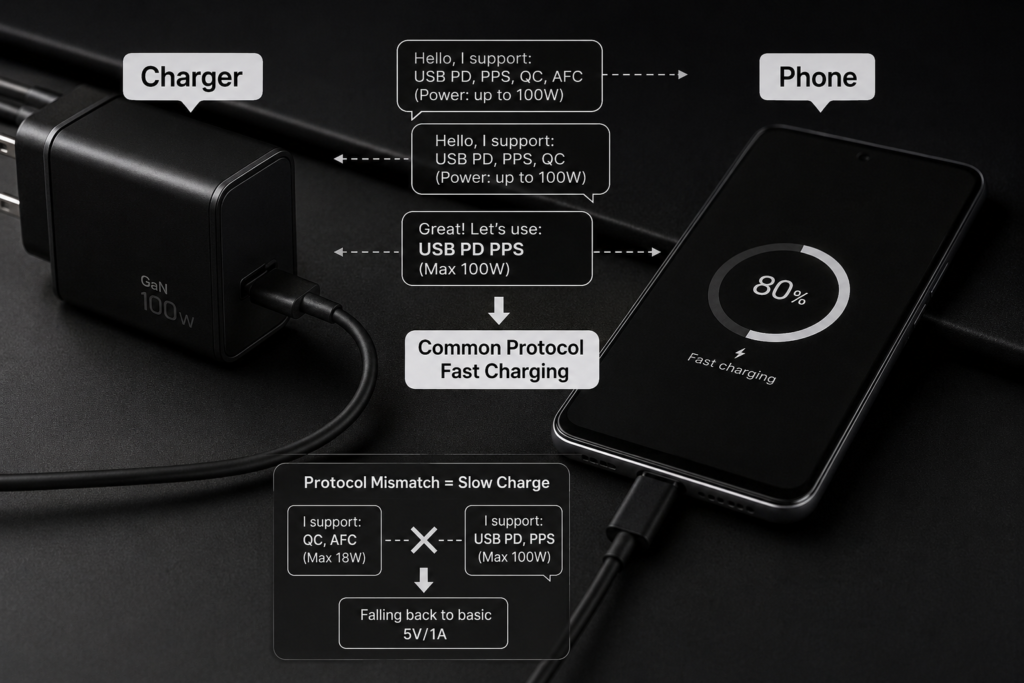
Think of a charging protocol as a shared language between your charger and your phone.
Before charging starts, the charger “asks” the phone: here are the voltage and current levels I can provide. Which ones work for you? The phone responds, and both sides agree on the fastest compatible setting before high-power charging begins.
If they don’t speak the same language (protocol mismatch), they can only use the basic 5V slow charging mode. This is why a high-wattage charger can feel slow on some devices.
2.2 Fast Charging Technical Approaches
Fast charging works by increasing electrical power. Since Power = Voltage × Current, the industry has taken three main paths:
2.2.1 High Voltage, Low Current
Raises voltage while keeping current steady. It works with standard cables but generates more heat during charging. Early QC and PD used this method.
2.2.2 Low Voltage, High Current
Keeps voltage low and increases current. It runs cooler and more efficiently, but requires special thicker cables. Most brand-specific proprietary chargers use this design.
2.2.3 Hybrid Adaptive Voltage
Dynamically adjusts voltage and current based on battery status, balancing speed and temperature. This is the modern standard, used by PD PPS and UFCS.
3 The Three Major Fast Charging Standards
3.1 USB PD: The Global Universal Standard
USB Power Delivery (PD) is the most widely accepted and versatile fast charging standard in the world.
3.1.1 Background
Developed by the USB Implementers Forum (USB-IF), it is the official industry standard for USB — essentially the “global language” of charging, available royalty-free for every brand.
3.1.2 Key Milestones
- PD 2.0 (2014): Established the foundation for fast charging, up to 100W with fixed voltage levels (5V, 9V, 12V, 20V).
- PD 3.0 (2015): Added Programmable Power Supply (PPS), allowing fine, continuous voltage adjustments for smoother, cooler charging.
- PD 3.1 (2021): Introduced Extended Power Range (EPR), supporting up to 240W — enough to power gaming laptops and monitors.
3.1.3 Core Features
- Communicates via the CC pin on Type-C connectors; only works with Type-C ports
- Supports bidirectional power: devices can charge each other
- Split into Standard Power Range (up to 100W) and Extended Power Range (up to 240W)
3.1.4 Compatible Devices
All Apple iPhones, laptops, Nintendo Switch, and most universal chargers and accessories.
3.2 Quick Charge (QC): The Veteran for Snapdragon Devices
Quick Charge is Qualcomm’s proprietary fast charging technology, built specifically for phones with Snapdragon processors. It was one of the first widely adopted fast charging standards on Android.
3.2.1 Background
Because most early Android phones used Snapdragon chips, QC became the de facto “veteran” standard in the Android ecosystem.
3.2.2 Key Milestones
- QC 1.0 (2013): 10W at 5V/2A, the first step into fast charging
- QC 2.0 (2015): 24W, establishing the high-voltage charging approach
- QC 3.0 (2016): 36W with INOV intelligent voltage adjustment in 0.2V increments
- QC 4.0+ (2017): Up to 100W, with native USB PD compatibility
- QC 5/5+ (2020–2025): Over 100W, with major improvements to temperature control and safety
3.2.3 Core Features
- Communicates via the D+ and D- pins of the USB connector
- Works with both Type-A and Type-C ports
- Natively supported on nearly all Snapdragon-powered phones
3.2.4 Compatible Devices
Android phones with Snapdragon processors, and universal charging accessories.
3.3 UFCS: China’s Unified Fast Charging Standard
UFCS (Universal Fast Charging Specification) is a standard led by the China Academy of Information and Communications Technology (CAICT), developed jointly with major Chinese phone makers including Huawei, OPPO, vivo, and Xiaomi.
3.3.1 Background
Its main goal is to break down the walls between brand-specific proprietary chargers, so different phone brands can charge at high speed with the same charger.
3.3.2 Key Milestones
- 2021: Version 1.0 released, supporting 33–44W with basic cross-brand compatibility
- 2025: UFCS 2.0 released, raising maximum power to 100W with improved interoperability and precision
3.3.3 Core Features
- Dual-channel communication via both D+/D- and CC pins for broader compatibility
- Extremely precise voltage adjustment: 10mV voltage steps and 10mA current steps for ultra-smooth charging
- SHA256 security verification for enhanced charging safety
- Backward compatible with PD, QC, and other major protocols — one charger works with more devices
3.3.4 Key Benefit
Eliminates the frustration of “Brand A’s fast charger only slow-charges Brand B’s phone”, enabling true cross-brand fast charging across Chinese domestic brands.
3.3.5 Compatible Devices
Major Chinese Android phones, and UFCS-certified chargers and accessories.
4 Side-by-Side Comparison
4.1 Core Specifications
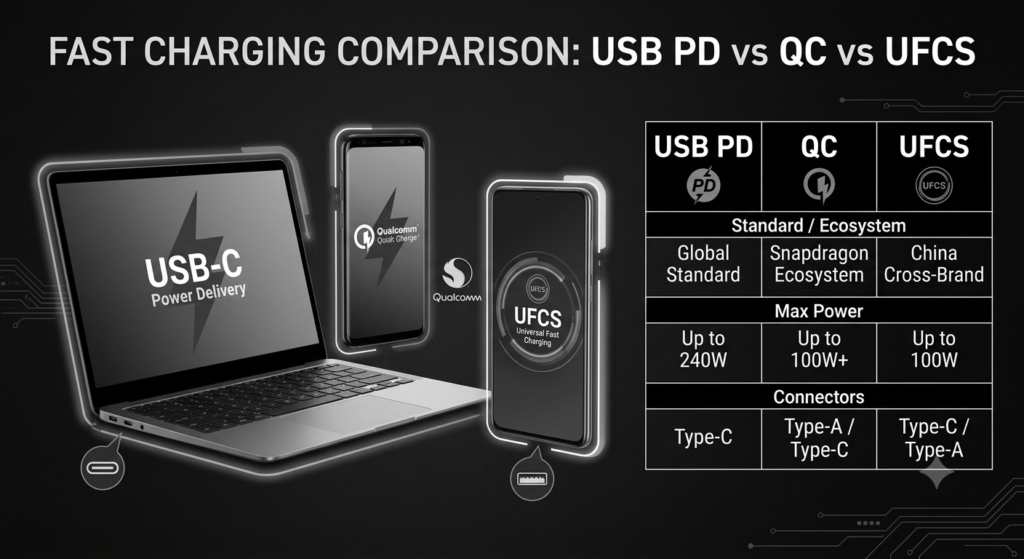
| Category | USB PD | Quick Charge (QC) | UFCS |
|---|---|---|---|
| Developed by | USB-IF (global industry association) | Qualcomm (USA) | CAICT + Chinese device makers |
| First released | 2012 | 2013 | 2021 |
| Max power | 240W (PD 3.1 EPR) | 100W+ (QC 5+) | 100W (UFCS 2.0) |
| Communication | CC pin (BMC encoding) | D+ / D- pins | D+ / D- + CC dual channel |
| Port type | Type-C only | Type-A / Type-C | Type-C primary, Type-A compatible |
| Voltage step precision | 20mV (with PPS) | 200mV (QC 3.0) | 10mV |
4.2 Compatibility & Versatility
- USB PD: The most universal. Works with everything from earbuds and phones to laptops and monitors — a true cross-platform, cross-brand standard.
- Quick Charge: Limited to its ecosystem. Great for Snapdragon phones, but rarely supported on non-Snapdragon or Apple devices.
- UFCS: Strong regional interoperability. Works best across Chinese Android brands, but global adoption is still growing.
4.3 Power Range & Use Cases
- Low power (18–33W): All three standards work well, with little real-world difference for everyday phone charging.
- Medium power (45–65W): PD and UFCS have the advantage, with finer voltage control and better thermal performance.
- High power (100W+): PD 3.1 has the highest ceiling at 240W; QC 5+ and UFCS 2.0 both cover the 100W class.
- Laptops, monitors & high-power devices: PD is in a league of its own — it is the only universal standard capable of powering laptops.
5 Protocol Compatibility: Can You Mix and Match?
A common question: will mixing chargers and phones damage my device? The short answer is no — but charging speed may be reduced.
5.1 Compatibility Hierarchy
- USB PD is the universal base standard. QC 4.0+ and UFCS both natively support PD, so any QC or UFCS device will charge fine with a PD charger.
- QC and UFCS do not natively talk to each other. They can still work together, but fall back to their shared PD baseline.
- Brand-specific proprietary protocols (like Huawei SCP or OPPO VOOC) are usually built on top of these three public standards.
5.2 Real-World Mixing Examples
- PD charger + QC phone: Will charge at PD speeds, slightly slower than native QC but not slow charging.
- QC charger + UFCS phone: Will typically fall back to basic PD power, not UFCS high-speed mode.
- UFCS charger + PD device: Works exactly like a standard PD charger.
- Different Chinese brand phones + UFCS charger: Will trigger UFCS standard fast charging — the biggest advantage of UFCS.
6 Buying Guide for Everyday Users
6.1 Choose by Your Devices
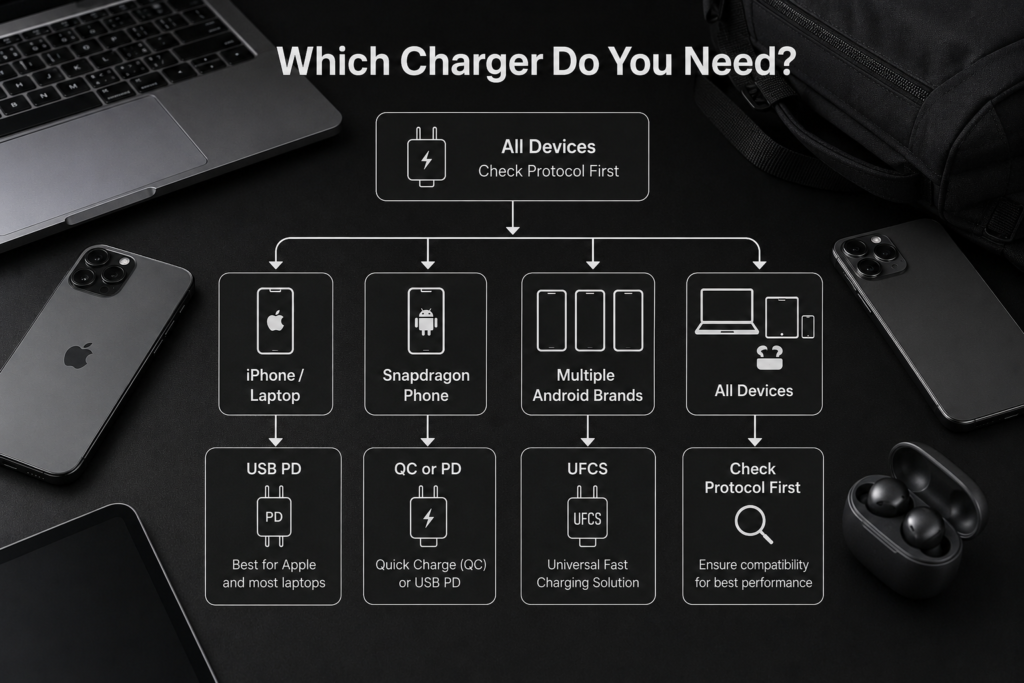
- Apple users: Stick with USB PD chargers. All iPhones use PD exclusively, and it’s the most stable, reliable option.
- Single-brand Android users: The original brand charger is always best. For third-party options, pick one that supports your phone’s proprietary protocol.
- Multi-device users: Go for a PD-based multi-protocol GaN charger. One charger handles phones, earbuds, tablets and more.
- Multiple Chinese Android brands: Look for UFCS-certified chargers. You get standard fast charging across brands without carrying multiple chargers.
6.2 Choose by Your Scenario
- Everyday carry: 30–45W is plenty, compact and portable.
- Desk setup: A 65W multi-port GaN charger is ideal — power your phone, earbuds and tablet from one outlet.
- Laptop charging: You’ll need a 100W+ PD 3.0/3.1 charger to meet laptop power requirements.
- Travel: A multi-port PD GaN charger is the most convenient — one charger for all your gear, less bulk in your bag.
6.3 Common Pitfalls to Avoid
6.3.1 Wattage alone doesn’t equal speed
A 120W proprietary charger may perform worse than a 25W PD charger on an unsupported phone.
6.3.2 Cheap chargers often skip protocols
Many budget chargers advertise high wattage but only support basic PD modes, missing QC, UFCS and other standards.
6.3.3 Cables matter too
Charging above 60W requires an E-Marker chip cable. High-current charging needs 5A-rated cables. Standard cables will limit your charging speed.
6.3.4 Look for official certification
Prefer products with USB-IF certification or UFCS official certification for better compatibility and safety.
7 The Future of Fast Charging
7.1 The Move Toward Global Standardization
With the EU’s mandatory Type-C law for phones and tablets, the world has already unified on the charging port. The next step is unifying charging protocols.
USB PD will remain the global baseline standard for the foreseeable future. UFCS, backed by its massive domestic adoption, is also growing internationally and becoming an important part of the global charging landscape.
7.2 Where Technology Is Headed
Future fast charging won’t just chase higher wattage. It will focus on three areas:
- Better balance between charging speed, temperature control and battery lifespan
- Convergence of wired and wireless charging standards
- Smarter battery health management to reduce wear while charging fast
7.3 The Future of UFCS
As a China-led standard, UFCS has strong growth potential:
- Its domestic market penetration will keep rising, with more phones and accessories gaining UFCS certification
- It will expand beyond phones to tablets, laptops, wearables and more consumer electronics
- With the scale of the Chinese market, it is well-positioned to compete in global standard-setting
8 Final Summary
Here’s the simple breakdown to help you choose:
8.1 For global compatibility and multi-device use (phone + laptop + tablet): go with USB PD
8.2 For Snapdragon Android phones: QC works great, and PD is also perfectly fine
8.3 For multiple Chinese Android brands: prioritize UFCS-certified products
The number one rule of fast charging: protocol compatibility always matters more than the wattage number.