
1. The “Negotiation Mechanism” of Fast Charging
1.1 Why Can’t Fast Charging Reach Full Speed Right After Plugging In?
Many people wonder: if a charger is rated for 65W high power, why doesn’t it charge my phone at full speed immediately?
The answer is simple: fast charging is not a one-way process where the charger forces power into the device. It is a process of mutual negotiation.
Different electronic devices have different battery voltage limits and charging circuit designs. For example, a phone battery usually runs at around 3.7V, while a laptop requires 20V. If the charger output its maximum voltage right away, it could either fail to charge the device or even damage its internal components.
That’s why before formal power delivery, the charger and the device must “talk” first: what can you provide? What do I need? Only after both sides reach an agreement does fast charging begin. This set of communication rules is the core of the USB PD fast charging protocol.
1.2 Simple Analogy: PDO = The Charger’s Menu, RDO = The Device’s Order
To understand PDO and RDO, think of dining at a restaurant. This analogy makes everything clear:
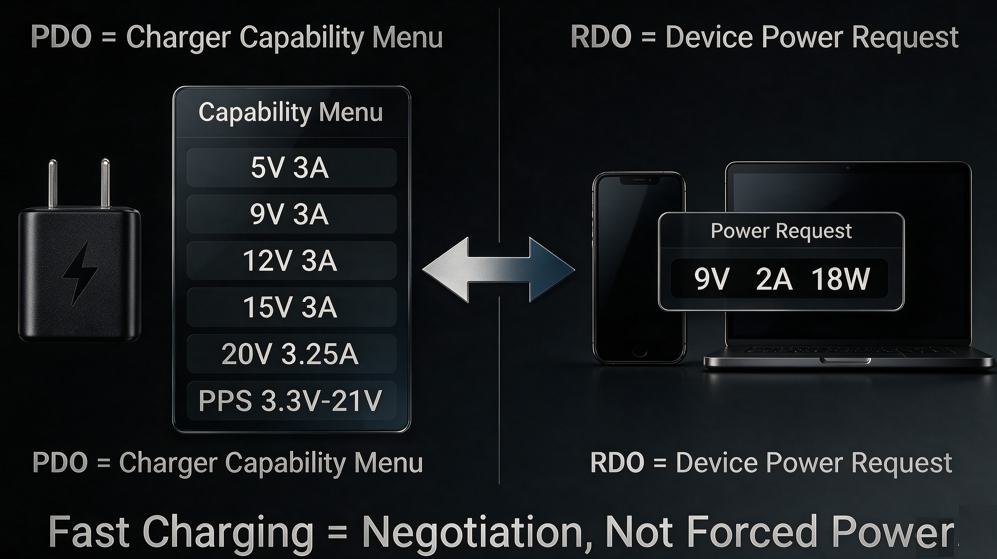
- PDO (Power Delivery Object) is the restaurant’s menu. It lists all the dishes the restaurant can make and the portion size of each. Similarly, a charger lists all the voltage and current levels it can output.
- RDO (Request Data Object) is the customer’s order. The customer picks suitable dishes from the menu based on their appetite and preferences. In the same way, the powered device selects a suitable power specification from the charger’s capabilities. The entire fast charging negotiation process is exactly like a restaurant experience: the restaurant gives you a menu → you look at the menu → you place your order → the restaurant serves your food.
1.3 Their Roles in the USB PD Fast Charging System
PDO and RDO are the two most basic and core “communication units” in the USB PD fast charging protocol.
- PDO is the “capability statement” of the power source (chargers, power banks, car chargers, etc.), and it is the foundation of all negotiation.
- RDO is the “demand instruction” of the powered device (phones, laptops, tablets, etc.), and it determines the final power output. Without PDO, the device would not know what the charger can provide. Without RDO, the charger would not know what the device needs. Working together, they allow one charger to fast charge many different devices while ensuring charging safety.
2. PDO Explained: The Charger’s Capability List
2.1 What is PDO?
PDO stands for Power Delivery Object.
In simple terms, it is a list of the charger’s capabilities. When you plug a PD charger into a device, the charger immediately sends all its available power specifications to the device, saying: “Here are all my power modes. Choose whichever you like.”
Each power specification is one PDO. A PD charger usually has multiple PDOs, corresponding to different voltage and current combinations.
2.2 Three Main Types of PDO
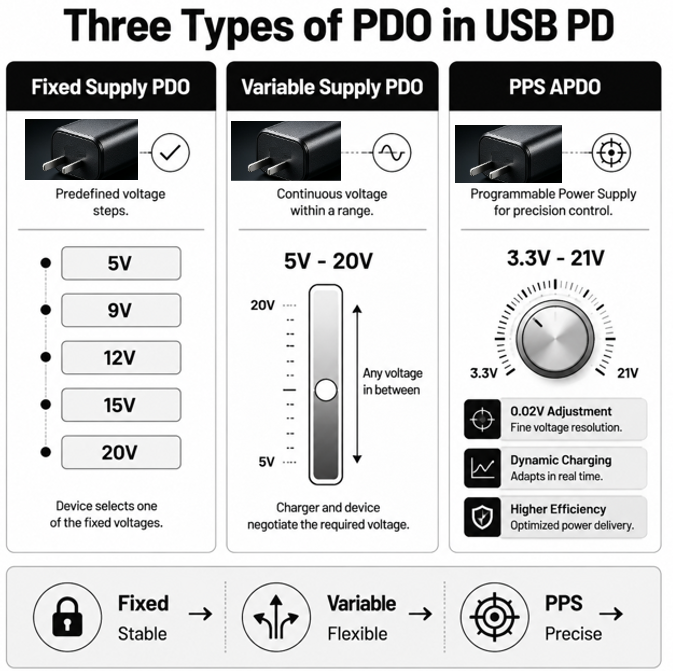
PD chargers on the market mainly have three types of PDO, designed for different usage scenarios.
2.2.1 Fixed Supply PDO
This is the most common and most compatible type of PDO.
It features fixed voltage levels, just like set meals on a menu with only fixed options. The classic fast charging levels we often hear about — 5V, 9V, 12V, 15V, 20V — all belong to fixed supply PDOs.
Most phone fast charging and laptop charging use these fixed levels. This technology is the most mature and has the best compatibility, working with almost all PD-enabled devices.
2.2.2 Variable Supply PDO
This type of PDO does not have fixed voltage points. Instead, it supports a continuous voltage range, for example, adjustable anywhere between 5V and 20V.
It is like “choose your own portion size” at a restaurant — you can have any amount within a certain range. This type is commonly found in car chargers and some power banks. Since a car’s battery voltage fluctuates, this wide-range PDO can better adapt to unstable input conditions.
It is rarely used for daily phone or laptop charging, and is mostly designed for special scenarios.
2.2.3 Programmable Power Supply (PPS APDO)
This is the most popular type of PDO for smartphone fast charging today. It is called Programmable Power Supply, or PPS for short.
Unlike fixed voltage levels, PPS supports fine voltage and current adjustment in very small steps — for example, adjusting voltage by 0.02V at a time. It is like a custom meal where you can choose exactly how well-done your food is and how much sauce you want, perfectly matching the real-time status of the phone battery.
Its core value is improving charging efficiency and reducing heat generation. Many 100W+ fast charging phones rely on PPS: they adjust voltage and current in real time based on battery temperature and charge level, maintaining efficient charging throughout the process.
2.3 Key Information in a PDO
Every PDO contains three key pieces of information, which are very easy to understand:
- Output voltage / voltage range: The voltage this level can provide, such as 9V, or a PPS range like 3.3V to 11V.
- Maximum output current: The maximum current the charger can provide at this voltage level, such as 3A.
- Corresponding power: Power = Voltage × Current. For example, 9V × 3A = 27W, which is the maximum power of this level. When we say a charger is 65W, we usually mean the maximum power of its highest level, such as 20V 3.25A, which equals exactly 65W.
2.4 Example: Typical PDO List of a 65W PD Charger
Take the most common 65W PD charger as an example. Its PDO list usually looks like this:
- 5V 3A (15W)
- 9V 3A (27W)
- 12V 3A (36W)
- 15V 3A (45W)
- 20V 3.25A (65W) If the charger also supports PPS, it will usually have one more entry:
- 3.3V-21V 3.25A (PPS) This is the charger’s complete “menu”. The device will pick the most suitable one from these levels.
3. RDO Explained: The Powered Device’s Power Request
3.1 What is RDO?
RDO stands for Request Data Object.
If PDO is the menu handed over by the charger, RDO is the order filled out by the device. After reading the charger’s PDO list, the device selects the most suitable level based on its own charging circuit design and current battery status, then packages its demand into an RDO and sends it back to the charger.
Simply put: PDO is “what I can give”, RDO is “what I want”.
3.2 Core Functions of RDO
An RDO mainly does three things:
First, it selects which PDO level to use. It tells the charger: “I’ll take the second option, the 9V level on your menu.”
Second, it specifies the required voltage and current limit. It tells the charger: “I need 9V, and I will use at most 2A of current.”
Third, it ensures charging safety. The requested values in the RDO never exceed the device’s own tolerance limit, and never exceed the charger’s capability limit stated in the PDO. Both sides stay within safe boundaries, so overload never happens.
3.3 Key Parameters of RDO
You don’t need to understand complex protocol structures. The core information in an RDO is just three things:
- Target PDO number: Which item on the menu is selected, corresponding to one of the charger’s voltage levels.
- Operating voltage: The voltage the device currently needs. For example, a phone may need different voltages when the screen is on versus when it’s off.
- Maximum operating current: The peak current the device will draw at this voltage — like saying “this is the most I will eat”. After receiving the RDO, the charger adjusts its output according to these requirements.
3.4 Basic Principles for Device PDO Selection
Devices don’t pick levels randomly. They usually follow three principles:
First, voltage matching comes first. The device prioritizes the voltage level closest to its charging circuit design. For example, if a phone’s charging IC supports 9V, it will choose the 9V level first instead of jumping straight to 20V. Too much voltage step-down wastes energy and generates more heat.
Second, current never exceeds the PDO limit. The maximum current requested by the device will never exceed the maximum current the PDO can provide. For example, if the PDO is 9V 3A, the device will request at most 3A, never 4A.
Third, prioritize the most efficient solution. Among all usable levels, the device picks the one with the least charging loss and highest efficiency. For example, a phone that supports PPS will choose the PPS level over a fixed voltage level, because PPS allows finer voltage adjustment and higher efficiency.
4. Full Interaction: The Complete Process of a PD Fast Charging Negotiation
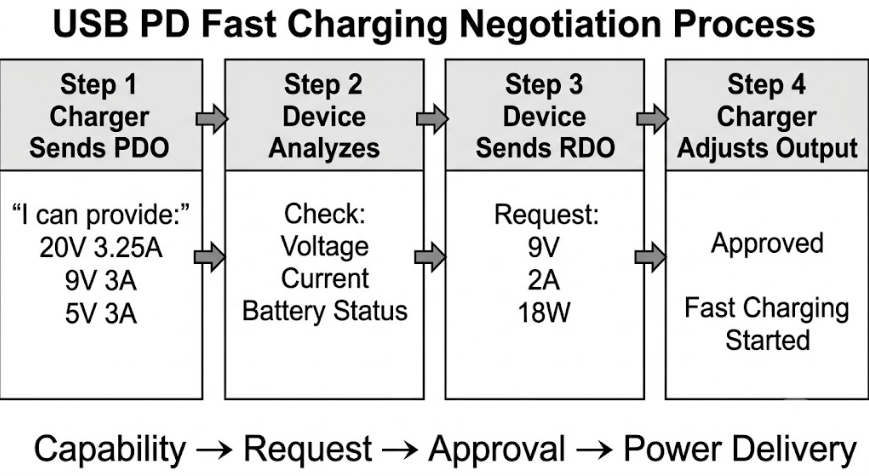
Now that we understand PDO and RDO, let’s put the whole process together to see how a complete fast charging negotiation happens. The whole process is extremely fast — it completes the moment you plug in the charger.
4.1 Stage 1: The Charger Broadcasts PDOs, Showing Its “Menu”
When the charger is plugged into power and the device is connected via the cable, the charger immediately broadcasts its full PDO list through the CC pin. It’s like handing the menu to the customer.
This process is initiated by the charger. Whether the device responds or not, it first states its capabilities clearly.
4.2 Stage 2: The Device Parses PDOs and Plans Its “Order”
After receiving the PDO list, the device’s internal charging chip immediately analyzes them: do I support these levels? Which level is best for my current status?
For example, when a phone’s battery is very low, it may choose a high-voltage, high-current level for fast charging. When the battery is almost full, it will switch to a low-voltage, low-current level for trickle charging. The device calculates the optimal power request based on its real-time status.
4.3 Stage 3: The Device Sends RDO, Submitting Its “Order Request”
Once the demand is determined, the device packages the request into an RDO and sends it back to the charger.
This is like a customer handing their written order to the waiter after reading the menu. The RDO clearly states which level to use and how much current is needed.
4.4 Stage 4: The Charger Confirms RDO and Adjusts Output
After receiving the RDO, the charger first checks: is this request within my capability?
If everything is fine, the charger adjusts its internal output voltage and current, and starts supplying power according to the RDO requirements. At this point, the device officially enters fast charging mode.
If the request is out of range (for example, a faulty device sends an abnormal request), the charger will reject it and stay at the basic 5V output to ensure safety.
4.5 Dynamic Adjustment: RDO Updates During Charging (PPS Scenario)
The process above is for fixed voltage level negotiation. In PPS-enabled scenarios, negotiation is not a one-time event — it happens dynamically throughout the charging process.
During charging, the battery voltage gradually rises, and the temperature also changes. The device will resend an RDO at regular intervals, fine-tuning the voltage and current to keep charging as efficient and safe as possible.
It’s like a customer calling the waiter over at any time during the meal to add or remove dishes, getting exactly what they need the whole time. This dynamic RDO adjustment is why many phone fast chargers charge quickly at first, then steady down without overheating.
5. Practical Guide: What’s the Use of Understanding PDO/RDO?
Understanding PDO and RDO not only helps you grasp how fast charging works, but also answers many common questions about daily charging.
5.1 Answers to Common Questions
Why do PD chargers charge at very different speeds even if they have the same power rating?
The core reason is their PDO lists are different.
For example, take two 65W PD chargers. One only has fixed 5V/9V/12V/15V/20V levels, while the other additionally supports PPS. When charging a PPS-enabled phone, the second one can reach full fast charging speed, while the first may only charge at 18W or even 10W.
In short: it’s not just about total power. Matching voltage levels is the key to fast charging.
Why won’t a high-power PD charger damage my phone?
Many people worry: will a 65W charger damage an 18W phone?
Not at all. Charging is actively requested by the device; the charger always responds passively to the RDO. The phone will only request the voltage and current it can handle — for example, only requesting 9V 2A — and the charger will only output 9V 2A. It will never force 65W into the phone.
It’s like ordering a small bowl of noodles at a restaurant — the restaurant won’t force you to take a full feast. The device is in control, so it’s completely safe.
5.2 How Ordinary Users Can Check PDO Information
If you want to know what PDO levels your charger has, there are two simple methods:
Method 1: Read with a charging tester. Inexpensive PD decoy meters or power testers available online can read the complete PDO list when plugged into the charger, showing you all voltage and current levels directly.
Method 2: Infer from the product spec sheet. Genuine chargers always list their output levels on the spec page, for example “Output: 5V3A, 9V3A, 12V3A, 20V3.25A”. These are its PDO levels.
5.3 Common Misconceptions Clarified
Misconception 1: The higher the charger power, the faster the charge
Wrong. The maximum charging speed is determined by the device. If your phone only supports 18W PD fast charging at most, even a 100W charger will only charge it at 18W. A high-power charger just has a higher capability ceiling; it will not force extra power into the device.
Misconception 2: Supporting PD protocol means supporting PPS
Wrong. PPS is an optional feature in the PD protocol, not a mandatory one. Many early PD chargers only support fixed voltage levels and do not support PPS. When buying a charger, don’t just look for “PD support” — check if the specifications mention “PPS” or “programmable power supply”.
Misconception 3: The charger will output exactly whatever the RDO requests
Wrong. The charger can only output within its own PDO capabilities. For example, if the device requests 10V but the charger only has fixed 9V and 12V levels, it can only output the closest level (9V or 12V). It cannot magically produce 10V. Only PPS-enabled chargers can deliver fine, continuous voltage adjustment.
6. Summary
Core Logic Recap
The essence of PD fast charging is a friendly negotiation between the power source and the powered device.
- PDO is the charger’s capability list — “what I can give”
- RDO is the device’s demand instruction — “what I want”
- The process is led by the device, with the charger responding passively. This ensures both wide compatibility and safety.
Remember PDO and RDO in One Sentence
PDO is the charger’s menu, RDO is the device’s order. Fast charging is not forced power delivery — it’s a negotiation.