
Quick Summary
- Core Definition: 100-240V means the charger is designed to operate within an AC input range from 100V to 240V, automatically converting mains power into stable direct current (DC) output for electronic devices.
- Key Value: Modern USB-C PD and GaN travel chargers with this specification are compatible with power grids in most countries worldwide, including the US, Japan, Europe, and Australia.
- Critical Distinction: Wide voltage solves electrical compatibility — it does not change plug shape. You will usually still need a plug adapter for different countries.
- Ideal For: International leisure travel, business trips, overseas study, and multi-region work setups.
Why Do Travel Chargers Need 100-240V Wide Input?
1.1 Global Power Grids Are Not Standardized
Different countries built their electrical systems independently over the past century, resulting in several regional voltage standards, with approximately 100-120V and 220-240V systems being the most common groups.
| Region | Nominal Voltage | Grid Frequency |
|---|---|---|
| United States | 120V | 60Hz |
| Canada | 120V | 60Hz |
| Japan | 100V | 50Hz (eastern) / 60Hz (western) |
| Most of Europe | 230V | 50Hz |
| United Kingdom | 230V | 50Hz |
| Australia | 230V | 50Hz |
| China | 220V | 50Hz |
| South Korea | 220V | 60Hz |
Aligned with IEC international electrical standards
Japan is unique among major economies because eastern regions (including Tokyo) mainly use 50Hz while western regions (including Osaka) mainly use 60Hz, a legacy of 19th-century infrastructure built by different European suppliers.
Plugging a single-voltage device into the wrong grid is not just inconvenient — it can cause permanent equipment damage, overheating, or even electrical fire risks. For frequent travelers, this used to be a constant source of anxiety.
1.2 What Problems Does Wide Input Solve?
Before universal chargers became common, international travel meant packing a heavy bag of accessories: country-specific chargers for every device, plus bulky voltage converters. Wide voltage input changes everything.
- Fewer items to pack: No need for region-specific chargers or external voltage converters. One charger handles nearly every destination.
- Zero user error risk: Older dual-voltage devices required you to manually flip a switch between 110V and 220V. Forget to flip it, and your device would burn out instantly. Wide input chargers adapt completely automatically.
How to Read the 100-240V Label on Your Charger
2.1 Breakdown of the Input Rating
Nearly every charger prints its electrical specifications on the back or bottom. Look for a line that reads:
INPUT: 100-240V~ 50/60Hz
Each part has a clear meaning:
- 100-240V: The full rated range of AC input voltages the charger is certified to safely accept. Any voltage between these two numbers works, no manual adjustment needed.
- ~ (tilde symbol): Indicates alternating current (AC), the type of electricity that comes from wall sockets.
- 50/60Hz: The charger is compatible with both major global grid frequencies. For modern electronic chargers, frequency difference has no noticeable effect on performance or lifespan.
2.2 Input Voltage ≠ Output Fast-Charging Power
This is one of the most common points of confusion. A charger has two completely separate sets of specs:
- INPUT: The electricity the charger takes from the wall. This determines whether it works in a given country.
- OUTPUT: The DC power the charger delivers to your device (for example, USB-C PD at 5V / 9V / 12V / 15V / 20V). This determines charging speed and device compatibility.
Bottom line: The input voltage range does not directly determine how fast your device charges. A quality 65W charger delivers full 65W output whether it is plugged into a 100V Japanese socket or a 230V German socket.
2.3 Three Types of Input Design, Compared
Not all chargers handle international travel equally. Here is how the three common designs stack up:
| Design Type | Typical Label | How It Works | Travel Suitability |
|---|---|---|---|
| Single Voltage | 120V only | Works only in one voltage region | Very low — will break if used abroad |
| Manual Dual Voltage | 110/220V Switch | Requires you to flip a physical switch | Moderate — high risk of user error |
| Automatic Wide Voltage | 100-240V~ 50/60Hz | Automatically adapts to any voltage in range | Excellent — true plug-and-play worldwide |
How Does a 100-240V Charger Auto-Adjust to Different Voltages?
3.1 The Secret: Switch-Mode Power Supply (SMPS) Technology
Many older low-cost power supplies and traditional linear adapters relied on fixed-ratio transformers or linear regulation methods. Those bulky, brick-style adapters from the 1990s and early 2000s are a common example — they stepped down voltage at a fixed ratio, so using them on the wrong grid would produce incorrect output and risk damaging your device.
Modern chargers use switch-mode power supply (SMPS) technology, which works on an entirely different principle. Think of it like a smart water tap: no matter how high or low the incoming water pressure (voltage), it adjusts instantly to deliver exactly the flow rate (power) your device needs.
This design brings three huge advantages:
- Much higher energy efficiency (most quality models meet DoE Level VI or VII standards)
- Far smaller size and lighter weight
- Natural ability to handle a very wide input voltage range
You do not need to memorize how each internal component works. The key takeaway is simple: this smart design lets the charger automatically turn unstable, variable wall power into clean, steady power for your devices — no manual settings required.
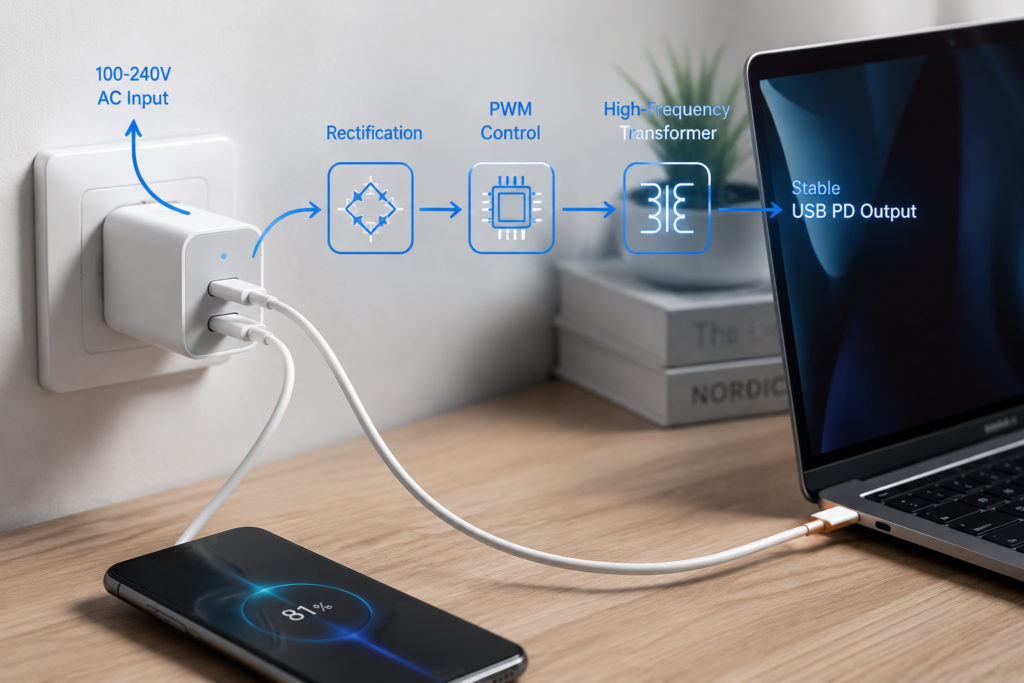
3.2 Step-by-Step: What Happens Inside a Wide-Voltage Charger
The conversion from wall AC to stable USB output happens in four clean stages:
plaintext
100-240V AC from wall socket
        ↓
① EMI Filtering + Rectification → converts rough AC into high-voltage DC
        ↓
② PWM Switching Control → high-speed regulation matches power demand
        ↓
③ High-Frequency Transformer → steps down voltage, provides electrical isolation from mains power, and enables compact size
        ↓
④ Synchronous Rectification + Filtering → clean, stable USB PD output
3.3 How Control Systems Achieve Automatic Regulation
At the heart of the system is a PWM (Pulse Width Modulation) control chip — the “brain” of the charger.
It continuously monitors both the incoming voltage levels and real-time power demand from your device, then dynamically adjusts the switching behavior of the power circuit. On lower input voltage, the controller adjusts switching behavior to transfer sufficient energy; on higher input voltage, it reduces component stress and optimizes efficiency.
This automatic calibration happens thousands of times per second, ensuring the output voltage and power stay perfectly steady across the full rated input range.
3.4 Why 50Hz and 60Hz Both Work
You might wonder why frequency barely matters. The reason is simple: the very first thing the charger does is rectify AC into DC. Once the electricity becomes direct current, the original grid frequency no longer plays any role in the conversion process.
For modern USB chargers, the difference between 50Hz and 60Hz normally has no noticeable impact on charging speed, output stability, or service life.
Does Input Voltage Affect Charger Output Wattage?
This is one of the most common questions from travelers: will a 100W charger only deliver half its power in a 100V country?
For properly designed 100-240V chargers, output wattage remains consistent across the full rated input range. A 65W charger will deliver full 65W to your laptop whether you plug it into a 100V socket in Tokyo or a 230V socket in Paris.
There is, however, an important difference on the input side:
- On a 240V grid: the charger draws a lower input current to produce the same output power
- On a 100V grid: the charger must draw a higher input current to maintain the same output power
For low and mid-power chargers (up to 65W–100W), this difference is invisible to users and fully handled by the charger’s internal design. For very high-power models (140W, 240W USB PD 3.1 EPR), low-voltage operation places more stress on input components and wiring. A small number of ultra-high-power chargers may have region-specific power limits, so always check the product specifications if you are traveling with a 100W+ charger.
Many well-designed chargers include additional operating margin beyond the rated 100-240V range to handle brief voltage dips or surges. However, this wider tolerance is an internal design capability, not a guaranteed specification unless explicitly stated by the manufacturer.
Bottom line for most travelers: standard 30W–100W wide-voltage chargers deliver full rated power everywhere in their rated voltage range.
How Does 100-240V Relate to USB-C PD and GaN Technology?
Think of a charger as a translator: 100-240V handles the “language” of the wall socket, while USB PD handles the language between the charger and your device. People often mix up these three terms, but they each describe a completely different part of the charger.
4.1 Each Technology Has Its Own Job
- 100-240V wide input: Handles the AC input side — makes the charger compatible with global wall sockets.
- USB Power Delivery (PD): Handles the DC output side — negotiates voltage and current with your device for fast charging.
- Programmable Power Supply (PPS): An extension of PD that dynamically fine-tunes output voltage for optimized battery charging.
- GaN (Gallium Nitride): A semiconductor material used in the switching components. It improves efficiency and power density, meaning smaller size for the same wattage.
Before USB-C PD became the global standard, travelers often carried multiple brand-specific chargers — one for their phone, one for their laptop, one for their camera. USB-PD unified charging across nearly all modern consumer electronics, so one wide-voltage PD charger can power almost all of your travel gear. This combination is what made compact, universal travel chargers widely accessible.
4.2 Why GaN Shines in Travel Chargers
GaN technology does not by itself create wide voltage capability — circuit design does that. But GaN makes wide-voltage high-power chargers much more travel-friendly:
- Higher switching efficiency means less wasted heat
- Lower heat means smaller heat sinks and more compact bodies
- Higher power density lets 65W, 100W, even 140W chargers fit in your pocket
Important note: Not every GaN charger automatically supports 100-240V. Always check the INPUT label to confirm.
Global Travel Guide: Where Can You Use It?
5.1 Major Voltage Regions
A 100-240V charger covers virtually every populated country on Earth. Here is how the world breaks down:
- Approximately 100–120V low-voltage regions
- United States, Canada, Taiwan (110–120V)
- Japan (100V, the lowest common mainstream voltage)
- Most of Central America and parts of northern South America
- 220–240V high-voltage regions
- Almost all of Europe, including the UK (230V)
- Australia, New Zealand (230V)
- China, South Korea, most of Southeast Asia (220–230V)
- Most of Africa and the Middle East (220–240V)
5.2 Wide Voltage ≠ Universal Plug Compatibility
This is the single most important travel rule to remember:
✅ 100-240V solves the voltage problem
❌ It does not solve the plug shape problem
For example: an American Type A/B charger has perfectly compatible voltage for Germany, but its physical plug will not fit into a German Type F socket. You still need a plug adapter (also called a travel adapter) to bridge the physical gap.
Common plug types and their primary regions:
- Type A / B: United States, Canada, Japan, North America
- Type C / F (Schuko): Most of continental Europe, Russia, parts of Asia and Africa
- Type G: United Kingdom, Ireland, Hong Kong, Singapore, parts of the Middle East
- Type I: Australia, New Zealand, China, Argentina
Plug Adapter vs. Voltage Converter: What Is the Difference?
Many travelers buy the wrong product because they confuse these two accessories. They serve completely different purposes.
6.1 Plug Adapter (Plug Adaptor / Travel Adapter)
- What it does: Changes the shape of your plug so it fits into a foreign socket.
- What it does NOT do: It does not change voltage at all.
- When to use it: Whenever your device already supports 100-240V wide input — which is true for nearly all modern phone, tablet, and laptop chargers.
6.2 Voltage Converter / Voltage Transformer
- What it does: Physically steps voltage up or down (for example, 230V → 120V).
- When to use it: Only for devices that do NOT support wide input — typically older high-power appliances like hair dryers, electric kettles, or certain kitchen tools.
6.3 USB Chargers Almost Never Need a Voltage Converter
If your USB charger clearly states INPUT: 100-240V~ 50/60Hz, you only need a lightweight plug adapter. You do not need a heavy, expensive voltage converter.
Safety Features Inside Modern Wide Voltage Chargers
Travelers often ask: is it safe to plug my expensive laptop into a foreign socket? Quality wide-voltage chargers include multiple layers of built-in protection to safeguard both the charger and your devices:
- Surge protection: Absorbs sudden voltage spikes caused by unstable grids or lightning, preventing damage to sensitive electronics.
- Over-voltage protection (OVP): Automatically cuts power if input or output voltage exceeds safe limits.
- Over-current protection (OCP): Limits current flow to prevent overheating and component failure.
- Over-temperature protection (OTP): Reduces power or shuts down the charger if internal temperatures rise too high.
- Short-circuit protection (SCP): Immediately stops power output if a short circuit is detected, protecting both the charger and connected devices.
These protections are especially valuable when traveling in regions with less stable power infrastructure, as they isolate your devices from grid irregularities.
Real-World Benefits of 100-240V Wide Input
7.1 Lighter, Simpler Travel
One high-quality multi-port GaN charger replaces:
- Your phone charger
- Your tablet charger
- Your laptop charger
- Your camera battery charger
- Your headphone charger
Add one small universal plug adapter, and you are ready for almost any country on Earth — no heavy voltage converter required.
7.2 Better Device Safety
Quality wide-input chargers are built with generous safety margins and the full suite of protection features listed above. They do not just work at exactly 100V or 240V — they are engineered to handle normal grid variation reliably.
This is especially valuable in regions with unstable grids, where voltage can swing wildly. The charger absorbs the fluctuation and delivers clean, steady power to your expensive electronics.
7.3 One Charger for All Your Gear
Pair a 100-240V multi-port USB-C PD GaN charger with a good travel adapter, and you can charge your phone, tablet, laptop, and wireless earbuds all at once — from a single wall socket.
How to Choose a Reliable 100-240V Travel Charger
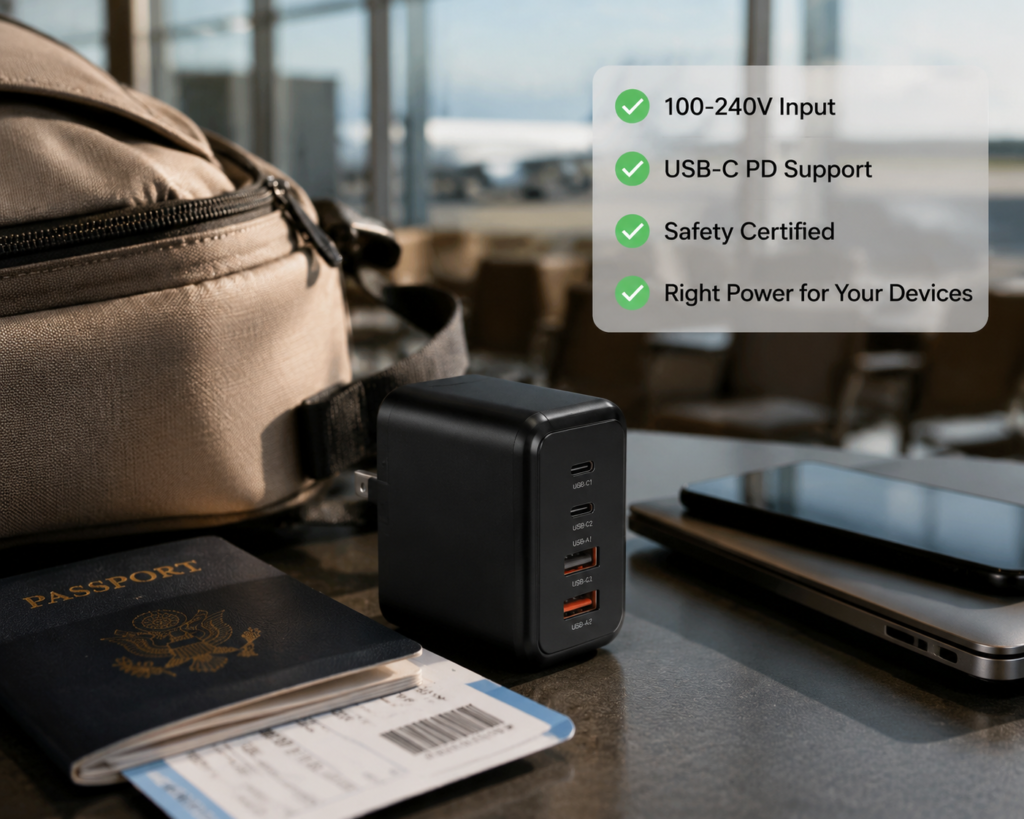
8.1 Always Verify the Input Specs First
Marketing words like “travel edition” or “international version” mean nothing. Turn the charger over and read the label yourself.
Look for exactly this:INPUT: 100-240V~ 50/60Hz
If the label only shows a single voltage, or the text is blurry, poorly printed, or missing entirely — walk away.
8.2 Look for Trusted Safety Certifications
Reputable chargers carry third-party safety certifications. These marks confirm the product passed rigorous testing for electrical safety, insulation, and electromagnetic compatibility.
| Certification | Region | What It Covers |
|---|---|---|
| UL | United States / Canada | Electrical safety standard (UL 62368-1) |
| FCC | United States | Mandatory electromagnetic compatibility |
| CE | European Union | Compliance with safety, EMC, and RoHS directives |
| UKCA | United Kingdom | Post-Brexit UK market compliance |
| PSE | Japan | Mandatory electrical appliance safety |
| SAA / RCM | Australia / New Zealand | Electrical safety and EMC |
Certified products are tested to operate safely across their full rated voltage range.
8.3 Pick the Right Power Level for Your Devices
Match the charger’s output power to your gear, and leave a small safety buffer:
- Phones, earbuds, small tablets: 30W – 45W USB-C PD
- Tablets, ultraportable laptops: 45W – 65W USB-C PD
- Full-size laptops, multi-device travel: 65W – 140W GaN multi-port charger
8.4 Watch Out for Multi-Port Power Sharing
A 100W multi-port charger does not deliver 100W to every port at the same time. Always check:
- Maximum power per single port
- Power distribution when all ports are in use
For travel, a charger that can deliver full laptop power on one port while also charging your phone on another is ideal.
Common Myths & FAQ
Q1: Can a 100-240V charger plug directly into every socket in the world?
A: No. Voltage compatibility is only half the story. You also need the plug shape to match the socket. In most cases, a simple plug adapter is all you need.
Q2: Does charging happen faster on 240V than on 120V?
A: No. Charging speed depends on output power, PD protocol support, and your device’s charging logic. A properly designed wide-input charger delivers identical output power across its full voltage range.
Q3: Does every GaN charger support 100-240V?
A: Not automatically. GaN describes the semiconductor material used inside. The input voltage range depends on the circuit design. Always check the INPUT label.
Q4: Can a travel plug adapter change voltage?
A: No. Ordinary plug adapters only change the physical shape of the connector. They do not alter voltage or frequency in any way.
Q5: Can I apply the same logic to hair dryers and electric kettles?
A: Be very careful. High-power heating appliances often run on single voltage. Even if labeled dual-voltage, they work differently from electronic chargers. Always check the device’s own label before traveling.
Q6: Is it safe to use a wide-voltage charger long-term on 110V grids?
A: Absolutely. They are engineered to run continuously across their entire input range. Long-term use at any voltage within the 100-240V range will not shorten lifespan.
Q7: Will a 100W charger lose power in 100V countries?
A: For standard consumer 100W chargers rated 100-240V, no — full output power is maintained. Only ultra-high-power 140W+ models may have design-specific limits, which will be stated in the product specs.
Q8: Can I use a 100-240V charger in Europe with a US plug?
A: Yes, the voltage is fully compatible. However, you will need a Type C/F plug adapter to physically fit the US plug into European sockets. The adapter only changes the plug shape — it does not alter voltage.
Q9: Does 100-240V mean my charger is universal?
A: It means the charger is voltage-universal for nearly all countries. It does not mean plug-universal — you will still need the right plug adapter for your destination.
Summary: The 3-Step Travel Charger Check
Before you pack for any international trip, run through this simple three-step checklist:
- Check the input label — Confirm your charger clearly shows
100-240V~ 50/60Hz. - Check the plug type — Look up your destination’s socket standard and pack the right plug adapter.
- Match power and protocol — Make sure the charger’s output wattage and PD/PPS support meet your devices’ needs.
Final Takeaway
100-240V wide voltage input is the foundational technology that makes true global travel charging possible. It solves the “will this work?” question for electricity, while plug adapters solve the “will this fit?” question for sockets.
The best travel chargers combine four things: solid 100-240V wide input, modern USB PD fast charging, trusted safety certifications, and a compact, travel-friendly design. Get all four right, and you can charge confidently anywhere in the world.